Study shows rapid warming on the West Antarctic Ice Sheet
COLUMBUS, Ohio—In a discovery that raises further concerns about the future contribution of Antarctica to sea level rise, a new study finds that the western part of the ice sheet is experiencing nearly twice as much warming as previously thought.
The temperature record from Byrd Station, a scientific outpost in the center of the West Antarctic Ice Sheet (WAIS), demonstrates a marked increase of 4.3 degrees Fahrenheit (2.4 degrees Celsius) in average annual temperature since 1958—that is, three times faster than the average temperature rise around the globe.
This temperature increase is nearly double what previous research has suggested, and reveals—for the first time—warming trends during the summer months of the Southern Hemisphere (December through February), said David Bromwich, professor of geography at Ohio State University and senior research scientist at the Byrd Polar Research Center.
The findings were published online this week in the journal Nature Geoscience.
"Our record suggests that continued summer warming in West Antarctica could upset the surface mass balance of the ice sheet, so that the region could make an even bigger contribution to sea level rise than it already does," said Bromwich.
"Even without generating significant mass loss directly, surface melting on the WAIS could contribute to sea level indirectly, by weakening the West Antarctic ice shelves that restrain the region's natural ice flow into the ocean."
Andrew Monaghan, study co-author and scientist at the National Center for Atmospheric Research (NCAR), said that these findings place West Antarctica among the fastest-warming regions on Earth.
"We've already seen enhanced surface melting contribute to the breakup of the Antarctic's Larsen B Ice Shelf, where glaciers at the edge discharged massive sections of ice into the ocean that contributed to sea level rise," Monaghan said. "The stakes would be much higher if a similar event occurred to an ice shelf restraining one of the enormous WAIS glaciers."
Researchers consider the WAIS especially sensitive to climate change, explained Ohio State University doctoral student Julien Nicolas. Since the base of the ice sheet rests below sea level, it is vulnerable to direct contact with warm ocean water. Its melting currently contributes 0.3 mm to sea level rise each year—second to Greenland, whose contribution to sea level rise has been estimated as high as 0.7 mm per year.
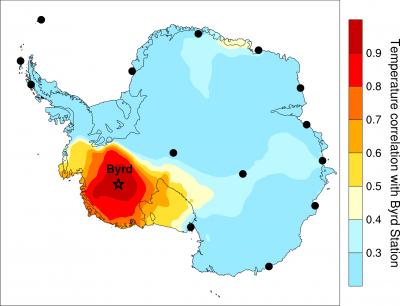
Due to its location some 700 miles from the South Pole and near the center of the WAIS, Byrd Station is an important indicator of climate change throughout the region.
In the past, researchers haven't been able to make much use of the Byrd Station measurements because the data was incomplete; nearly one third of the temperature observations were missing for the time period of the study. Since its establishment in 1957, the station hasn't always been occupied. A year-round automated station was installed in 1980, but it has experienced frequent power outages, especially during the long polar night, when its solar panels can't recharge.
Bromwich and two of his graduate students, along with colleagues from NCAR and the University of Wisconsin-Madison, corrected the past Byrd temperature measurements and used corrected data from a computer atmospheric model and a numerical analysis method to fill in the missing observations.
Aside from offering a more complete picture of warming in West Antarctica, the study suggests that if this warming trend continues, melting will become more extensive in the region in the future, Bromwich said.
While the researchers work to fully understand the cause of the summer warming at Byrd Station, the next step is clear, he added.
"West Antarctica is one of the most rapidly changing regions on Earth, but it is also one of the least known," he said. "Our study underscores the need for a reliable network of meteorological observations throughout West Antarctica, so that we can know what is happening—and why—with more certainty."
INFORMATION:
This research was funded by the National Science Foundation.
Contact:
David Bromwich, 614-292-6692; Bromwich.1@osu.edu
Written by Pam Frost Gorder, 614-292-9475; Gorder.1@osu.edu
Additional contacts:
Andrew Monaghan, 303-497-8424; monaghan@ucar.edu
Media contacts for Andrew Monaghan:
David Hosansky, 303-497-8611; hosansky@ucar.edu
Zhenya Gallon 303-497-8607; zhenya@ucar.edu
Editor's note: Contact Pam Frost Gorder for images related to the story.
The temperature record from Byrd Station, a scientific outpost in the center of the West Antarctic Ice Sheet (WAIS), demonstrates a marked increase of 4.3 degrees Fahrenheit (2.4 degrees Celsius) in average annual temperature since 1958—that is, three times faster than the average temperature rise around the globe.
This temperature increase is nearly double what previous research has suggested, and reveals—for the first time—warming trends during the summer months of the Southern Hemisphere (December through February), said David Bromwich, professor of geography at Ohio State University and senior research scientist at the Byrd Polar Research Center.
The findings were published online this week in the journal Nature Geoscience.
"Our record suggests that continued summer warming in West Antarctica could upset the surface mass balance of the ice sheet, so that the region could make an even bigger contribution to sea level rise than it already does," said Bromwich.
"Even without generating significant mass loss directly, surface melting on the WAIS could contribute to sea level indirectly, by weakening the West Antarctic ice shelves that restrain the region's natural ice flow into the ocean."
Andrew Monaghan, study co-author and scientist at the National Center for Atmospheric Research (NCAR), said that these findings place West Antarctica among the fastest-warming regions on Earth.
"We've already seen enhanced surface melting contribute to the breakup of the Antarctic's Larsen B Ice Shelf, where glaciers at the edge discharged massive sections of ice into the ocean that contributed to sea level rise," Monaghan said. "The stakes would be much higher if a similar event occurred to an ice shelf restraining one of the enormous WAIS glaciers."
Researchers consider the WAIS especially sensitive to climate change, explained Ohio State University doctoral student Julien Nicolas. Since the base of the ice sheet rests below sea level, it is vulnerable to direct contact with warm ocean water. Its melting currently contributes 0.3 mm to sea level rise each year—second to Greenland, whose contribution to sea level rise has been estimated as high as 0.7 mm per year.
Due to its location some 700 miles from the South Pole and near the center of the WAIS, Byrd Station is an important indicator of climate change throughout the region.
In the past, researchers haven't been able to make much use of the Byrd Station measurements because the data was incomplete; nearly one third of the temperature observations were missing for the time period of the study. Since its establishment in 1957, the station hasn't always been occupied. A year-round automated station was installed in 1980, but it has experienced frequent power outages, especially during the long polar night, when its solar panels can't recharge.
Bromwich and two of his graduate students, along with colleagues from NCAR and the University of Wisconsin-Madison, corrected the past Byrd temperature measurements and used corrected data from a computer atmospheric model and a numerical analysis method to fill in the missing observations.
Aside from offering a more complete picture of warming in West Antarctica, the study suggests that if this warming trend continues, melting will become more extensive in the region in the future, Bromwich said.
While the researchers work to fully understand the cause of the summer warming at Byrd Station, the next step is clear, he added.
"West Antarctica is one of the most rapidly changing regions on Earth, but it is also one of the least known," he said. "Our study underscores the need for a reliable network of meteorological observations throughout West Antarctica, so that we can know what is happening—and why—with more certainty."
INFORMATION:
This research was funded by the National Science Foundation.
Contact:
David Bromwich, 614-292-6692; Bromwich.1@osu.edu
Written by Pam Frost Gorder, 614-292-9475; Gorder.1@osu.edu
Additional contacts:
Andrew Monaghan, 303-497-8424; monaghan@ucar.edu
Media contacts for Andrew Monaghan:
David Hosansky, 303-497-8611; hosansky@ucar.edu
Zhenya Gallon 303-497-8607; zhenya@ucar.edu
Editor's note: Contact Pam Frost Gorder for images related to the story.