Cultural evolution changes bird song
Published 2013-01-29 · Original archive entry · Explore research explainers
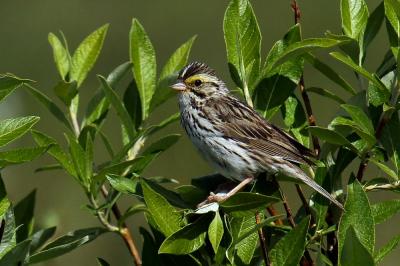
Thanks to cultural evolution, male Savannah sparrows are changing their tune, partly to attract "the ladies."
According to a study of more than 30 years of Savannah sparrows recordings, the birds are singing distinctly different songs today than their ancestors did 30 years ago – changes passed along generation to generation, according to a new study by University of Guelph researchers.
Integrative biology professors Ryan Norris and Amy Newman, in collaboration with researchers at Bowdoin College and Williams College in the U.S., analyzed the songs of male Savannah sparrows (Passerculus sandwichiensis) recorded over three decades, and found that the songs had changed distinctly from 1980 to 2011.
"The change is the result of cultural transmission of different song elements through many generations," said Norris.
Norris added that the change in tune resembles changes in word choice and language among humans.
AUDIO: This is a Savannah sparrow song from 1980. The song would change from generation to generation, as a result of cultural evolution.
Click here for more information.
"If you listen to how people used to talk in the 1890s and how we talk today, you would notice major differences, and this is the result of shifts in culture or the popularity of certain forms," he said. "The change in sparrow songs over time has occurred much the same way"
The sparrows, which live on Kent Island, N.B., in the Bay of Fundy, can generally sing only one song type that consists of several parts. Male sparrows learn that song early in their first year and continue to sing the same tune for the rest of their lives.
"Young male sparrows learn their songs from the birds around them," said Norris. "It may be their fathers, or it could be other older male birds that live nearby."
Each male sparrow has his own unique sound, added Newman.
"While the island's sparrows all sing a characteristic 'savannah sparrow song,' with the same verses and sound similar, there are distinct differences between each bird," she said. "Essentially, it is like karaoke versions of popular songs. It is the rise and fall in popular cover versions that has changed over time."
The research team found that, in general, each song has three primary elements. The first identifies the bird as a Savannah sparrow, the second identifies which individual is singing, and the third component is used by females to assess males.
Using sonograms recorded from singing males each breeding season, the researchers determined that, while the introductory notes had stayed generally consistent for the last 30 years, the sparrows had added a series of clicks to the middle of their songs. The birds had also changed the ending trill: once long and high-frequency, it is now shorter and low-frequency.
"We found that the ending trill of the song has become shorter, likely because female sparrows preferred this, because males with shorter trills had higher reproductive success," Norris said.
Kent Island has been home to the Bowdoin Scientific Station since it was donated by J. Sterling Rockefeller in 1932, and the birds have been recorded since the 1980s. Individual birds are also monitored throughout their lifetime.
"We know the identity and history of every single sparrow in the study population" said Norris, who has led the project with Newman since 2009. "To have 30 years of recordings is very rare, and it was definitely surprising to see such drastic changes."
INFORMATION:
Their study appears in the January 2013 issue of Animal Behaviour.
For media questions, contact Communications and Public Affairs: Lori Bona Hunt, 519 824-4120, Ext. 53338, or lhunt@uoguelph.ca; or Kevin Gonsalves, Ext. 56982, or kgonsalves@uoguelph.ca.
According to a study of more than 30 years of Savannah sparrows recordings, the birds are singing distinctly different songs today than their ancestors did 30 years ago – changes passed along generation to generation, according to a new study by University of Guelph researchers.
Integrative biology professors Ryan Norris and Amy Newman, in collaboration with researchers at Bowdoin College and Williams College in the U.S., analyzed the songs of male Savannah sparrows (Passerculus sandwichiensis) recorded over three decades, and found that the songs had changed distinctly from 1980 to 2011.
"The change is the result of cultural transmission of different song elements through many generations," said Norris.
Norris added that the change in tune resembles changes in word choice and language among humans.
AUDIO: This is a Savannah sparrow song from 1980. The song would change from generation to generation, as a result of cultural evolution.
Click here for more information.
"If you listen to how people used to talk in the 1890s and how we talk today, you would notice major differences, and this is the result of shifts in culture or the popularity of certain forms," he said. "The change in sparrow songs over time has occurred much the same way"
The sparrows, which live on Kent Island, N.B., in the Bay of Fundy, can generally sing only one song type that consists of several parts. Male sparrows learn that song early in their first year and continue to sing the same tune for the rest of their lives.
"Young male sparrows learn their songs from the birds around them," said Norris. "It may be their fathers, or it could be other older male birds that live nearby."
Each male sparrow has his own unique sound, added Newman.
"While the island's sparrows all sing a characteristic 'savannah sparrow song,' with the same verses and sound similar, there are distinct differences between each bird," she said. "Essentially, it is like karaoke versions of popular songs. It is the rise and fall in popular cover versions that has changed over time."
The research team found that, in general, each song has three primary elements. The first identifies the bird as a Savannah sparrow, the second identifies which individual is singing, and the third component is used by females to assess males.
Using sonograms recorded from singing males each breeding season, the researchers determined that, while the introductory notes had stayed generally consistent for the last 30 years, the sparrows had added a series of clicks to the middle of their songs. The birds had also changed the ending trill: once long and high-frequency, it is now shorter and low-frequency.
"We found that the ending trill of the song has become shorter, likely because female sparrows preferred this, because males with shorter trills had higher reproductive success," Norris said.
Kent Island has been home to the Bowdoin Scientific Station since it was donated by J. Sterling Rockefeller in 1932, and the birds have been recorded since the 1980s. Individual birds are also monitored throughout their lifetime.
"We know the identity and history of every single sparrow in the study population" said Norris, who has led the project with Newman since 2009. "To have 30 years of recordings is very rare, and it was definitely surprising to see such drastic changes."
INFORMATION:
Their study appears in the January 2013 issue of Animal Behaviour.
For media questions, contact Communications and Public Affairs: Lori Bona Hunt, 519 824-4120, Ext. 53338, or lhunt@uoguelph.ca; or Kevin Gonsalves, Ext. 56982, or kgonsalves@uoguelph.ca.