Tiny minotaurs and mini-Casanovas: Ancient pigmy moths reveal secrets of their diversity
Published 2013-03-18 · Original archive entry · Explore research explainers
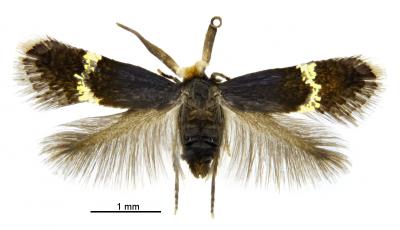
Researchers Robert Hoare (Landcare Research, New Zealand) and Erik van Nieukerken (Naturalis Biodiversity Center, Netherlands) have named new moths after the Minotaur of Greek mythology and the legendary Italian philanderer Giacomo Casanova in a study of the evolution of southern pigmy moths. The study was published in the open access journal ZooKeys.
The tiny moths, with wingspans of 3 to 8 millimetres, belong to a very old group (the family Nepticulidae), which dates back more than 110 million years to the time of the dinosaurs. Australian pigmy moths are particularly diverse and unusual, and one group (genus Pectinivalva, 'ancient pigmy moths') has until now only been reported from that continent, where over 140 species are known.
Each species of pigmy moth is associated with one or a few related species of plant on which they lay their eggs. Caterpillars make a mine inside the leaf, the shape of the mine often being characteristic of the species that made it.
By reconstructing the evolution of the ancient pigmy moths, Hoare and van Nieukerken have shown that the original host of the group was probably a rainforest plant of the myrtle family (Myrtaceae). As Australia dried out from about 15 million years ago, the rainforest was greatly reduced in extent, and the myrtle family came to dominate the vegetation of the arid interior, with the now familiar eucalyptus trees becoming especially diverse and abundant. The ancient pigmy moths in their turn transferred to the newly dominant host-plants, and now most known species of Pectinivalva feed on Eucalyptus and its close relatives, with just a few still attached to rainforest myrtles. Probably, the rainforests of Indonesia, New Guinea and New Caledonia will be found to be home to further undiscovered members of the genus Pectinivalva; a new species (P. xenadelpha) from Borneo is the first non-Australian member of the genus known.
What of those new names? The males of many species of ancient pigmy moths display special scales for close-range scent dispersal during courtship of the female. These can be on the front legs, on the wings or on the body of the moth, and may form moustache-like tufts or groups like overlapping shells, best seen under high magnification. Some species have a strange pocket-like structure on the hind wing with scent scales surrounding it in a palisade. In one group of metallic-coloured species, the males are particularly well equipped for courtship with a variety of sex-specific modifications. This group has been named as a subgenus Casanovula after Giacomo Casanova (1725-1798), the Italian adventurer famous for his many romantic entanglements. The male of the most spectacular species not only has two different kinds of shell-like scent scales on the body, but huge flattened and expanded antennae, whose function is unknown, but which are also presumed to be attractive to females. This species has been named Pectinivalva (Casanovula) minotaurus, after the bull-headed Cretan beast of Greek mythology.
INFORMATION:
The research collaboration was aided by funding from the Naturalis Temminck Fellowship programme, taken up by Robert Hoare in 2009.
Original source
Hoare RJB, van Nieukerken EJ (2013) Phylogeny and host-plant relationships of the Australian Myrtaceae leafmining moth genus Pectinivalva (Lepidoptera, Nepticulidae), with new subgenera and species. ZooKeys 278: 1. doi: 10.3897/zookeys.278.4743
Additional Contact:
Dr Erik van Nieukerken
nieukerken@naturalis.nl
+31 71 5686 7682
Licensing
This press release is available under the Creative Commons Attribution 3.0 License. It is expected to link back to the original article.
Posted by Pensoft Publishers.
The tiny moths, with wingspans of 3 to 8 millimetres, belong to a very old group (the family Nepticulidae), which dates back more than 110 million years to the time of the dinosaurs. Australian pigmy moths are particularly diverse and unusual, and one group (genus Pectinivalva, 'ancient pigmy moths') has until now only been reported from that continent, where over 140 species are known.
Each species of pigmy moth is associated with one or a few related species of plant on which they lay their eggs. Caterpillars make a mine inside the leaf, the shape of the mine often being characteristic of the species that made it.
By reconstructing the evolution of the ancient pigmy moths, Hoare and van Nieukerken have shown that the original host of the group was probably a rainforest plant of the myrtle family (Myrtaceae). As Australia dried out from about 15 million years ago, the rainforest was greatly reduced in extent, and the myrtle family came to dominate the vegetation of the arid interior, with the now familiar eucalyptus trees becoming especially diverse and abundant. The ancient pigmy moths in their turn transferred to the newly dominant host-plants, and now most known species of Pectinivalva feed on Eucalyptus and its close relatives, with just a few still attached to rainforest myrtles. Probably, the rainforests of Indonesia, New Guinea and New Caledonia will be found to be home to further undiscovered members of the genus Pectinivalva; a new species (P. xenadelpha) from Borneo is the first non-Australian member of the genus known.
What of those new names? The males of many species of ancient pigmy moths display special scales for close-range scent dispersal during courtship of the female. These can be on the front legs, on the wings or on the body of the moth, and may form moustache-like tufts or groups like overlapping shells, best seen under high magnification. Some species have a strange pocket-like structure on the hind wing with scent scales surrounding it in a palisade. In one group of metallic-coloured species, the males are particularly well equipped for courtship with a variety of sex-specific modifications. This group has been named as a subgenus Casanovula after Giacomo Casanova (1725-1798), the Italian adventurer famous for his many romantic entanglements. The male of the most spectacular species not only has two different kinds of shell-like scent scales on the body, but huge flattened and expanded antennae, whose function is unknown, but which are also presumed to be attractive to females. This species has been named Pectinivalva (Casanovula) minotaurus, after the bull-headed Cretan beast of Greek mythology.
INFORMATION:
The research collaboration was aided by funding from the Naturalis Temminck Fellowship programme, taken up by Robert Hoare in 2009.
Original source
Hoare RJB, van Nieukerken EJ (2013) Phylogeny and host-plant relationships of the Australian Myrtaceae leafmining moth genus Pectinivalva (Lepidoptera, Nepticulidae), with new subgenera and species. ZooKeys 278: 1. doi: 10.3897/zookeys.278.4743
Additional Contact:
Dr Erik van Nieukerken
nieukerken@naturalis.nl
+31 71 5686 7682
Licensing
This press release is available under the Creative Commons Attribution 3.0 License. It is expected to link back to the original article.
Posted by Pensoft Publishers.