Motion and muscles don't always work in lockstep, researchers find in surprising new study
Unique research by UC Riverside biologists on wild anole lizards reveals new insights on how animals might adapt to their habitat and handle various forms of motion
Published 2014-03-14 · Original archive entry · Explore research explainers
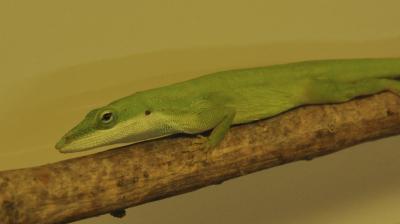
RIVERSIDE, Calif. — Animals "do the locomotion" every day, whether it's walking down the hall to get some coffee or darting up a tree to avoid a predator. And until now, scientists believed the inner workings of movement were pretty much the same — the nerves send a message to the muscles and there is motion.
But in a first-of-its-kind study on wild green anole lizards, biologists at the University of California, Riverside have discovered that the link between muscle function and movement is a lot more complicated than anyone realized.
"We were trying to understand how animals move in trees; how muscle, in general, deals with something as complex as climbing a tree, with its horizontal and vertical inclines, the tiny little branches and the upright trunks," said Kathleen Foster, a Ph.D. student in Evolution, Ecology and Organismal Biology, who performed the study. "We were expecting to find that as the movements were changing, the muscles would be generating those changes; we'd just show that and move on. Instead, we saw there isn't always this tight relationship between activity in the muscles and the movement we're seeing. Now we have new questions about how animals work."
"No one has ever looked at this before," said Timothy Higham, an assistant professor of biology and Foster's graduate adviser. "A lot of people study anoles and a lot of people remove muscles and study them in a lab, as opposed to measuring the muscles in the animal as it's moving. Our work brings the lab into the forest, and it can help us answer questions about how these animals are doing what they're doing and why they're so diverse."
Foster and Higham's findings were published March 12 in the British biology journal, Proceedings of the Royal Society B, a journal from the same publisher that featured papers by Isaac Newton and Charles Darwin.
In their study, "Context-dependent changes in motor control and kinematics during locomotion: modulation and decoupling," Foster surgically inserted electrodes into the forelimbs and hind limbs of seven male green anole lizards. She then tracked the lizard movements on a flat and 90-degree incline and a broad and narrow perch, using high-speed video to record movements and electromyography to monitor electrical activity in the muscles.
"We expected to see a one-to-one correlation between the muscle activity and movements because motion is generally driven by muscles," Higham said, "but as we changed the structure of their habitat and they changed their motions, we were surprised to find very few accompanying changes in muscle activity."
For instance, the researchers found that while the lizard movements changed considerably when they were running along narrow perches (compared to broad perches), there were few significant changes in muscle activity. And when the lizards were running up an incline, they noted more changes in muscle activity than movement.
"This generally means we can't understand what the muscles are doing just by what we see," Higham said. "We also found that variability in muscle activity differed between the treatments, raising another question: Does variability in muscle activity reflect a preferred way of moving or just reflect what they've always done? This has unearthed a lot of questions about ecology, evolution, how parts of animals evolve and how they respond to their environment."
Though these 2-inch-long green anoles weigh just 5 grams — about the same as a U.S. nickel — their muscles work the same way as every other vertebrate.
"This means what we learn from studying their muscle function could well apply to a variety of fields," Foster said.
The study's findings also raise new questions in ecomorphology — how habitat and environment affect an organism's anatomy. The study found that muscle activity in the green anoles was most consistent on broad, vertical surfaces, such as tree trunks, "suggesting that, despite being classified as a trunk-crown ecomorph, this species may prefer trunks," Foster said.
The study has implications also for people who design artificial limbs or robots.
"Clearly, locomotion is not as simple as we thought it was," Foster said. "This decoupling — big changes in movement without corresponding changes in muscle activity — suggests there are other important factors going on and we need to better understand them if we want to reproduce these movements in prosthetics or robotics."
INFORMATION: Funding for the study was provided by a postgraduate scholarship to Foster from the Natural Sciences and Engineering Research Council of Canada; and a grant to Higham from the U.S. National Science Foundation.
The University of California, Riverside is a doctoral research university, a living laboratory for groundbreaking exploration of issues critical to Inland Southern California, the state and communities around the world. Reflecting California's diverse culture, UCR's enrollment has exceeded 21,000 students. The campus opened a medical school in 2013 and has reached the heart of the Coachella Valley by way of the UCR Palm Desert Center. The campus has an annual statewide economic impact of more than $1 billion. A broadcast studio with fiber cable to the AT&T Hollywood hub is available for live or taped interviews. UCR also has ISDN for radio interviews. To learn more, call (951) UCR-NEWS.
By Jeanette Marantos
But in a first-of-its-kind study on wild green anole lizards, biologists at the University of California, Riverside have discovered that the link between muscle function and movement is a lot more complicated than anyone realized.
"We were trying to understand how animals move in trees; how muscle, in general, deals with something as complex as climbing a tree, with its horizontal and vertical inclines, the tiny little branches and the upright trunks," said Kathleen Foster, a Ph.D. student in Evolution, Ecology and Organismal Biology, who performed the study. "We were expecting to find that as the movements were changing, the muscles would be generating those changes; we'd just show that and move on. Instead, we saw there isn't always this tight relationship between activity in the muscles and the movement we're seeing. Now we have new questions about how animals work."
"No one has ever looked at this before," said Timothy Higham, an assistant professor of biology and Foster's graduate adviser. "A lot of people study anoles and a lot of people remove muscles and study them in a lab, as opposed to measuring the muscles in the animal as it's moving. Our work brings the lab into the forest, and it can help us answer questions about how these animals are doing what they're doing and why they're so diverse."
Foster and Higham's findings were published March 12 in the British biology journal, Proceedings of the Royal Society B, a journal from the same publisher that featured papers by Isaac Newton and Charles Darwin.
In their study, "Context-dependent changes in motor control and kinematics during locomotion: modulation and decoupling," Foster surgically inserted electrodes into the forelimbs and hind limbs of seven male green anole lizards. She then tracked the lizard movements on a flat and 90-degree incline and a broad and narrow perch, using high-speed video to record movements and electromyography to monitor electrical activity in the muscles.
"We expected to see a one-to-one correlation between the muscle activity and movements because motion is generally driven by muscles," Higham said, "but as we changed the structure of their habitat and they changed their motions, we were surprised to find very few accompanying changes in muscle activity."
For instance, the researchers found that while the lizard movements changed considerably when they were running along narrow perches (compared to broad perches), there were few significant changes in muscle activity. And when the lizards were running up an incline, they noted more changes in muscle activity than movement.
"This generally means we can't understand what the muscles are doing just by what we see," Higham said. "We also found that variability in muscle activity differed between the treatments, raising another question: Does variability in muscle activity reflect a preferred way of moving or just reflect what they've always done? This has unearthed a lot of questions about ecology, evolution, how parts of animals evolve and how they respond to their environment."
Though these 2-inch-long green anoles weigh just 5 grams — about the same as a U.S. nickel — their muscles work the same way as every other vertebrate.
"This means what we learn from studying their muscle function could well apply to a variety of fields," Foster said.
The study's findings also raise new questions in ecomorphology — how habitat and environment affect an organism's anatomy. The study found that muscle activity in the green anoles was most consistent on broad, vertical surfaces, such as tree trunks, "suggesting that, despite being classified as a trunk-crown ecomorph, this species may prefer trunks," Foster said.
The study has implications also for people who design artificial limbs or robots.
"Clearly, locomotion is not as simple as we thought it was," Foster said. "This decoupling — big changes in movement without corresponding changes in muscle activity — suggests there are other important factors going on and we need to better understand them if we want to reproduce these movements in prosthetics or robotics."
INFORMATION: Funding for the study was provided by a postgraduate scholarship to Foster from the Natural Sciences and Engineering Research Council of Canada; and a grant to Higham from the U.S. National Science Foundation.
The University of California, Riverside is a doctoral research university, a living laboratory for groundbreaking exploration of issues critical to Inland Southern California, the state and communities around the world. Reflecting California's diverse culture, UCR's enrollment has exceeded 21,000 students. The campus opened a medical school in 2013 and has reached the heart of the Coachella Valley by way of the UCR Palm Desert Center. The campus has an annual statewide economic impact of more than $1 billion. A broadcast studio with fiber cable to the AT&T Hollywood hub is available for live or taped interviews. UCR also has ISDN for radio interviews. To learn more, call (951) UCR-NEWS.
By Jeanette Marantos
Attachments