Impurity size affects performance of emerging superconductive material
Published 2014-04-18 · Original archive entry · Explore research explainers
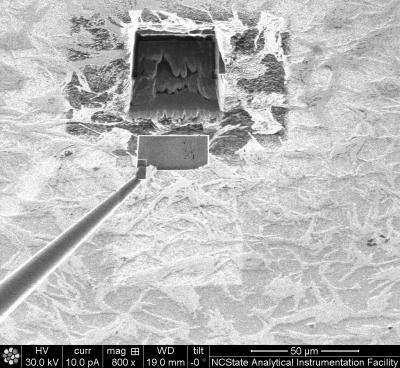
Research from North Carolina State University finds that impurities can hurt performance – or possibly provide benefits – in a key superconductive material that is expected to find use in a host of applications, including future particle colliders. The size of the impurities determines whether they help or hinder the material's performance.
At issue is a superconductive material called bismuth strontium calcium copper oxide (Bi2212). A superconductor is a material that can carry electricity without any loss – none of the energy is dissipated as heat, for example. Superconductive materials are currently used in medical MRI technology, and are expected to play a prominent role in emerging power technologies.
"Bi2212 is the only high-temperature superconductor that can be made as a round wire, and is expected to have applications in magnets for use in everything from magnetic resonance imaging technologies to the next generation of super colliders – almost anything that falls under the category of high-energy physics or requires a very high magnetic field," says Golsa Naderi, a Ph.D. student at NC State and lead author of a paper describing the work.
To use Bi2212 for any of these potential applications, the material needs to be formed into a multifilamentary wire, which contains 500 to1,000 Bi2212 filaments embedded in silver, and then heat-treated to nearly 900 degrees C. However, this processing results in impurities in the material. These impurities largely consist of porosity and bismuth strontium copper oxide (Bi2201).
"We know that porosity, or the formation of voids in the Bi2212, is problematic. But we wanted to go beyond porosity and learn more about the Bi2201 impurities and how they could help or hurt Bi2212's performance," says Dr. Justin Schwartz, senior author of the paper and Kobe Steel Distinguished Professor and head of the Department of Materials Science and Engineering at NC State. "That would help us determine how to optimize the material's superconducting characteristics through better processing."
The researchers found that nanoscale impurities, from 1.2 to2.5 nanometers wide, appear to improve Bi2212's performance as a superconductor.
"The nanoscale impurities, or defects, serve as centers for 'pinning' magnetic flux in place," Naderi says. "Without those pinning centers, the magnetic vortices can move, creating resistivity and impeding superconductivity when a magnetic field is present.
"People want to use Bi2212 to create high magnetic fields using current, so pinning magnetic flux is essential – technology using this material must be able to operate in the presence of a magnetic field," Naderi adds.
But the researchers also found that large-scale impurities, measured in microns (or micrometers), are detrimental to Bi2212's superconductivity. This is because these impurities are so large that they act as barriers to current, forcing electrons to change their paths and weakening the material's superconductivity.
"Our previous work had shown that large-scale Bi2201 defects were a significant problem for Bi2212 wires, and this work bears that out," Schwartz says. "But now we know that at the nanoscale, Bi2201 is not detrimental – and may improve performance."
The researchers say that a key next step will be for materials engineers to reassess long-standing processing protocols for Bi2212 wires to determine how to minimize the formation of the large-scale impurities.
INFORMATION: The paper, "On the roles of Bi2Sr2CuOx intergrowths in Bi2Sr2CaCu2Ox/Ag round wires: c-axis transport and magnetic flux pinning," is published online in Applied Physics Letters.
At issue is a superconductive material called bismuth strontium calcium copper oxide (Bi2212). A superconductor is a material that can carry electricity without any loss – none of the energy is dissipated as heat, for example. Superconductive materials are currently used in medical MRI technology, and are expected to play a prominent role in emerging power technologies.
"Bi2212 is the only high-temperature superconductor that can be made as a round wire, and is expected to have applications in magnets for use in everything from magnetic resonance imaging technologies to the next generation of super colliders – almost anything that falls under the category of high-energy physics or requires a very high magnetic field," says Golsa Naderi, a Ph.D. student at NC State and lead author of a paper describing the work.
To use Bi2212 for any of these potential applications, the material needs to be formed into a multifilamentary wire, which contains 500 to1,000 Bi2212 filaments embedded in silver, and then heat-treated to nearly 900 degrees C. However, this processing results in impurities in the material. These impurities largely consist of porosity and bismuth strontium copper oxide (Bi2201).
"We know that porosity, or the formation of voids in the Bi2212, is problematic. But we wanted to go beyond porosity and learn more about the Bi2201 impurities and how they could help or hurt Bi2212's performance," says Dr. Justin Schwartz, senior author of the paper and Kobe Steel Distinguished Professor and head of the Department of Materials Science and Engineering at NC State. "That would help us determine how to optimize the material's superconducting characteristics through better processing."
The researchers found that nanoscale impurities, from 1.2 to2.5 nanometers wide, appear to improve Bi2212's performance as a superconductor.
"The nanoscale impurities, or defects, serve as centers for 'pinning' magnetic flux in place," Naderi says. "Without those pinning centers, the magnetic vortices can move, creating resistivity and impeding superconductivity when a magnetic field is present.
"People want to use Bi2212 to create high magnetic fields using current, so pinning magnetic flux is essential – technology using this material must be able to operate in the presence of a magnetic field," Naderi adds.
But the researchers also found that large-scale impurities, measured in microns (or micrometers), are detrimental to Bi2212's superconductivity. This is because these impurities are so large that they act as barriers to current, forcing electrons to change their paths and weakening the material's superconductivity.
"Our previous work had shown that large-scale Bi2201 defects were a significant problem for Bi2212 wires, and this work bears that out," Schwartz says. "But now we know that at the nanoscale, Bi2201 is not detrimental – and may improve performance."
The researchers say that a key next step will be for materials engineers to reassess long-standing processing protocols for Bi2212 wires to determine how to minimize the formation of the large-scale impurities.
INFORMATION: The paper, "On the roles of Bi2Sr2CuOx intergrowths in Bi2Sr2CaCu2Ox/Ag round wires: c-axis transport and magnetic flux pinning," is published online in Applied Physics Letters.