PRESS-NEWS.org - Press Release Distribution
PRESS RELEASES DISTRIBUTION

New cocaine tracking system could lead to better drug enforcement

New cocaine tracking system could lead to better drug enforcement
2014-06-19
(Press-News.org) Law enforcement authorities need to better understand trafficking patterns of cocaine in the United States to address one of the world's largest illegal drug markets, according to a Michigan State University researcher whose new methodology might help.

Siddharth Chandra, an economist, studied wholesale powdered cocaine prices in 112 cities to identify city-to-city links for the transit of the drug. He used data published by the National Drug Intelligence Center of the U.S. Department of Justice from 2002 to 2011, which field intelligence officers and local, regional and federal law enforcement sources collected through drug arrests and investigations.

"These data enable us to identify suspected links between cities that may have escaped the attention of drug enforcement authorities," said Chandra, director of MSU's Asian Studies Center and professor in MSU's James Madison College. "By identifying patterns and locations, drug policy and enforcement agencies could provide valuable assistance to federal, state and local governments in their decisions on where and how to allocate limited law enforcement resources to mitigate the cocaine problem."

Chandra analyzed prices for 6,126 pairs of cities for possible links. If two cities are connected, prices will move in lockstep. So if there's a spike in cocaine prices in the city of origin – or a source city, where the drug originates – that spike will be transmitted to all cities dependent upon that source. In addition, cocaine will flow from the city with the lower price to the city with the higher price. It takes a number of transactions for cocaine to reach its end price, and prices tend to go up as drugs move from one city to another, he said.

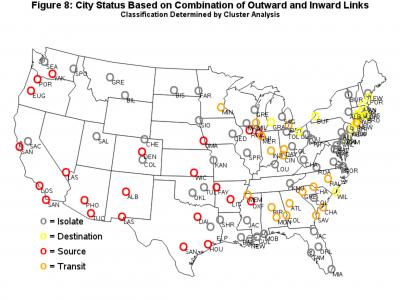
While cities in the north and northeast are destination cities for cocaine, Chandra found cities in the southern U.S. and along the west coast are source cities. In addition, cities in other regions, like Chicago and Atlanta, are major hubs for cocaine.

Chandra also created a map of possible drug routes, which he compared with a map produced by the National Drug Intelligence Center, and found that a number of his routes hadn't been identified.

But Chandra cautions that his methodology shouldn't be used in isolation. Instead, it is one piece of the larger drug trafficking puzzle. Individual bits of the publicly available NDIC data may or may not be accurate based on whether drug smugglers tell the truth. However, the combined data could lead to better drug enforcement.

Unfortunately, Chandra said, the NDIC was closed in 2012 and he's not sure if another agency is continuing to collect data. But his research shows the importance of doing so.

"As an economist, the big takeaway is that prices carry some valuable information about trafficking in illegal goods," Chandra said.

INFORMATION: Two of Chandra's former students, Samuel Peters and Nathaniel Zimmer, who recently graduated, assisted with the research. The study is published in the Journal of Drug Issues.

[Attachments] See images for this press release:
New cocaine tracking system could lead to better drug enforcement

ELSE PRESS RELEASES FROM THIS DATE:

In hairless man, arthritis drug spurs hair growth -- lots

2014-06-19
A man with almost no hair on his body has grown a full head of it after a novel treatment by doctors at Yale University. There is currently no cure or long-term treatment for alopecia universalis, the disease that left the 25-year-old patient bare of hair. This is the first reported case of a successful targeted treatment for the rare, highly visible disease. The patient has also grown eyebrows and eyelashes, as well as facial, armpit, and other hair, which he lacked at the time he sought help. "The results are exactly what we hoped for," said Brett A. King, M.D., ...

Stem cell mobilization therapy may effectively treat osteoarthritis

2014-06-19
Putnam Valley, NY. (June 19, 2014) – Researchers in Taiwan have found that peripheral blood stem cells can be "mobilized" by injection of a special preparation of granulocyte colony-stimulating factor (G-CSF) into rats that modeled osteoarthritis (OA). The bone marrow was stimulated to produce stem cells, leading to the inhibition of OA progression. The finding, they said, may lead to a more effective therapy for OA, a common joint disease that affects 10 percent of Americans over the age of 60. The study will be published in a future issue of Cell Transplantation and ...

New digital fabrication technique creates interlocking 3D-printed ceramic PolyBricks

New digital fabrication technique creates interlocking 3D-printed ceramic PolyBricks
2014-06-19
New Rochelle, NY, June 19, 2014—An innovative system using automated 3D printing technology and advanced digital tools to create customized, prefabricated ceramic building blocks, called PolyBricks, is enabling the construction of mortar-less brick building assemblies at much greater scales than was previously possible. The new techniques that use 3D printers to produce modular ceramic bricks from a single material that then interlock and assemble easily into larger units for architectural applications are described in an article in 3D Printing and Additive Manufacturing ...

Haters spend more time…hating?

Haters spend more time…hating?
2014-06-19
PHILADELPHIA (June 19, 2014) – We already know haters are predisposed to be that way. Now we see they also spend a lot of time at fewer activities than their non-hater counterparts. But in a twist of irony, that grumpy person at work may actually be pretty good at their job since they spend so much time on fewer activities, thereby giving them the opportunity to hone their skills in specific tasks. It's all covered in a new study published in the journal Social Psychology. It seems that a person's "dispositional attitude" – whether the person is a "hater" or a "liker" ...

Criminal profiling technique targets killer diseases

2014-06-19
A mathematical tool used by the Metropolitan Police and FBI has been adapted by researchers at Queen Mary University of London to help control outbreaks of malaria, and has the potential to target other infectious diseases. In cases of serial crime such as murder or rape, police typically have too many suspects to consider, for example, the Yorkshire Ripper investigation in the UK generated a total of 268,000 names. To help prioritise these investigations, police forces around the world use a technique called geographic profiling, which uses the spatial locations of ...

Humans have been changing Chinese environment for 3,000 years

Humans have been changing Chinese environment for 3,000 years
2014-06-19
For thousands of years, Mother Nature has taken the blame for tremendous human suffering caused by massive flooding along the Yellow River, long known in China as the "River of Sorrow" and "Scourge of the Sons of Han." Now, new research from Washington University in St. Louis links the river's increasingly deadly floods to a widespread pattern of human-caused environmental degradation and related flood-mitigation efforts that began changing the river's natural flow nearly 3,000 years ago. "Human intervention in the Chinese environment is relatively massive, remarkably ...

Study: Controllable optical steady behavior obtainable from nonradiation coherence

Study: Controllable optical steady behavior obtainable from nonradiation coherence
2014-06-19
A new proposed scheme, by Wen-Xing Yang, from the Department of Physics, Southeast University, China, and colleagues, analyzed in detail the optical steady behavior in GaAs quantum well structure driven by an elliptically polarized field (EPF) in a unidirectional ring cavity. They show that the controllable optical steady behavior including multi-stability (OM) and optical bistability (OB) can be obtained via nonradiation coherence, and the frequency detuning, cooperation parameter and the amplitude of the EPF. Most interestingly, the conversion between OB and OM can ...

Iconic Minnesota conifers may give way to a more broad-leafed forest in the next century

Iconic Minnesota conifers may give way to a more broad-leafed forest in the next century
2014-06-19
Houghton, Mich., June 19, 2014: Over the next 100 years, Minnesota's iconic boreal forest and deep snow may change into a deciduous forest with winters warm enough for some precipitation to fall as rain, according to a new U.S. Forest Service assessment of the vulnerability of Minnesota forests to climate change. "Minnesota Forest Ecosystem Vulnerability Assessment and Synthesis" was published by the U.S. Forest Service's Northern Research Station and is available online at: http://www.nrs.fs.fed.us/pubs/45939 The assessment describes effects of climate change that ...

The sweetest calculator in the world

The sweetest calculator in the world
2014-06-19
Jena (Germany) In a chemistry lab at the Friedrich Schiller University Jena (Germany): Prof. Dr. Alexander Schiller works at a rectangular plastic board with 384 small wells. The chemist carefully pipets some drops of sugar solution into a row of the tiny reaction vessels. As soon as the fluid has mixed with the contents of the vessels, fluorescence starts in some of the wells. What the Junior Professor for Photonic Materials does here – with his own hands – could also be called in a very simplified way, the 'sweetest computer in the world'. The reason: the sugar molecules ...

Cochrane Review -- Effectiveness of antimicrobial drugs to treat cholera

2014-06-19
Researchers from the Cochrane Infectious Diseases Group, co-ordinated through the editorial base in LSTM, conducted an independent review of the effects of treating cholera with antimicrobial drugs, published in The Cochrane Library today. Cholera is an acute watery diarrhoea caused by infection with the bacterium Vibrio cholerae, which can cause rapid dehydration and death. Effective treatment requires early diagnosis and rehydration using oral rehydration salts or intravenous fluids. This review looked at the effects of adding antimicrobial drugs to this treatment. Thirty-nine ...

LAST 30 PRESS RELEASES:

Making lighter work of calculating fluid and heat flow

Normalizing blood sugar can halve heart attack risk

Lowering blood sugar cuts heart attack risk in people with prediabetes

Study links genetic variants to risk of blinding eye disease in premature infants

Non-opioid ‘pain sponge’ therapy halts cartilage degeneration and relieves chronic pain

AI can pick up cultural values by mimicking how kids learn

China’s ecological redlines offer fast track to 30 x 30 global conservation goal

Invisible indoor threats: emerging household contaminants and their growing risks to human health

Adding antibody treatment to chemo boosts outcomes for children with rare cancer

Germline pathogenic variants among women without a history of breast cancer

Tanning beds triple melanoma risk, potentially causing broad DNA damage

Unique bond identified as key to viral infection speed

Indoor tanning makes youthful skin much older on a genetic level

Mouse model sheds new light on the causes and potential solutions to human GI problems linked to muscular dystrophy

The Journal of Nuclear Medicine ahead-of-print tip sheet: December 12, 2025

Smarter tools for peering into the microscopic world

Applications open for funding to conduct research in the Kinsey Institute archives

Global measure underestimates the severity of food insecurity

Child survivors of critical illness are missing out on timely follow up care

Risk-based vs annual breast cancer screening / the WISDOM randomized clinical trial

University of Toronto launches Electric Vehicle Innovation Ontario to accelerate advanced EV technologies and build Canada’s innovation advantage

Early relapse predicts poor outcomes in aggressive blood cancer

American College of Lifestyle Medicine applauds two CMS models aligned with lifestyle medicine practice and reimbursement

Clinical trial finds cannabis use not a barrier to quitting nicotine vaping

Supplemental nutrition assistance program policies and food insecurity

Switching immune cells to “night mode” could limit damage after a heart attack, study suggests

URI-based Global RIghts Project report spotlights continued troubling trends in worldwide inhumane treatment

Neutrophils are less aggressive at night, explaining why nighttime heart attacks cause less damage than daytime events

Menopausal hormone therapy may not pose breast cancer risk for women with BRCA mutations

Mobile health tool may improve quality of life for adolescent and young adult breast cancer survivors

[Press-News.org] New cocaine tracking system could lead to better drug enforcement