PRESS-NEWS.org - Press Release Distribution
PRESS RELEASES DISTRIBUTION

KAIST develops TransWall, a transparent touchable display wall

KAIST develops TransWall, a transparent touchable display wall
2014-07-08
(Press-News.org) Daejeon, Republic of Korea, July 8, 2014 – At a busy shopping mall, shoppers walk by store windows to find attractive items to purchase. Through the windows, shoppers can see the products displayed, but may have a hard time imagining doing something beyond just looking, such as touching the displayed items or communicating with sales assistants inside the store. With TransWall, however, window shopping could become more fun and real than ever before.

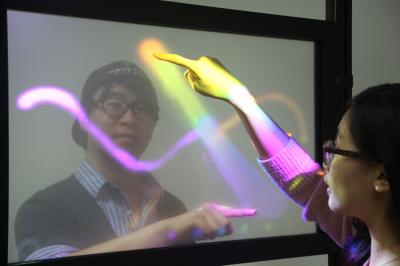
Woohun Lee, a professor of Industrial Design at KAIST, and his research team have recently developed TransWall, a two-sided, touchable, and transparent display wall that greatly enhances users' interpersonal experiences.

With an incorporated surface transducer, TransWall offers audio and vibrotactile feedback to the users. As a result, people can collaborate via a shared see-through display and communicate with one another by talking or even touching one another through the wall. A holographic screen film is inserted between the sheets of plexiglass, and beam projectors installed on each side of the wall project images that are reflected.

TransWall is touch-sensitive on both sides. Two users standing face-to-face on each side of the wall can touch the same spot at the same time without any physical interference. When this happens, TransWall provides the users with specific visual, acoustic, and vibrotactile experiences, allowing them to feel as if they are touching one another.

Professor Lee said, "TransWall concept enables people to see, hear, or even touch others through the wall while enjoying gaming and interpersonal communication. TransWall can be installed inside buildings, such as shopping centers, museums, and theme parks, for people to have an opportunity to collaborate even with strangers in a natural way."

He further added that "TransWall will be useful in places that require physical isolation for high security and safety, germ-free rooms in hospitals, for example." TransWall will allow patients to interact with family and friends without compromising medical safety.

INFORMATION: TransWall was exhibited at the 2014 Conference on Computer-Human Interaction (CHI) held from April 26, 2014 to May 1, 2014 in Toronto, Canada.

YouTube Link: http://www.youtube.com/watch?v=1QdYC_kOQ_w&list=PLXmuftxI6pTXuyjjrGFlcN5YFTKZinDhK

For further inquires:

Woohun Lee
Professor of Industrial Design, KAIST
Design Media Lab, KAIST
Tel: +82-42-350-4519
Email: woohun.lee@kaist.ac.kr

[Attachments] See images for this press release:
KAIST develops TransWall, a transparent touchable display wall

ELSE PRESS RELEASES FROM THIS DATE:

Travel campaign fuels $1B rise in hospitality industry

Travel campaign fuels $1B rise in hospitality industry
2014-07-08
EAST LANSING, Mich. --- The Obama administration's controversial travel-promotion program has generated a roughly $1 billion increase in the value of the hospitality industry and stands to benefit the U.S. economy in the long run. So finds the first scientific evidence, from a Michigan State University-led study, showing a positive economic impact of the Travel Promotion Act. Congress is currently reviewing whether to extend the law, which went into effect in March 2010. "We found positive stock market reactions related to the passage of the act and therefore agree ...

Low doses of arsenic cause cancer in male mice

Low doses of arsenic cause cancer in male mice
2014-07-08
Mice exposed to low doses of arsenic in drinking water, similar to what some people might consume, developed lung cancer, researchers at the National Institutes of Health have found. Arsenic levels in public drinking water cannot exceed 10 parts per billion (ppb), which is the standard set by the U.S. Environmental Protection Agency. However, there are no established standards for private wells, from which millions of people get their drinking water. In this study, the concentrations given to the mice in their drinking water were 50 parts per billion (ppb), 500 ppb, ...

Recalled yogurt contained highly pathogenic mold

2014-07-08
DURHAM, N.C. -- Samples isolated from Chobani yogurt that was voluntarily recalled in September 2013 have been found to contain the most virulent form of a fungus called Mucor circinelloides, which is associated with infections in immune-compromised people. The study by Duke University scientists shows that this strain of the fungus can survive in a mouse and be found in its feces as many as 10 days after ingestion. In August and September 2013, more than 200 consumers of contaminated Chobani Greek Yogurt became ill with vomiting, nausea and diarrhea. The U.S. Food ...

Shining light on the 100-year mystery of birds sensing spring for offspring

Shining light on the 100-year mystery of birds sensing spring for offspring
2014-07-08
Nagoya, Japan – Professor Takashi Yoshimura and colleagues of the Institute of Transformative Bio-Molecules (WPI-ITbM) of Nagoya University have finally found the missing piece in how birds sense light by identifying a deep brain photoreceptor in Japanese quails, in which the receptor directly responds to light and controls seasonal breeding activity. Although it has been known for over 100 years that vertebrates apart from mammals detect light deep inside their brains, the true nature of the key photoreceptor has remained to be a mystery up until now. This study led by ...

A healthy lifestyle adds years to life

A healthy lifestyle adds years to life
2014-07-08
Cardiovascular diseases (CVDs), cancer, diabetes and chronic respiratory disorders - the incidence of these non-communicable diseases (NCDs) is constantly rising in industrialised countries. The Federal Office of Public Health (FOPH) is, therefore, in the process of developing a national prevention strategy with a view to improving the population's health competence and encouraging healthier behaviour. Attention is focusing, amongst other things, on the main risk factors for these diseases which are linked to personal behaviour – i.e. tobacco smoking, an unhealthy diet, ...

HIV study leads to insights into deadly infection

2014-07-08
Research led by the University of Adelaide has provided new insights into how the HIV virus greatly boosts its chances of spreading infection, and why HIV is so hard to combat. HIV infects human immune cells by turning the infection-fighting proteins of these cells into a "backdoor key" that lets the virus in. Recent research has found that another protein is involved as well. A peptide in semen that sticks together and forms structures known as "amyloid fibrils" enhances the virus's infection rate by up to an astonishing 10,000 times. How and why these fibrils enhance ...

AAU launches STEM education initiative website, announces STEM network conference

AAU launches STEM education initiative website, announces STEM network conference
2014-07-08
The Association of American Universities (AAU), an association of leading public and private research universities, today launched the AAU STEM Initiative Hub, a website that will both support and widen the impact of the association's initiative to improve the quality of undergraduate teaching and learning in science, technology, engineering and mathematics (STEM) fields at its member institutions. AAU has partnered with HUBzero, a web-based platform for scientific collaboration developed and managed by Purdue University, to create the AAU STEM Initiative Hub. The new ...

Silicon sponge improves lithium-ion battery performance

2014-07-08
RICHLAND, Wash. – The lithium-ion batteries that power our laptops and electric vehicles could store more energy and run longer on a single charge with the help of a sponge-like silicon material. Researchers developed the porous material to replace the graphite traditionally used in one of the battery's electrodes, as silicon has more than 10 times the energy storage capacity of graphite. A paper describing the material's performance as a lithium-ion battery electrode was published today in Nature Communications. "Silicon has long been sought as a way to improve the ...

Underage drinkers overexposed to magazine advertising for the brands they consume

2014-07-08
PISCATAWAY, NJ – The brands of alcohol popular with underage drinkers also happen to be the ones heavily advertised in magazines that young people read, a new study finds. The findings, reported in July's Journal of Studies on Alcohol and Drugs, add to evidence that alcohol ads can encourage kids to drink. They also suggest that the alcohol industry's self-imposed standards on advertising are inadequate, said lead researcher Craig Ross, Ph.D., M.B.A., of the Natick, Mass.,-based Virtual Media Resources. "All of the ads in our study were in complete compliance with ...

Underage drinkers heavily exposed to magazine ads for alcohol brands they consume

2014-07-08
Underage drinkers between the ages of 18 and 20 see more magazine advertising than any other age group for the alcohol brands they consume most heavily, raising important questions about whether current alcohol self-regulatory codes concerning advertising are sufficiently protecting young people. This is the conclusion of a new study from the Center on Alcohol Marketing and Youth (CAMY) at the Johns Hopkins Bloomberg School of Public Health that examined which age groups saw the most magazine advertising for the 25 alcohol brands most popular among underage boys and ...

LAST 30 PRESS RELEASES:

Eye for trouble: Automated counting for chromosome issues under the microscope

The vast majority of US rivers lack any protections from human activities, new research finds

Ultrasound-responsive in situ antigen "nanocatchers" open a new paradigm for personalized tumor immunotherapy

Environmental “superbugs” in our rivers and soils: new one health review warns of growing antimicrobial resistance crisis

Triple threat in greenhouse farming: how heavy metals, microplastics, and antibiotic resistance genes unite to challenge sustainable food production

Earthworms turn manure into a powerful tool against antibiotic resistance

AI turns water into an early warning network for hidden biological pollutants

Hidden hotspots on “green” plastics: biodegradable and conventional plastics shape very different antibiotic resistance risks in river microbiomes

Engineered biochar enzyme system clears toxic phenolic acids and restores pepper seed germination in continuous cropping soils

Retail therapy fail? Online shopping linked to stress, says study

How well-meaning allies can increase stress for marginalized people

Commercially viable biomanufacturing: designer yeast turns sugar into lucrative chemical 3-HP

Control valve discovered in gut’s plumbing system

George Mason University leads phase 2 clinical trial for pill to help maintain weight loss after GLP-1s

Hop to it: research from Shedd Aquarium tracks conch movement to set new conservation guidance

Weight loss drugs and bariatric surgery improve the body’s fat ‘balance:’ study

The Age of Fishes began with mass death

TB harnesses part of immune defense system to cause infection

Important new source of oxidation in the atmosphere found

A tug-of-war explains a decades-old question about how bacteria swim

Strengthened immune defense against cancer

Engineering the development of the pancreas

The Journal of Nuclear Medicine ahead-of-print tip sheet: Jan. 9, 2026

Mount Sinai researchers help create largest immune cell atlas of bone marrow in multiple myeloma patients

Why it is so hard to get started on an unpleasant task: Scientists identify a “motivation brake”

Body composition changes after bariatric surgery or treatment with GLP-1 receptor agonists

Targeted regulation of abortion providers laws and pregnancies conceived through fertility treatment

Press registration is now open for the 2026 ACMG Annual Clinical Genetics Meeting

Understanding sex-based differences and the role of bone morphogenetic protein signaling in Alzheimer’s disease

Breakthrough in thin-film electrolytes pushes solid oxide fuel cells forward

[Press-News.org] KAIST develops TransWall, a transparent touchable display wall