Reptile Database surpasses 10,000 reptile species
Published 2014-08-01 · Original archive entry · Explore research explainers
More than 10,000 reptile species have been recorded into the Reptile Database, a web-based catalogue of all living reptile species and classification, making the reptile species among the most diverse vertebrate groups in the world, alongside bird and fish species.
For some time, experts have projected that 2014 would mark the year that reptiles would become the most diverse vertebrate group in the world. Reptiles include snakes, lizards, turtles, crocodiles, tuataras and amphisbaenians.
"Officially, we have logged 10,038 reptile species into the database, which is up from 9,952 that was reported in April," said Peter Uetz, Ph.D., associate professor of systems biology and bioinformatics in the Center for the Study of Biological Complexity at Virginia Commonwealth University, part of VCU Life Sciences. Uetz is the founder, editor and curator of the Reptile Database, which he operates together with Jiří Hošek, a programmer in the Czech Republic.
"Previously, 10,000 was considered the landmark number because there are approximately 10,000 bird species. However, we can predict that reptiles will be more speciose, at least on paper, than birds very soon. Finally, reptiles will be the most speciose vertebrate group after fish," said Uetz.
Speciose refers to the number of species known. Uetz added that there are "only" approximately 5,000 species of mammals and approximately 7,000 species of amphibians.
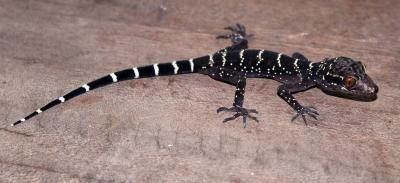
The 10,000th species recorded into the database is Cyrtodactylus vilaphongi, a tiny gecko found in the jungle of Laos in Southeast Asia, which was discovered by a team of German, Vietnamese and Lao scientists.
The discoveries that are entered into the Reptile Database are made by taxonomists working in the field studying reptiles worldwide, and those working in museum collections or laboratories. The Reptile Database receives the information from the taxonomists directly or collects it from the scientific literature. Uetz and a team of reptilian and biodiversity experts, including many volunteers, organize the data, evaluate it and redistribute it.
According to Uetz, in recent years, many species are discovered by genetic analyses — showing that species look very similar although they may be genetically different.
Uetz said that many of the experts contributing to the database, including himself, conduct research using taxonomic information. Some experts study the morphology or ecology of particular species, while others analyze certain characters across all reptile species. For example, Uetz helped some colleagues from Israel and elsewhere to analyze the effect of temperature on the distribution in reptiles. Another ongoing study addresses longevity in reptiles. Previous studies have included some meta-analyses that describe the rates of discovery over the centuries.
"Species discoveries continue unabatedly, but also ironically, as many species turn out to be endangered, as soon as they are discovered, given that many are restricted to very small ranges, such as mountain tops — including small mountains," he said.
Uetz said that reaching the 10,000 mark happened faster than he expected, and could be due to an occurrence that taxonomists refer to as "revalidation" and "elevation."
"This means that species are resurrected that were previously synonymized with some other species, or that a subspecies becomes a species, respectively," Uetz said.
According to Uetz, there is much more work ahead for the Reptile Database, which has little to no support in terms of funding dollars. He said that in addition to collecting new species, the names of species are constantly changing because of new insights into their evolutionary history. Additionally, there is a lot of distribution and natural history data that needs to be entered, and then finally, all that data needs to be analyzed for various biological projects, including conservation efforts.
"Hopefully, the new status as a five-digit species animal group brings more support, funding and awareness for the bewildering diversity reptiles continue to reveal," said Uetz.
Uetz will present these findings during the 2014 Joint Meeting of Ichthyologists and Herpetologists, July 30-Aug. 3, in Chattanooga, Tennessee.
INFORMATION: END
For some time, experts have projected that 2014 would mark the year that reptiles would become the most diverse vertebrate group in the world. Reptiles include snakes, lizards, turtles, crocodiles, tuataras and amphisbaenians.
"Officially, we have logged 10,038 reptile species into the database, which is up from 9,952 that was reported in April," said Peter Uetz, Ph.D., associate professor of systems biology and bioinformatics in the Center for the Study of Biological Complexity at Virginia Commonwealth University, part of VCU Life Sciences. Uetz is the founder, editor and curator of the Reptile Database, which he operates together with Jiří Hošek, a programmer in the Czech Republic.
"Previously, 10,000 was considered the landmark number because there are approximately 10,000 bird species. However, we can predict that reptiles will be more speciose, at least on paper, than birds very soon. Finally, reptiles will be the most speciose vertebrate group after fish," said Uetz.
Speciose refers to the number of species known. Uetz added that there are "only" approximately 5,000 species of mammals and approximately 7,000 species of amphibians.
The 10,000th species recorded into the database is Cyrtodactylus vilaphongi, a tiny gecko found in the jungle of Laos in Southeast Asia, which was discovered by a team of German, Vietnamese and Lao scientists.
The discoveries that are entered into the Reptile Database are made by taxonomists working in the field studying reptiles worldwide, and those working in museum collections or laboratories. The Reptile Database receives the information from the taxonomists directly or collects it from the scientific literature. Uetz and a team of reptilian and biodiversity experts, including many volunteers, organize the data, evaluate it and redistribute it.
According to Uetz, in recent years, many species are discovered by genetic analyses — showing that species look very similar although they may be genetically different.
Uetz said that many of the experts contributing to the database, including himself, conduct research using taxonomic information. Some experts study the morphology or ecology of particular species, while others analyze certain characters across all reptile species. For example, Uetz helped some colleagues from Israel and elsewhere to analyze the effect of temperature on the distribution in reptiles. Another ongoing study addresses longevity in reptiles. Previous studies have included some meta-analyses that describe the rates of discovery over the centuries.
"Species discoveries continue unabatedly, but also ironically, as many species turn out to be endangered, as soon as they are discovered, given that many are restricted to very small ranges, such as mountain tops — including small mountains," he said.
Uetz said that reaching the 10,000 mark happened faster than he expected, and could be due to an occurrence that taxonomists refer to as "revalidation" and "elevation."
"This means that species are resurrected that were previously synonymized with some other species, or that a subspecies becomes a species, respectively," Uetz said.
According to Uetz, there is much more work ahead for the Reptile Database, which has little to no support in terms of funding dollars. He said that in addition to collecting new species, the names of species are constantly changing because of new insights into their evolutionary history. Additionally, there is a lot of distribution and natural history data that needs to be entered, and then finally, all that data needs to be analyzed for various biological projects, including conservation efforts.
"Hopefully, the new status as a five-digit species animal group brings more support, funding and awareness for the bewildering diversity reptiles continue to reveal," said Uetz.
Uetz will present these findings during the 2014 Joint Meeting of Ichthyologists and Herpetologists, July 30-Aug. 3, in Chattanooga, Tennessee.
INFORMATION: END