Diverse neighborhoods may help infants' social learning
Published 2014-09-10 · Original archive entry · Explore research explainers
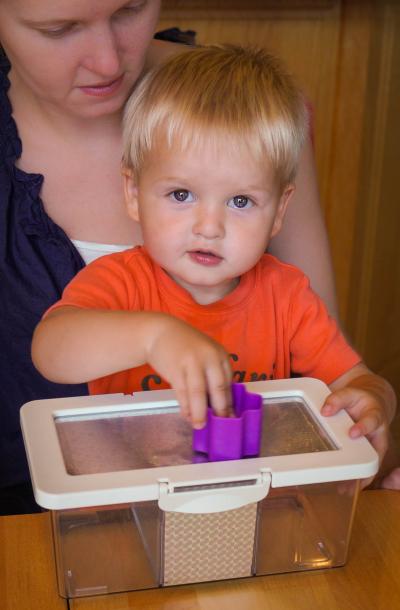
Experiencing diverse communities by hearing different languages at the park, on a bus or in the grocery store may make babies more open-minded in their social learning, a new study finds.
While previous research has shown that direct interactions with parents and caregivers shape early cognitive development, the influence of the broader community beyond those direct experiences has not been as carefully examined. In a new study published by the journal Cognition, University of Chicago Psychology Department researchers investigated whether the variety of languages in infants' neighborhoods affects their willingness to learn from people who are different from them.
"We were interested in linguistic diversity—that is, how many different languages babies might hear," said lead author Lauren H. Howard, a psychology doctoral student at UChicago. "All of the babies in our study heard only English from their parents and caretakers. But they lived in neighborhoods where multiple languages were spoken. Our findings showed that hearing those languages outside the home, for example at the park or on the bus, made infants more open to learning from someone who did not speak English," Howard added.
"Research has shown that children, like adults, are often biased against interacting with and learning from people who are different from them," explained Amanda Woodward, the William S. Gray Professor of Psychology at UChicago and an expert in social cognition during infancy and early childhood. "In this new study, we found that these fairly young babies are tuning into the social world outside of their home environment. The exposure to diversity may help protect against the development of a bias very early in life," Woodward said.
The researchers analyzed data from four experiments investigating 19-month-old infants' imitation of adults who either spoke the infants' native language (English) or a different language (Spanish). All of the 82 children were from the Chicago and Washington, D.C. metro areas, and were exposed only to English in their own households. Howard said she and her colleagues used U.S. Census Bureau data to identify the prevalence of non-English languages present in the infants' neighborhoods.
The experiments used various ways to test how well the infants could learn new tasks from a non-English speaker. One set of infants observed an English-speaking or a Spanish-speaking adult perform actions on a series of toys to attain a goal. For example, the adult would press a button to turn on a light or open a box to get a fun toy from inside. The adults spoke different languages, but relied on visual demonstration to show how to perform the task. A second group of infants saw both the English and Spanish speakers side-by-side performing different actions on the same toy to obtain a similar goal. For example, one experimenter might turn on a light with her head and the other would use an elbow. After a brief delay, the infants were allowed to act on each toy.
The researchers then assessed the infants' propensity to imitate one experimenter over another. They found that infants who heard a diversity of languages in their home neighborhoods were more likely than infants from less diverse areas to take cues from the Spanish-speaking adults.
"Both experimenters were providing useful information to the babies – 'how does this object work?' But they were not using language to explain what they were doing, just demonstrating," Howard said. "And babies from more diverse communities learned and imitated more of the Spanish speaker's actions."
Woodward said the findings could have implications for how neighborhoods affect children's general willingness to engage with people of other backgrounds as they grow older.
"This study provides evidence that infants' social learning is shaped by the diversity of the neighborhood in which they live, even if they do not have direct interaction with people who speak other languages," said Woodward. "This exposure to diversity might reduce the risk of developing bias, and may keep children open to opportunities to learn from and interact with diverse social partners."
INFORMATION:
While previous research has shown that direct interactions with parents and caregivers shape early cognitive development, the influence of the broader community beyond those direct experiences has not been as carefully examined. In a new study published by the journal Cognition, University of Chicago Psychology Department researchers investigated whether the variety of languages in infants' neighborhoods affects their willingness to learn from people who are different from them.
"We were interested in linguistic diversity—that is, how many different languages babies might hear," said lead author Lauren H. Howard, a psychology doctoral student at UChicago. "All of the babies in our study heard only English from their parents and caretakers. But they lived in neighborhoods where multiple languages were spoken. Our findings showed that hearing those languages outside the home, for example at the park or on the bus, made infants more open to learning from someone who did not speak English," Howard added.
"Research has shown that children, like adults, are often biased against interacting with and learning from people who are different from them," explained Amanda Woodward, the William S. Gray Professor of Psychology at UChicago and an expert in social cognition during infancy and early childhood. "In this new study, we found that these fairly young babies are tuning into the social world outside of their home environment. The exposure to diversity may help protect against the development of a bias very early in life," Woodward said.
The researchers analyzed data from four experiments investigating 19-month-old infants' imitation of adults who either spoke the infants' native language (English) or a different language (Spanish). All of the 82 children were from the Chicago and Washington, D.C. metro areas, and were exposed only to English in their own households. Howard said she and her colleagues used U.S. Census Bureau data to identify the prevalence of non-English languages present in the infants' neighborhoods.
The experiments used various ways to test how well the infants could learn new tasks from a non-English speaker. One set of infants observed an English-speaking or a Spanish-speaking adult perform actions on a series of toys to attain a goal. For example, the adult would press a button to turn on a light or open a box to get a fun toy from inside. The adults spoke different languages, but relied on visual demonstration to show how to perform the task. A second group of infants saw both the English and Spanish speakers side-by-side performing different actions on the same toy to obtain a similar goal. For example, one experimenter might turn on a light with her head and the other would use an elbow. After a brief delay, the infants were allowed to act on each toy.
The researchers then assessed the infants' propensity to imitate one experimenter over another. They found that infants who heard a diversity of languages in their home neighborhoods were more likely than infants from less diverse areas to take cues from the Spanish-speaking adults.
"Both experimenters were providing useful information to the babies – 'how does this object work?' But they were not using language to explain what they were doing, just demonstrating," Howard said. "And babies from more diverse communities learned and imitated more of the Spanish speaker's actions."
Woodward said the findings could have implications for how neighborhoods affect children's general willingness to engage with people of other backgrounds as they grow older.
"This study provides evidence that infants' social learning is shaped by the diversity of the neighborhood in which they live, even if they do not have direct interaction with people who speak other languages," said Woodward. "This exposure to diversity might reduce the risk of developing bias, and may keep children open to opportunities to learn from and interact with diverse social partners."
INFORMATION: