PRESS-NEWS.org - Press Release Distribution
PRESS RELEASES DISTRIBUTION

Prescribed burns in Western Australia

Prescribed burns in Western Australia
2014-10-14
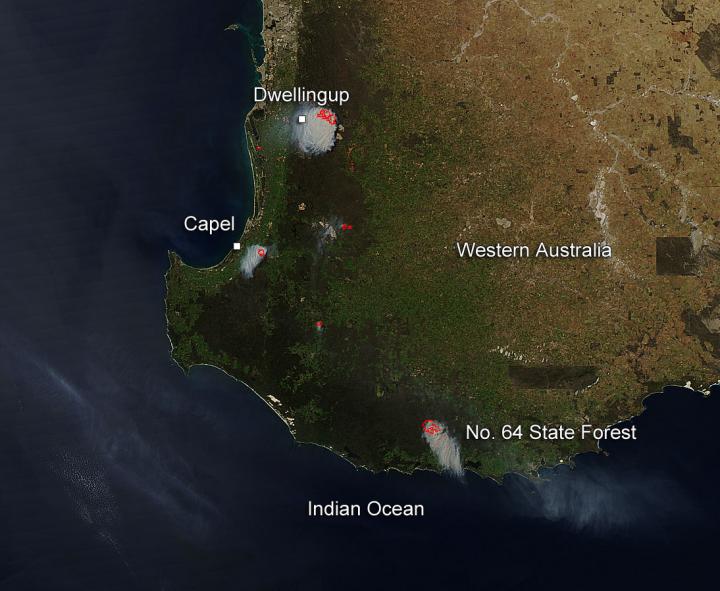
(Press-News.org) The Moderate Resolution Imaging Spectroradiometer (MODIS) on NASA's Aqua satellite detected fires burning in Western Australia on October 14, 2014. Matching these hot spots up to the the prescribed fire burns on Western Australia's parks and wildlife site: http://www.dpaw.wa.gov.au/management/fire/prescribed-burning/burns these fires are most likely prescribed burns used to limit bushfire outbreaks. According to the Government of Australia's Department of Parks and Wildlife, "Prescribed burning is the process of planning and applying fire to a predetermined area, under specific environmental conditions, to achieve a desired outcome." IT goes on to say these fires are set for the following reasons:

to maintain biodiversity, to mitigate the severity of bushfires and to help protect lives and property by reducing the build-up of flammable fuel loads, and to rehabilitate vegetation after disturbance, such as timber harvesting and mining to undertake research on fire and its interaction with our environment.

INFORMATION:

NASA image courtesy Jeff Schmaltz LANCE/EOSDIS MODIS Rapid Response Team, GSFC. Caption by Lynn Jenner


[Attachments] See images for this press release:
Prescribed burns in Western Australia

ELSE PRESS RELEASES FROM THIS DATE:

Early detection window when pancreatic cancer is in the family

2014-10-14
Pancreatic cancer likely takes between 10 and 20 years to develop, providing the potential for a very "broad window" of intervention if detected early, which may be possible for people who inherit a predisposition, say Australian clinical researchers. Dr Jeremy Humphris and Professor Andrew Biankin1, from Sydney's Garvan Institute of Medical Research, analysed medical histories and tumour samples taken from a cohort of 766 pancreatic cancer patients, operated on between 1994 and 20122. Roughly 9% of these patients had a first-degree relative (parent or sibling) with ...

Seniors run for the suburbs in their golden years

2014-10-14
Montreal, October 14, 2014 — By 2040, there will be more than three times the number of Americans aged 80+ than there were in 2000. Condo towers crowding city skylines seem to reflect builders' hopes that the grey set will head to urban centres for increased services and better transit options. But new research from Concordia University suggests that the opposite is more likely to occur. In a study recently published in the Journal of Transport Geography, researcher Zachary Patterson uses census data to map seniors' moving habits. What emerges is a clear pattern: ...

NASA's Aqua satellite sees Extra-Tropical Storm Vongfong pulling away from Hokkaido, Japan

NASAs Aqua satellite sees Extra-Tropical Storm Vongfong pulling away from Hokkaido, Japan
2014-10-14
NASA's Aqua satellite passed over Extra-Tropical Storm Vongfong on Oct. 4 as it was moving away from Hokkaido, Japan, the northernmost of the big islands. Vongfong transitioned into an extra-tropical storm early on Oct. 4 as its core changed from warm to cold. The MODIS or Moderate Resolution Imaging Spectroradiometer instrument aboard NASA's Aqua satellite captured a visible image of Tropical Storm Vongfong over Japan on Oct. 14 at 03:15 UTC as it was southeast of the island of Hokkaido, Japan. The image showed that south of the center of circulation was almost devoid ...

Future computers could be built from magnetic 'tornadoes'

2014-10-14
Magnetic materials form the basis of most hard disc drives as they are able to store data. A team from the University of Sheffield's Faculty of Engineering have been investigating whether they could also be used to perform calculations, and so take on the role of a computer's central processing unit (CPU). Lead researcher, Dr Tom Hayward, explains: "Magnetic materials are useful for data storage because they can retain information without consuming energy. A computer built around a CPU made of magnetic materials should be much more power efficient than existing technologies, ...

Institutional rearing may increase risk attention-deficit disorder

2014-10-14
Philadelphia, PA, October 14, 2014 – Over the past decades, we have seen numerous tragic examples where the failure of institutions to meet the needs of infants for social contact and stimulation has led to the failure of these infants to thrive. Infancy and childhood are critical life periods that shape the development of the cortex. A generation of research suggests that enriched environments, full of interesting stimuli to explore, promote cortical development and cognitive function. In contrast, deprivation and stress may compromise cortical development and ...

New discovery will enhance yield and quality of cereal and bioenergy crops

New discovery will enhance yield and quality of cereal and bioenergy crops
2014-10-14
ST. LOUIS, MO – October 13, 2014 –A team of scientists led by Thomas Brutnell, Ph.D., director of the Enterprise Rent-A-Car Institute for Renewable Fuels at the Donald Danforth Plant Science Center have developed a new way of identifying genes that are important for photosynthesis in maize, and in rice. Their research helps to prioritize candidate genes that can be used for crop improvement and revealed new pathways and information about how plants fix carbon. The findings, published in "Comparative analyses of C4 and C3 photosynthesis in developing leaves of ...

Scientists link ALS progression to increased protein instability

Scientists link ALS progression to increased protein instability
2014-10-14
LA JOLLA, CA—October 13, 2014—A new study by scientists from The Scripps Research Institute (TSRI), Lawrence Berkeley National Laboratory (Berkeley Lab) and other institutions suggests a cause of amyotrophic lateral sclerosis (ALS), also known as Lou Gehrig's disease. "Our work supports a common theme whereby loss of protein stability leads to disease," said John A. Tainer, professor of structural biology at TSRI and senior scientist at Berkeley Lab, who shared senior authorship of the new research with TSRI Professor Elizabeth Getzoff. Getzoff, Tainer and ...

Taking infestation with a grain of salt

Taking infestation with a grain of salt
2014-10-14
Twenty years ago, biologists Kathy Boyer and Joy Zedler, then researchers at San Diego State University, speculated that too many insects feeding on cordgrass in the marshes of San Diego Bay could endanger the grass, and in turn endanger the bay wildlife that relies on it. Picking up where Boyer and Zedler left off, SDSU biologist Jeremy Long is currently further exploring the dimensions of this relationship. What he's found so far suggests that it's not a simple as saying too many insects spell death for a host plant. Instead, his research suggests a complex interplay ...

Fermented milk made by Lactococcus lactis H61 improves skin of healthy young women

2014-10-14
Philadelphia, PA, October 13, 2014 – There has been much interest in the potential for using probiotic bacteria for treating skin diseases and other disorders. Japanese researchers have now found that milk that has been fermented using a probiotic dairy starter can also benefit the skin of young healthy women, reports the Journal of Dairy Science®. Probiotics have been defined by the Food and Agriculture Organization-World Health Organization as "live microorganisms which, when administered in adequate amounts, confer a health benefit to the host." "Although ...

Study reveals how deadly MERS virus enters human cells

2014-10-14
ITHACA, N.Y. – Cornell University researchers have uncovered details of how the deadly Middle East respiratory syndrome coronavirus (MERS-CoV) enters host cells, and offer possible new avenues for treatment. The study, appearing online this month in the Proceedings of the National Academy of Sciences, discovered that a common protease enzyme known as furin activates the MERS-CoV to fuse with cell membranes and enter host cells. The researchers, Gary Whittaker, Cornell professor of virology, and Jean Millet, a postdoctoral associate in Whittaker's lab, suggest ...

LAST 30 PRESS RELEASES:

Making lighter work of calculating fluid and heat flow

Normalizing blood sugar can halve heart attack risk

Lowering blood sugar cuts heart attack risk in people with prediabetes

Study links genetic variants to risk of blinding eye disease in premature infants

Non-opioid ‘pain sponge’ therapy halts cartilage degeneration and relieves chronic pain

AI can pick up cultural values by mimicking how kids learn

China’s ecological redlines offer fast track to 30 x 30 global conservation goal

Invisible indoor threats: emerging household contaminants and their growing risks to human health

Adding antibody treatment to chemo boosts outcomes for children with rare cancer

Germline pathogenic variants among women without a history of breast cancer

Tanning beds triple melanoma risk, potentially causing broad DNA damage

Unique bond identified as key to viral infection speed

Indoor tanning makes youthful skin much older on a genetic level

Mouse model sheds new light on the causes and potential solutions to human GI problems linked to muscular dystrophy

The Journal of Nuclear Medicine ahead-of-print tip sheet: December 12, 2025

Smarter tools for peering into the microscopic world

Applications open for funding to conduct research in the Kinsey Institute archives

Global measure underestimates the severity of food insecurity

Child survivors of critical illness are missing out on timely follow up care

Risk-based vs annual breast cancer screening / the WISDOM randomized clinical trial

University of Toronto launches Electric Vehicle Innovation Ontario to accelerate advanced EV technologies and build Canada’s innovation advantage

Early relapse predicts poor outcomes in aggressive blood cancer

American College of Lifestyle Medicine applauds two CMS models aligned with lifestyle medicine practice and reimbursement

Clinical trial finds cannabis use not a barrier to quitting nicotine vaping

Supplemental nutrition assistance program policies and food insecurity

Switching immune cells to “night mode” could limit damage after a heart attack, study suggests

URI-based Global RIghts Project report spotlights continued troubling trends in worldwide inhumane treatment

Neutrophils are less aggressive at night, explaining why nighttime heart attacks cause less damage than daytime events

Menopausal hormone therapy may not pose breast cancer risk for women with BRCA mutations

Mobile health tool may improve quality of life for adolescent and young adult breast cancer survivors

[Press-News.org] Prescribed burns in Western Australia