PRESS-NEWS.org - Press Release Distribution
PRESS RELEASES DISTRIBUTION

Typhoid Mary, not typhoid mouse

Lack of enzyme explains why typhoid fever is a human-specific disease

Typhoid Mary, not typhoid mouse
2014-12-04
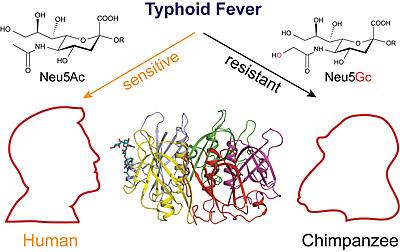
(Press-News.org) The bacterium Salmonella Typhi causes typhoid fever in humans, but leaves other mammals unaffected. Researchers at University of California, San Diego and Yale University Schools of Medicine now offer one explanation -- CMAH, an enzyme that humans lack. Without this enzyme, a toxin deployed by the bacteria is much better able to bind and enter human cells, making us sick. The study is published in the Dec. 4 issue of Cell.

In most mammals (including our closest evolutionary cousins, the great apes), the CMAH enzyme reconfigures the sugar molecules found on these animals' cell surfaces into a form that the typhoid toxin cannot bind. Humans don't produce CMAH, meaning our cell surface sugars are left unchanged -- and as this study shows, in a state just right for typhoid toxin attachment.

"We started this project looking at something completely different in relation to cancer, but serendipity instead helped us solve the mystery of what the typhoid toxin binds," said co-senior author Ajit Varki, MD, Distinguished Professor in the Departments of Medicine and Cellular and Molecular Medicine at UC San Diego. "That's the beauty of basic research -- though we didn't set out with the intent, these findings may now spur the development of new therapies for typhoid fever." Varki co-directed the study with Jorge E. Galán, PhD, DVM, professor and department chair at Yale University School of Medicine.

All mammals decorate their cell surfaces with a type of sialic acid sugar called Neu5Ac. In most mammals, the enzyme CMAH coverts Neu5Ac to Neu5Gc, a subtle but important distinction involving a single oxygen atom. Varki, Galán and their teams are the first to discover that typhoid toxin binding is exquisitely specific for Neu5Ac (the human type). The toxin damages cells expressing Neu5Ac sugars on their surface, but not those with Neu5Gc (the non-human type). In fact, when the researchers added Neu5Gc to cultured human cells, they became resistant to typhoid toxin. The findings were confirmed in a mouse model.

"We have previously shown that typhoid toxin can cause typhoid fever in experimental animals and that to intoxicate cells, the toxin must bind specific surface glycoproteins. The discovery that a single oxygen atom could make such a difference in toxin binding is remarkable and has implications for the design of potential toxin inhibitors," said Galán.

Typhoid is typically transmitted through food or water contaminated by infected people. While hand washing and other sanitary measures have minimized occurrences of typhoid fever in the U.S., roughly 21 million cases of typhoid fever and 200,000 deaths occur worldwide each year, according to the Centers for Disease Control and Prevention.

INFORMATION:

Co-authors include Lingquan Deng, Nissi Varki, Yuko Naito-Matsui, UC San Diego School of Medicine; Jeongmin Song, Xiang Gao, Yale University School of Medicine; Jiawei Wang, Tsinghua University; Hai Yu, Xi Chen, University of California, Davis.

This research was funded, in part, by the National Cancer Institute (grant CA38701) and the National Institute of Allergy and Infectious Diseases (grant AI079022), both part of the U.S. National Institutes of Health.


[Attachments] See images for this press release:
Typhoid Mary, not typhoid mouse

ELSE PRESS RELEASES FROM THIS DATE:

Obesity and hypertension

2014-12-04
The link between obesity and cardiovascular diseases is well acknowledged. Being obese or overweight is a major risk factor for the development of elevated blood pressure, and cardiovascular diseases. But it has net been known how obesity increases the risk of high blood pressure, making it difficult to develop evidence based therapies for obesity, hypertension and heart disease. In a ground-breaking study, published today in the prestigious journal, Cell (embargo midday EST), researchers from Monash University in Australia, Warwick, Cambridge in the UK and several American ...

'Satiety hormone' leptin links obesity to high blood pressure

2014-12-04
Leptin, a hormone that regulates the amount of fat stored in the body, also drives the increase in blood pressure that occurs with weight gain, according to researchers from Monash University and the University of Cambridge. Being obese or overweight is a major risk factor for the development of high blood pressure and cardiovascular disease. Whilst a number of factors may be involved, the precise explanation for the link between these two conditions has been unclear. In a study published today in the journal Cell, a research team led by Professor Michael Cowley, ...

People with mental illness more likely to be tested for HIV, Penn Medicine study finds

2014-12-04
PHILADELPHIA--People with mental illness are more likely to have been tested for HIV than those without mental illness, according to a new study from a team of researchers at Penn Medicine and the U.S. Centers for Disease Control and Prevention (CDC) published online this week in AIDS Patient Care and STDs. The researchers also found that the most seriously ill - those with schizophrenia and bipolar disease - had the highest rate of HIV testing. The study assessed nationally representative data from 21,785 adult respondents from the 2007 National Health Interview Survey ...

A poisonous cure

A poisonous cure
2014-12-04
EAST LANSING, Mich. - Take two poisonous mushrooms, and call me in the morning. While no doctor would ever write this prescription, toxic fungi may hold the secrets to tackling deadly diseases. A team of Michigan State University scientists has discovered an enzyme that is the key to the lethal potency of poisonous mushrooms. The results, published in the current issue of the journal Chemistry and Biology, reveal the enzyme's ability to create the mushroom's molecules that harbor missile-like proficiency in attacking and annihilating a single vulnerable target in the ...

Research: NFL athletes are seeking unproven stem cell treatments

2014-12-04
Some National Football League (NFL) players have been seeking out unproven stem cell therapies to help accelerate recoveries from injuries, according to a new paper from Rice University's Baker Institute for Public Policy. While most players seem to receive treatment within the United States, several have traveled abroad for therapies unavailable domestically and may be unaware of the risks involved, the paper found. The paper is published in the 2014 World Stem Cell Report, which is a special supplement to the journal Stem Cells and Development and is the official publication ...

Kent State researchers find more smartphone play equals less fun during leisure

Kent State researchers find more smartphone play equals less fun during leisure
2014-12-04
Today's smartphones are designed to entertain and are increasingly marketed to young adults as leisure devices. Not surprisingly, research suggests that young adults most often use their phones for entertainment purposes rather than for school or work. With this in mind, three Kent State University researchers, Andrew Lepp, Ph.D., Jacob Barkley, Ph.D. and Jian Li, Ph.D., and a Kent State graduate student, Saba Salehi-Esfahani, surveyed a random sample of 454 college students to examine how different types of cell phone users experience daily leisure. The trio from ...

Genome sequencing for newborns: What do new parents think?

2014-12-04
Boston, MA - A study published this week in Genetics in Medicine is the first to explore new parents' attitudes toward newborn genomic testing. The findings suggest that if newborn genomic testing becomes available, there would be robust interest among new parents, regardless of their demographic background. The study, led by researchers at Brigham and Women's Hospital (BWH) and Boston Children's Hospital, found that the majority of parents surveyed were interested in newborn genomic testing. As next-generation whole-exome and genome sequencing is integrated into clinical ...

Two in 10 adults seriously considered suicide in 2013, CAMH survey shows

Two in 10 adults seriously considered suicide in 2013, CAMH survey shows
2014-12-04
TORONTO, Dec. 4, 2014 - Results from an ongoing survey conducted by the Centre for Addiction and Mental Health (CAMH) show that 2.2 per cent of adults --or over 230,000 people in Ontario, Canada -- seriously contemplated suicide in the last year. The 2013 edition of the CAMH Monitor, released today, included questions about suicidal ideation for the first time in the survey's history. "Suicide is a major public health issue, and these data confirm that large numbers of Ontario adults report having suicidal thoughts," said Dr. Hayley Hamilton, CAMH scientist and co-principal ...

Insecticides foster 'toxic' slugs, reduce crop yields

Insecticides foster toxic slugs, reduce crop yields
2014-12-04
Insecticides aimed at controlling early-season crop pests, such as soil-dwelling grubs and maggots, can increase slug populations, thus reducing crop yields, according to researchers at Penn State and the University of South Florida. "Neonicotinoids are the most widely used insecticides in the world," said Margaret Douglas, graduate student in entomology, Penn State. "Seed applications of neonicotinoids are often viewed as cheap insurance against pest problems, but our results suggest that they can sometimes worsen pest problems and should be used with care." According ...

Higher birth weight indicates better performance in school

2014-12-04
GAINESVILLE, Fla. -- It's no secret that low-birth-weight babies face significantly greater risks for certain health problems early on, such as respiratory distress or infection. Now, a new study from researchers at the University of Florida and Northwestern University shows that lower weights at birth also have an adverse effect on children's performance in school, which is likely due to the early health struggles small babies often face. Using a unique set of data that matched birth and school records from 1.6 million children born in Florida between 1992 and 2002, ...

LAST 30 PRESS RELEASES:

Scientists trace microplastics in fertilizer from fields to the beach

The Lancet Obstetrics, Gynecology, & Women’s Health: Taking paracetamol during pregnancy does not increase risk of autism, ADHD or intellectual disabilities, confirms new gold-standard evidence review

Taking paracetamol during pregnancy does not increase risk of autism, ADHD or intellectual disabilities

Harm reduction vending machines in New York State expand access to overdose treatment and drug test strips, UB studies confirm

University of Phoenix releases white paper on Credit for Prior Learning as a catalyst for internal mobility and retention

Canada losing track of salmon health as climate and industrial threats mount

Molecular sieve-confined Pt-FeOx catalysts achieve highly efficient reversible hydrogen cycle of methylcyclohexane-toluene

Investment in farm productivity tools key to reducing greenhouse gas

New review highlights electrochemical pathways to recover uranium from wastewater and seawater

Hidden pollutants in shale gas development raise environmental concerns, new review finds

Discarded cigarette butts transformed into high performance energy storage materials

Researchers highlight role of alternative RNA splicing in schizophrenia

NTU Singapore scientists find new way to disarm antibiotic-resistant bacteria and restore healing in chronic wounds

Research suggests nationwide racial bias in media reporting on gun violence

Revealing the cell’s nanocourier at work

Health impacts of nursing home staffing

Public views about opioid overdose and people with opioid use disorder

Age-related changes in sperm DNA may play a role in autism risk

Ambitious model fails to explain near-death experiences, experts say

Multifaceted effects of inward foreign direct investment on new venture creation

Exploring mutations that spontaneously switch on a key brain cell receptor

Two-step genome editing enables the creation of full-length humanized mouse models

Pusan National University researchers develop light-activated tissue adhesive patch for rapid, watertight neurosurgical sealing

Study finds so-called super agers tend to have at least two key genetic advantages

Brain stimulation device cleared for ADHD in the US is overall safe but ineffective

Scientists discover natural ‘brake’ that could stop harmful inflammation

Tougher solid electrolyte advances long-sought lithium metal batteries

Experts provide policy roadmap to reduce dementia risk

New 3D imaging system could address limitations of MRI, CT and ultrasound

First-in-human drug trial lowers high blood fats

[Press-News.org] Typhoid Mary, not typhoid mouse
Lack of enzyme explains why typhoid fever is a human-specific disease