PRESS-NEWS.org - Press Release Distribution
PRESS RELEASES DISTRIBUTION

Stopping malaria in its tracks

Stopping malaria in its tracks
2015-07-20
(Press-News.org) A new drug acts as a roadblock for malaria, curing mice of established infection, according to a study in The Journal of Experimental Medicine. Treatment was not associated with obvious side effects, suggesting that the drug may also be safe and effective in humans.

Nearly 200 million cases of malaria occur worldwide each year, and roughly 500,000 people (mostly African children) die of the disease. Malaria is caused by infection with the parasite Plasmodium falciparum (Pf), and although the disease can be treated with anti-malarial drugs, the drugs are harsh and resistance often develops.

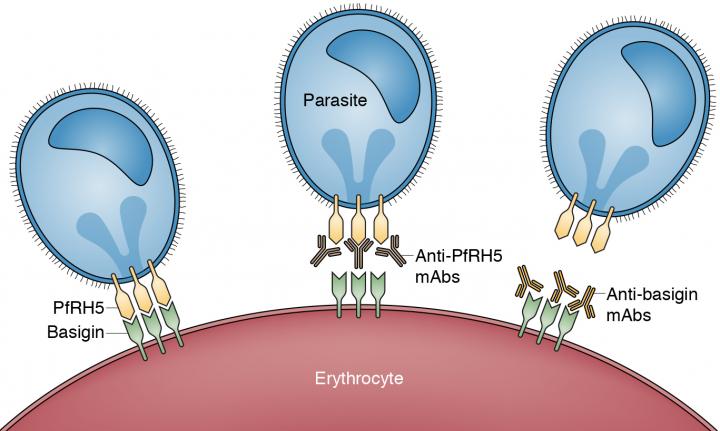
In 2011, a group of scientists at the Wellcome Trust Sanger Institute in the UK discovered that a human protein called basigin was required for all strains of Pf to invade red blood cells, an essential stage of the parasite's life cycle. Antibodies that block the interaction between basigin and the parasite protein PfRH5 were known to block Pf infection in culture, and the Sanger Institute group has now developed a nontoxic anti-basigin drug (called Ab-1) that cured mice of established blood infection.

The transition of promising new drugs from mice to humans usually requires costly and time-consuming clinical trials, but the path for Ab-1 may be less arduous. Basigin has also been implicated in the progression of certain cancers and in graft-versus-host disease in transplant patients, and drugs that block the protein have already proven safe and effective in patients and are already in clinical use.

INFORMATION:

Zenonos, Z.A., et al. 2015. J. Exp. Med. doi:10.1084/jem.20150032

About The Journal of Experimental Medicine The Journal of Experimental Medicine (JEM) is published by The Rockefeller University Press. All editorial decisions on manuscripts submitted are made by active scientists in conjunction with our in-house scientific editors. JEM content is posted to PubMed Central, where it is available to the public for free six months after publication. Authors retain copyright of their published works and third parties may reuse the content for non-commercial purposes under a creative commons license. For more information, please visit http://www.jem.org .


[Attachments] See images for this press release:
Stopping malaria in its tracks

ELSE PRESS RELEASES FROM THIS DATE:

Most chronic pain patients use alternative therapies, but many don't tell their doctors

2015-07-20
PORTLAND, Ore., July 20, 2015 -- More than half of chronic pain patients in a managed care setting reported using chiropractic care or acupuncture or both, but many of these patients didn't discuss this care with their primary care providers. These study results, published today in the American Journal of Managed Care, suggest that better care coordination is needed among patients and physicians. Researchers surveyed more than 6,000 patients in Oregon and Washington who were Kaiser Permanente members from 2009 - 2011 and had three or more outpatient visits for chronic ...

3D-printed 'smart cap' uses electronics to sense spoiled food

3D-printed smart cap uses electronics to sense spoiled food
2015-07-20
Berkeley -- It might not be long before consumers can just hit "print" to create an electronic circuit or wireless sensor in the comfort of their homes. Engineers at the University of California, Berkeley, in collaboration with colleagues at Taiwan's National Chiao Tung University, are expanding the already impressive portfolio of 3D printing technology to include electrical components, such as resistors, inductors, capacitors and integrated wireless electrical sensing systems. They have put the new technology to the test by printing a wireless "smart cap" for a milk ...

Finding the origins of life in a drying puddle

Finding the origins of life in a drying puddle
2015-07-20
Anyone who's ever noticed a water puddle drying in the sun has seen an environment that may have driven the type of chemical reactions that scientists believe were critical to the formation of life on the early Earth. Research reported July 15 in the journal Angewandte Chemie International Edition demonstrates that important molecules of contemporary life, known as polypeptides, can be formed simply by mixing amino and hydroxy acids - which are believed to have existed together on the early Earth - then subjecting them to cycles of wet and dry conditions. This simple ...

Global study of seed consumption uncovers wider risk to plant species

2015-07-20
The first worldwide study of animals and the seeds they eat has overturned a long-held assumption - that large animals mainly eat large seeds. The finding by UNSW Australia scientists has implications for conservation showing that a wider variety of plants than is often thought could be at risk if large animals go extinct and do not disperse their seeds. In a comprehensive study, UNSW's Si-Chong Chen and Professor Angela Moles compiled and analysed data on more than 13,000 animal-seed interactions, based on previously published reports. "It is the first broad-scale study ...

Sticky tape & phosphorus the key to ultrathin solar cells: ANU media release

Sticky tape & phosphorus the key to ultrathin solar cells: ANU media release
2015-07-20
Scientists studying thin layers of phosphorus have found surprising properties that could open the door to ultrathin and ultralight solar cells and LEDs. The team used sticky tape to create single-atom thick layers, termed phosphorene, in the same simple way as the Nobel-prize winning discovery of graphene. Unlike graphene, phosphorene is a semiconductor, like silicon, which is the basis of current electronics technology. "Because phosphorene is so thin and light, it creates possibilities for making lots of interesting devices, such as LEDs or solar cells," said lead ...

Researchers demonstrated the first realization of invisible absorbers and sensors

Researchers demonstrated the first realization of invisible absorbers and sensors
2015-07-20
The manipulation of light has led to many applications that have revolutionized society through communications, medicine and entertainment. Devices consuming the energy of electromagnetic radiation, such as absorbers and sensors, play an essential role in the using and controlling of light. The researchers at the Aalto University Department of Radio Science and Engineering have demonstrated the first realization of absorbers that do not reflect light over a wide range of frequencies. All previous absorbers at other frequencies were either fully reflective, as mirrors, ...

As the oceans warm, wide-ranging species will have an edge

As the oceans warm, wide-ranging species will have an edge
2015-07-20
Marine species that already have large ranges are extending their territories fastest in response to climate change, according to new research from University of British Columbia biodiversity experts. The study is one of the first comprehensive looks at how traits--other than thermal niche--impact marine animals' ability to respond to climate change. It could help improve global predictions of how different species redistribute as the oceans warm, and identify species in greatest jeopardy. "We have a bit of a mystery as to why some animals are moving quickly into cooler ...

Scientists reveal 'woodquakes'

Scientists reveal woodquakes
2015-07-20
Wood and its response to stress or strain has been less known at a fundamental level - until now. The structural properties of brittle materials like rock or ceramic, such as cracking under stress, have long been studied in detail, providing insight into avalanches, earthquakes and landslides. Wood and its response to stress or strain has been less known at a fundamental level - until now. Scientists, from the Department of Applied Physics at Aalto University in Finland, have applied well-established methods for studying all kinds of materials to wood, namely through ...

Keep fears at bay by learning something new

2015-07-20
Philadelphia, PA, July 20, 2015 - Exposure therapy is a commonly used and effective treatment for anxiety disorders, including posttraumatic stress disorder, obsessive-compulsive disorder, and phobias. The goal of such therapy is to extinguish fear, which is accomplished by presenting cues that are known to predict a negative experience in the absence of that experience. Over time, learning that the 'danger cue' is no longer dangerous produces extinction of the fearful response. However, fears and the associated defensive behaviors resulting from that fear often return ...

Clemson scientists stopping small insects from doing big damage to corn

Clemson scientists stopping small insects from doing big damage to corn
2015-07-20
FLORENCE - There are almost 275,000 acres of corn planted in South Carolina, with an economic impact of approximately $130 million. Though this is dwarfed by Midwest states such as Iowa (13.7 million acres, $8.75 billion), it's still a lot of corn - enough, at least, to make a person think S.C. would be a utopia for the insects that like to feast on tasty yellow kernels. But instead of being a slice of paradise, a cornfield can often be a far-from-optimal host for pests such as the corn earworm. Francis Reay-Jones, an associate professor and research scientist for Clemson ...

LAST 30 PRESS RELEASES:

Antipathy toward snakes? Your parents likely talked you into that at an early age

Sylvester Cancer Tip Sheet for Feb. 2026

Online exposure to medical misinformation concentrated among older adults

Telehealth improves access to genetic services for adult survivors of childhood cancers

Outdated mortality benchmarks risk missing early signs of famine and delay recognizing mass starvation

Newly discovered bacterium converts carbon dioxide into chemicals using electricity

Flipping and reversing mini-proteins could improve disease treatment

Scientists reveal major hidden source of atmospheric nitrogen pollution in fragile lake basin

Biochar emerges as a powerful tool for soil carbon neutrality and climate mitigation

Tiny cell messengers show big promise for safer protein and gene delivery

AMS releases statement regarding the decision to rescind EPA’s 2009 Endangerment Finding

Parents’ alcohol and drug use influences their children’s consumption, research shows

Modular assembly of chiral nitrogen-bridged rings achieved by palladium-catalyzed diastereoselective and enantioselective cascade cyclization reactions

Promoting civic engagement

AMS Science Preview: Hurricane slowdown, school snow days

Deforestation in the Amazon raises the surface temperature by 3 °C during the dry season

Model more accurately maps the impact of frost on corn crops

How did humans develop sharp vision? Lab-grown retinas show likely answer

Sour grapes? Taste, experience of sour foods depends on individual consumer

At AAAS, professor Krystal Tsosie argues the future of science must be Indigenous-led

From the lab to the living room: Decoding Parkinson’s patients movements in the real world

Research advances in porous materials, as highlighted in the 2025 Nobel Prize in Chemistry

Sally C. Morton, executive vice president of ASU Knowledge Enterprise, presents a bold and practical framework for moving research from discovery to real-world impact

Biochemical parameters in patients with diabetic nephropathy versus individuals with diabetes alone, non-diabetic nephropathy, and healthy controls

Muscular strength and mortality in women ages 63 to 99

Adolescent and young adult requests for medication abortion through online telemedicine

Researchers want a better whiff of plant-based proteins

Pioneering a new generation of lithium battery cathode materials

A Pitt-Johnstown professor found syntax in the warbling duets of wild parrots

Cleaner solar manufacturing could cut global emissions by eight billion tonnes

[Press-News.org] Stopping malaria in its tracks