PRESS-NEWS.org - Press Release Distribution
PRESS RELEASES DISTRIBUTION

New theory leads to radiationless revolution

Physicists have found a radical new way confine electromagnetic energy without it leaking away, akin to throwing a pebble into a pond with no splash

New theory leads to radiationless revolution
2015-08-27
(Press-News.org) Physicists have found a radical new way confine electromagnetic energy without it leaking away, akin to throwing a pebble into a pond with no splash.

The theory could have broad ranging applications from explaining dark matter to combating energy losses in future technologies.

However, it appears to contradict a fundamental tenet of electrodynamics, that accelerated charges create electromagnetic radiation, said lead researcher Dr Andrey Miroshnichenko from The Australian National University (ANU).

"This problem has puzzled many people. It took us a year to get this concept clear in our heads," said Dr Miroshnichenko, from the ANU Research School of Physics and Engineering.

The fundamental new theory could be used in quantum computers, lead to new laser technology and may even hold the key to understanding how matter itself hangs together.

"Ever since the beginning of quantum mechanics people have been looking for a configuration which could explain the stability of atoms and why orbiting electrons do not radiate," Dr Miroshnichenko said.

The absence of radiation is the result of the current being divided between two different components, a conventional electric dipole and a toroidal dipole (associated with poloidal current configuration), which produce identical fields at a distance.

If these two configurations are out of phase then the radiation will be cancelled out, even though the electromagnetic fields are non-zero in the area close to the currents.

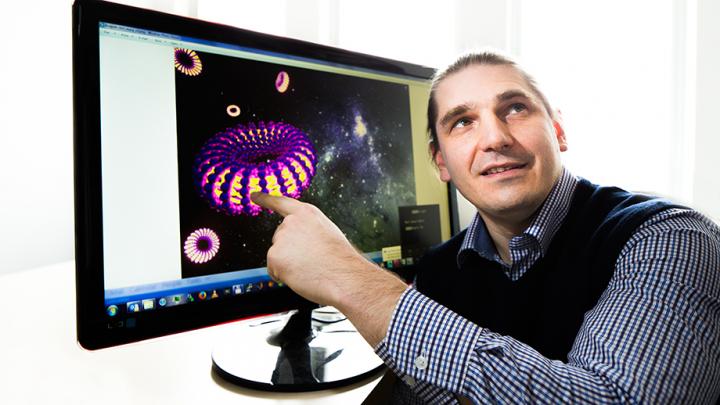
Dr Miroshnichenko, in collaboration with colleagues from Germany and Singapore, successfully tested his new theory with a single silicon nanodiscs between 160 and 310 nanometres in diameter and 50 nanometres high, which he was able to make effectively invisible by cancelling the disc's scattering of visible light.

This type of excitation is known as an anapole (from the Greek, 'without poles').

Dr Miroshnichenko's insight came while trying to reconcile differences between two different mathematical descriptions of radiation; one based on Cartesian multipoles and the other on vector spherical harmonics used in a Mie basis set.

"The two gave different answers, and they shouldn't. Eventually we realised the Cartesian description was missing the toroidal components," Dr Miroshnichenko said.

"We realised that these toroidal components were not just a correction, they could be a very significant factor."

Dr Miroshnichenko said the confined energy of anapoles could be important in the development of tiny lasers on the surface of materials, called spasers, and also in the creation of efficient X-ray lasers by high-order harmonic generation.

INFORMATION:


[Attachments] See images for this press release:
New theory leads to radiationless revolution New theory leads to radiationless revolution 2

ELSE PRESS RELEASES FROM THIS DATE:

CanDL database shines light on clinically important cancer gene mutations

2015-08-27
COLUMBUS, Ohio - Many clinical trials use genome sequencing to learn which gene mutations are present in a patient's tumor cells. The question is important because targeting the right mutations with the right drugs can stop cancer in its tracks. But it can be difficult to determine whether there is evidence in the medical literature that particular mutations might drive cancer growth and could be targeted by therapy, and which mutations are of no consequence. To help molecular pathologists, laboratory directors, bioinformaticians and oncologists identify key mutations ...

Study shows plant species' genetic responses to climate change

Study shows plant species genetic responses to climate change
2015-08-27
A study by the University of Liverpool has found that the genetic diversity of wild plant species could be altered rapidly by anthropogenic climate change. Scientists studied the genetic responses of different wild plant species, located in a natural grassland ecosystem near Buxton, to a variety of simulated climate change treatments--including drought, watering, and warming--over a 15-year period. Analysis of DNA markers in the plants revealed that the climate change treatments had altered the genetic composition of the plant populations. The results also indicated a ...

Political polarization on Twitter depends on the issue

2015-08-27
Twitter offers a public platform for people to post and share all sorts of content, from the serious to the ridiculous. While people tend to share political information with those who have similar ideological preferences, new research from NYU's Social Media and Political Participation Lab demonstrates that Twitter is more than just an "echo chamber." The research is published in Psychological Science, a journal of the Association for Psychological Science. "Platforms like Twitter or Facebook are creating unprecedented opportunities for citizens to communicate with ...

New strategy improves detection of genetic mutations in hereditary colorectal cancer

2015-08-27
Philadelphia, PA, August 27, 2015 - About 3% of colorectal cancers are due to Lynch syndrome, an inherited cancer susceptibility syndrome that predisposes individuals to various cancers. Close blood relatives of patients with Lynch syndrome have a 50% chance of inheritance. The role that PMS2 genetic mutations play in Lynch syndrome has been underestimated in part due to technological limitations. A new study in the Journal of Molecular Diagnostics describes a multi-method strategy to overcome existing technological limitations by more accurately identifying PMS2 gene mutations, ...

JBJS 'Watch' cites head-neck troubles with modular hip implants

2015-08-27
Needham, MA.-JBJS Case Connector, an online case report journal published by The Journal of Bone and Joint Surgery, has issued a "Watch" regarding relatively rare but potentially catastrophic complications from failure of modular head-neck prostheses commonly used in hip-replacement surgery. The arthroplasty community currently feels that the advantages gained from modularity in hip implants outweigh the risks, but this Watch raises that risk-benefit question again. The decision to issue the Watch was prompted by a case report by Swann et al. in the August 26, 2015 JBJS ...

Common 'heart attack' blood test may predict future hypertension

2015-08-27
Analysis of blood samples from more than 5,000 people suggests that a more sensitive version of a blood test long used to verify heart muscle damage from heart attacks could also identify people on their way to developing hypertension well before the so-called silent killer shows up on a blood pressure machine. Results of the federally funded study, led by Johns Hopkins investigators, found that people with subtle elevations in cardiac troponin T -- at levels well below the ranges detectable on the standard version of this "heart attack" test -- were more likely to be ...

Clinical trials of dogs with cancer could lead to better treatments for humans

2015-08-26
Dogs get cancer, too. And they have even fewer treatment options than their human owners do. But an article in Chemical & Engineering News (C&EN), the weekly newsmagazine of the American Chemical Society, offers a glimmer of hope. It explores how clinical trials on man's best friend could be a win-win for both dogs and people. Judith Lavelle, an intern at C&EN, notes that only a small percentage of potential human cancer drugs get approved by the U.S. Food and Drug Administration. Many of them fail when tested in people in clinical trials. A major reason for this late ...

This week from AGU: Mars' ice, Earth's mantle & 5 new research papers

2015-08-26
GeoSpace Terraced craters: Windows into Mars' icy past Just beneath Mars' dirt surface, or regolith, researchers found an enormous slab of water ice, measuring 40 meters (130 feet) thick, and covering an area equivalent to that of California and Texas combined, according to a new study published today in Geophysical Research Letters. Eos.org What lies deep in the mantle below? For decades, scientists have probed Earth's remote mantle by analyzing how seismic waves of distant earthquakes pass through it. But we are still challenged by the technique's limitations. New ...

Researchers reveal how a common mutation causes neurodegenerative disease

2015-08-26
WORCESTER, MA -- Researchers have determined how the most common gene mutation in amyotrophic lateral sclerosis (ALS) and frontotemporal dementia (FTD) disrupts normal cell function, providing insight likely to advance efforts to develop targeted therapies for these brain diseases. Scientists from the University of Massachusetts Medical School (UMMS) and St. Jude Children's Research Hospital led the research, which appeared in the science journal Nature. Investigators reported evidence that mutation of C9ORF72 interferes with the movement of RNAs and proteins into and ...

New survey on Americans' views on papal encyclical on climate change

2015-08-26
A new national survey conducted by The Associated Press-NORC Center for Public Affairs Research and researchers at Yale University found that fewer than 1 in 3 Americans, and 40 percent of Catholics, are aware of Pope Francis's efforts to publicize global warming as a priority issue for the Catholic Church. While there is relatively low awareness of the papal encyclical, a majority of Americans say it is appropriate for the pope to take a public position on the issue of global warming. This is true even though very few Americans consider global warming as an issue of religion, ...

LAST 30 PRESS RELEASES:

Effectiveness of exercise to ease osteoarthritis symptoms likely minimal and transient

Cost of copper must rise double to meet basic copper needs

A gel for wounds that won’t heal

Iron, carbon, and the art of toxic cleanup

Organic soil amendments work together to help sandy soils hold water longer, study finds

Hidden carbon in mangrove soils may play a larger role in climate regulation than previously thought

Weight-loss wonder pills prompt scrutiny of key ingredient

Nonprofit leader Diane Dodge to receive 2026 Penn Nursing Renfield Foundation Award for Global Women’s Health

Maternal smoking during pregnancy may be linked to higher blood pressure in children, NIH study finds

New Lund model aims to shorten the path to life-saving cell and gene therapies

Researchers create ultra-stretchable, liquid-repellent materials via laser ablation

Combining AI with OCT shows potential for detecting lipid-rich plaques in coronary arteries

SeaCast revolutionizes Mediterranean Sea forecasting with AI-powered speed and accuracy

JMIR Publications’ JMIR Bioinformatics and Biotechnology invites submissions on Bridging Data, AI, and Innovation to Transform Health

Honey bees navigate more precisely than previously thought

Air pollution may directly contribute to Alzheimer’s disease

Study finds early imaging after pediatric UTIs may do more harm than good

UC San Diego Health joins national research for maternal-fetal care

New biomarker predicts chemotherapy response in triple-negative breast cancer

Treatment algorithms featured in Brain Trauma Foundation’s update of guidelines for care of patients with penetrating traumatic brain injury

Over 40% of musicians experience tinnitus; hearing loss and hyperacusis also significantly elevated

Artificial intelligence predicts colorectal cancer risk in ulcerative colitis patients

Mayo Clinic installs first magnetic nanoparticle hyperthermia system for cancer research in the US

Calibr-Skaggs and Kainomyx launch collaboration to pioneer novel malaria treatments

JAX-NYSCF Collaborative and GSK announce collaboration to advance translational models for neurodegenerative disease research

Classifying pediatric brain tumors by liquid biopsy using artificial intelligence

Insilico Medicine initiates AI driven collaboration with leading global cancer center to identify novel targets for gastroesophageal cancers

Immunotherapy plus chemotherapy before surgery shows promise for pancreatic cancer

A “smart fluid” you can reconfigure with temperature

New research suggests myopia is driven by how we use our eyes indoors

[Press-News.org] New theory leads to radiationless revolution
Physicists have found a radical new way confine electromagnetic energy without it leaking away, akin to throwing a pebble into a pond with no splash