New starfish-like fossil reveals evolution in action
Published 2021-01-21 · Original archive entry · Explore research explainers
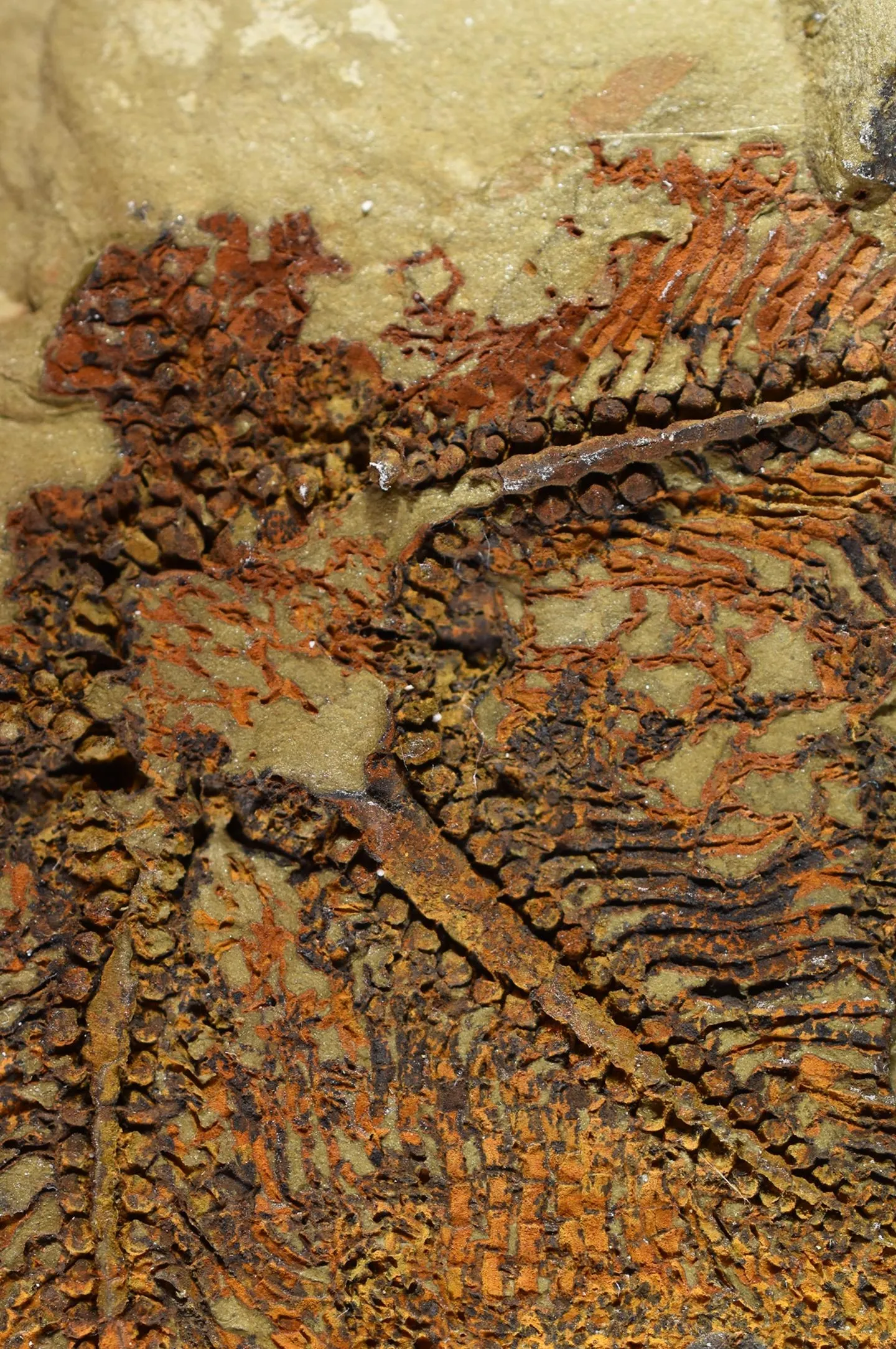
Researchers from the University of Cambridge have discovered a fossil of the earliest starfish-like animal, which helps us understand the origins of the nimble-armed creature.
The prototype starfish, which has features in common with both sea lilies and modern-day starfish, is a missing link for scientists trying to piece together its early evolutionary history.
The exceptionally preserved fossil, named Cantabrigiaster fezouataensis, was discovered in Morroco's Anti-Atlas mountain range. Its intricate design - with feathery arms akin to a lacework - has been frozen in time for roughly 480 million years.
The new species is unusual because it doesn't have many of the key features of its contemporary relatives, lacking roughly 60% of a modern starfish's body plan. The fossil's features are instead a hybrid between those of a starfish and a sea lily or crinoid - not a plant but a wavy-armed filter feeder which fixes itself to the seabed via a cylindrical 'stem'.
The discovery, reported in Biology Letters, captures the early evolutionary steps of the animal at a time in Earth's history when life suddenly expanded, a period known as the Ordovician Biodiversification Event.
The find also means scientists can now use the new find as a template to work out how it evolved from this more basic form to the complexity of their contemporaries.
"Finding this missing link to their ancestors is incredibly exciting. If you went back in time and put your head under the sea in the Ordovician then you wouldn't recognize any of the marine organisms - except the starfish, they are one of the first modern animals," said lead author Dr Aaron Hunter, a visiting postdoctoral researcher in the Department of Earth Sciences.
Modern starfish and brittle stars are part of a family of spiny-skinned animals called the echinoderms which, although they don't have a backbone, are one of the closest group of animals to vertebrates. Crinoids, and otherworldly creatures like the sea urchins and sea cucumbers are all echinoderms.
The origin of starfish has eluded scientists for decades. But the new species is so well preserved that its body can finally be mapped in detail and its evolution understood. "The level of detail in the fossil is amazing - its structure is so complex that it took us a while to unravel its significance," said Hunter.
It was Hunter's work on both living and fossil echinoderms that helped him spot its hybrid features. "I was looking at a modern crinoid in one of the collections at the Western Australian Museum and I realised the arms looked really familiar, they reminded me of this unusual fossil that I had found years earlier in Morocco but had found difficult to work with," he said.
Fezouata in Morocco is something of a holy grail for palaeontologists - the new fossil is just one of the many remarkably well preserved soft-bodied animals uncovered from the site.
Hunter and co-author Dr Javier Ortega-Hernández, who was previously based at Cambridge's Department of Zoology and is now based at Harvard University, named the species Cantabrigiaster in honour of the long history of echinoderm research at their respective institutions.
Hunter and Ortega-Hernández examined their new species alongside a catalogue of hundreds starfish-like animals. They indexed all of their body structures and features, building a road map of the echinoderm skeleton which they could use to assess how Cantabrigiaster was related to other family members.
Modern echinoderms come in many shapes and sizes, so it can be difficult to work out how they are related to one another. The new analysis, which uses extra-axial theory - a biology model usually only applied to living species - meant that Hunter and Ortega-Hernández could identify similarities and differences between the body plan of modern echinoderms and then figure out how each family member was linked to their Cambrian ancestors.
They found that only the key or axial part of the body, the food groove - which funnels food along each of the starfish's arms - was present in Cantabrigiaster. Everything outside this, the extra-axial body parts, were added later.
The authors plan to expand their work in search of early echinoderms. "One thing we hope to answer in the future is why starfish developed their five arms," said Hunter. "It seems to be a stable shape for them to adopt - but we don't yet know why. We still need to keep searching for the fossil that gives us that particular connection, but by going right back to the early ancestors like Cantabrigiaster we are getting closer to that answer."
The prototype starfish, which has features in common with both sea lilies and modern-day starfish, is a missing link for scientists trying to piece together its early evolutionary history.
The exceptionally preserved fossil, named Cantabrigiaster fezouataensis, was discovered in Morroco's Anti-Atlas mountain range. Its intricate design - with feathery arms akin to a lacework - has been frozen in time for roughly 480 million years.
The new species is unusual because it doesn't have many of the key features of its contemporary relatives, lacking roughly 60% of a modern starfish's body plan. The fossil's features are instead a hybrid between those of a starfish and a sea lily or crinoid - not a plant but a wavy-armed filter feeder which fixes itself to the seabed via a cylindrical 'stem'.
The discovery, reported in Biology Letters, captures the early evolutionary steps of the animal at a time in Earth's history when life suddenly expanded, a period known as the Ordovician Biodiversification Event.
The find also means scientists can now use the new find as a template to work out how it evolved from this more basic form to the complexity of their contemporaries.
"Finding this missing link to their ancestors is incredibly exciting. If you went back in time and put your head under the sea in the Ordovician then you wouldn't recognize any of the marine organisms - except the starfish, they are one of the first modern animals," said lead author Dr Aaron Hunter, a visiting postdoctoral researcher in the Department of Earth Sciences.
Modern starfish and brittle stars are part of a family of spiny-skinned animals called the echinoderms which, although they don't have a backbone, are one of the closest group of animals to vertebrates. Crinoids, and otherworldly creatures like the sea urchins and sea cucumbers are all echinoderms.
The origin of starfish has eluded scientists for decades. But the new species is so well preserved that its body can finally be mapped in detail and its evolution understood. "The level of detail in the fossil is amazing - its structure is so complex that it took us a while to unravel its significance," said Hunter.
It was Hunter's work on both living and fossil echinoderms that helped him spot its hybrid features. "I was looking at a modern crinoid in one of the collections at the Western Australian Museum and I realised the arms looked really familiar, they reminded me of this unusual fossil that I had found years earlier in Morocco but had found difficult to work with," he said.
Fezouata in Morocco is something of a holy grail for palaeontologists - the new fossil is just one of the many remarkably well preserved soft-bodied animals uncovered from the site.
Hunter and co-author Dr Javier Ortega-Hernández, who was previously based at Cambridge's Department of Zoology and is now based at Harvard University, named the species Cantabrigiaster in honour of the long history of echinoderm research at their respective institutions.
Hunter and Ortega-Hernández examined their new species alongside a catalogue of hundreds starfish-like animals. They indexed all of their body structures and features, building a road map of the echinoderm skeleton which they could use to assess how Cantabrigiaster was related to other family members.
Modern echinoderms come in many shapes and sizes, so it can be difficult to work out how they are related to one another. The new analysis, which uses extra-axial theory - a biology model usually only applied to living species - meant that Hunter and Ortega-Hernández could identify similarities and differences between the body plan of modern echinoderms and then figure out how each family member was linked to their Cambrian ancestors.
They found that only the key or axial part of the body, the food groove - which funnels food along each of the starfish's arms - was present in Cantabrigiaster. Everything outside this, the extra-axial body parts, were added later.
The authors plan to expand their work in search of early echinoderms. "One thing we hope to answer in the future is why starfish developed their five arms," said Hunter. "It seems to be a stable shape for them to adopt - but we don't yet know why. We still need to keep searching for the fossil that gives us that particular connection, but by going right back to the early ancestors like Cantabrigiaster we are getting closer to that answer."
INFORMATION: