Younger Tyrannosaurus Rex bites were less ferocious than their adult counterparts
"Based on biomechanical data, we presume that they pursued smaller prey and fulfilled an environmental role similar to the 'raptor' dinosaurs such as the dromaeosaurs. Adult tyrannosaurs were likely subduing large dinosaurs such as the duckbilled hadrosaurs and Triceratops, which would be quickly killed by their bone-crunching bite.
"This study illustrates the importance of 3D modeling and computational studies in vertebrate paleontology - the methodology we used in our study can be applied to many different groups of extinct animals so that we can better understand how they adapted to their respective environments."
There are two major components of this research that Andre and the team would like to see future researchers delve into continued CT and surface scanning of dinosaur cranial material and more application of 3D models in dinosaur biomechanics research.
Andre added: "There remains a plethora of unearthed dinosaur material that has not been utilized in studies of feeding and function - ideally, all of our existing specimens will one day be scanned and made widely available online to researchers everywhere.
"The current lack of 3D model availability is noticeable in dinosaur research; relatively few studies involving 3D models of carnivorous dinosaurs have been published thus far. There is still much work to be done concerning skull function in all extinct animals - not only dinosaurs."
INFORMATION:
Paper:
'Biomechanics of juvenile tyrannosaurid mandibles and their implications for bite force' by A. Rowe and E. Snively in The Anatomical Record
The Anatomical Record: Advances in Integrative Anatomy and Evolutionary Biology, an official publication of the American Association for Anatomy, publishes new discoveries in the morphological aspects of molecular, cellular, systems, and evolutionary biology.
Images:
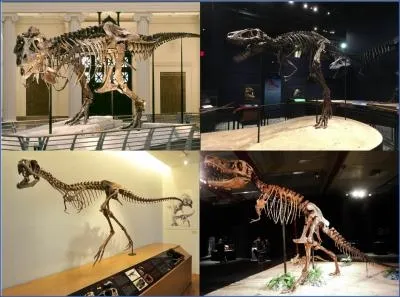
Skeletons of four tyrannosaurid specimens tested in the study. Clockwise from above left: adult Tyrannosaurus rex "Sue" (FMNH PR 2081) (Field Museum of Natural History, Chicago, IL; photo by the Field Museum), juvenile Tyrannosaurus rex "Jane" (BMRP 2002.4.1) (Burpee Museum of Natural History; photo by A. Rowe), adult Tarbosaurus bataar (Dinosaurium exhibition, Prague, Czech Republic; photo by R. Holiš) and Raptorex kriegsteini skeletal reconstruction (LH PV18) (Long Hao Institute of Geology and Paleontology, Hohhot, Inner Mongolia, China; photo by P. Sereno). Credits: Listed in caption. Final image by Andre Rowe.
https://fluff.bris.ac.uk/fluff/u1/rc16966/VTa9xR75YMD8xquzh756uAzfs/
Finite element analysis results for an adult Tyrannosaurus rex (FMNH PR 2081) jaw demonstrating a range of biting stresses. Blue and green (cool colors) denote the lowest amount of stresses experienced whereas red and white (hot colors) display the highest. Analyses were performed on all tyrannosaurid specimens in the engineering software Strand7. Credit: Andre Rowe.
https://fluff.bris.ac.uk/fluff/u3/rc16966/vNXytj0mFsk4QBBbfZUU5wzff/
Lateral mandible views (from top to bottom) of Raptorex kriegsteini (LH PV18), juvenile T. rex (BMRP 2002.4.1), and adult T. rex (FMNH PR 2081), illustrating differences in jaw form and stresses during tyrannosaur development. Units are in mega pascals (MPa). Credit: Andre Rowe
https://fluff.bris.ac.uk/fluff/u2/rc16966/QiJIi5_WWruyFKreWWC_Tgzf6/
Issued by the University of Bristol Media and PR Team on Thursday 4 March 2021. For more information email press-office@bristol.ac.uk