PRESS-NEWS.org - Press Release Distribution
PRESS RELEASES DISTRIBUTION

Remote control for quantum emitters

Novel approach could become a asset in quantum computers and quantum simulation

Remote control for quantum emitters
2021-03-12
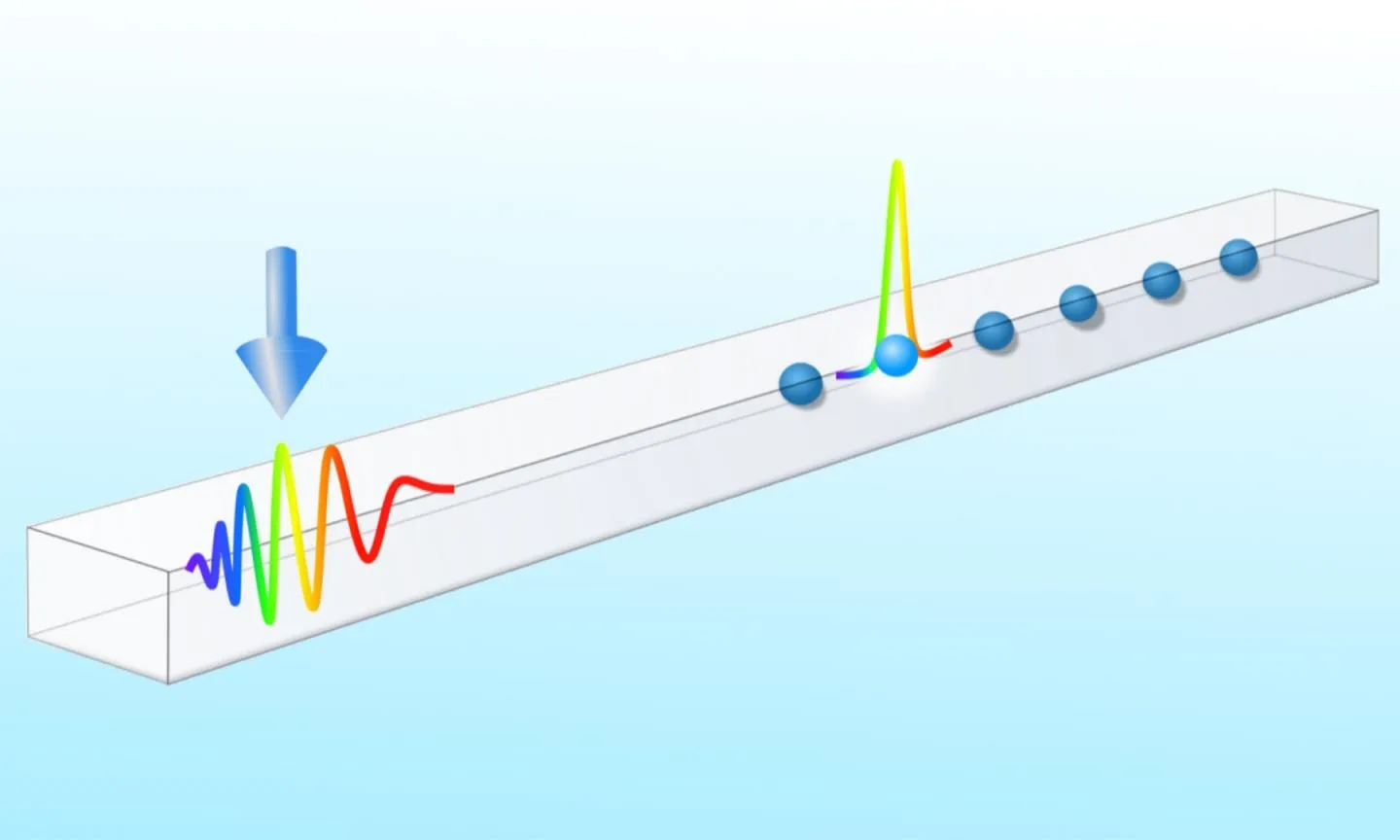
(Press-News.org) In order to exploit the properties of quantum physics technologically, quantum objects and their interaction must be precisely controlled. In many cases, this is done using light. Researchers at the University of Innsbruck and the Institute of Quantum Optics and Quantum Information (IQOQI) of the Austrian Academy of Sciences have now developed a method to individually address quantum emitters using tailored light pulses. "Not only is it important to individually control and read the state of the emitters," says Oriol Romero-Isart, "but also to do so while leaving the system as undisturbed as possible." Together with Juan Jose? Garci?a-Ripoll (IQOQI visiting fellow) from the Instituto de Fi?sica Fundamental in Madrid, Romero-Isart's research group has now investigated how specifically engineered pulses can be used to focus light on a single quantum emitter.

Self-compressing light pulse

"Our proposal is based on chirped light pulses," explains Silvia Casulleras, first author of the research paper. "The frequency of these light pulses is time-dependent." So, similar to the chirping of birds, the frequency of the signal changes over time. In structures with certain electromagnetic properties - such as waveguides - the frequencies propagate at different speeds. "If you set the initial conditions of the light pulse correctly, the pulse compresses itself at a certain distance," explains Patrick Maurer from the Innsbruck team. "Another important part of our work was to show that the pulse enables the control of individual quantum emitters." This approach can be used as a kind of remote control to address, for example, individual superconducting quantum bits in a waveguide or atoms near a photonic crystal.

Wide range of applications

In their work, now published in Physical Review Letters, the scientists show that this method works not only with light or electromagnetic pulses, but also with other waves such as lattice oscillations (phonons) or magnetic excitations (magnons). The research group led by the Innsbruck experimental physicist Gerhard Kirchmair, wants to implement the concept for superconducting qubits in the laboratory in close collaboration with the team of theorists.

INFORMATION:

The research was financially supported by the European Union.


[Attachments] See images for this press release:
Remote control for quantum emitters

ELSE PRESS RELEASES FROM THIS DATE:

Clemson researchers' breakthrough featured in Nature Communications

Clemson researchers breakthrough featured in Nature Communications
2021-03-12
CLEMSON, South Carolina -- By using laser spectroscopy in a photophysics experiment, Clemson University researchers have broken new ground that could result in faster and cheaper energy to power electronics. This novel approach, using solution-processed perovskite, is intended to revolutionize a variety of everyday objects such as solar cells, LEDs, photodetectors for smart phones and computer chips. Solution-processed perovskite are the next generation materials for solar cell panels on rooftops, X-ray detectors for medical diagnosis, and LEDs for daily-life lighting. The research team included ...

Multiyear workplace health promotion program shown to prevent health risks

Multiyear workplace health promotion program shown to prevent health risks
2021-03-12
A multiyear workplace health promotion program can slow down the increase in health risks for working-age people. A study by the Faculty of Sport and Health Sciences at the University of Jyväskylä followed what kind of changes happened among participants during an eight-year workplace health promotion program in smoking, minor exercise, high blood pressure, musculoskeletal disorders, and overweight. The results of the study were encouraging for health promotion. According to earlier studies, a high number of health risks are connected to an increase in occupational health care costs, lower productivity at work, and the growing number of sickness ...

Study provides insights into architecture of abnormal protein deposits in brain disorders

2021-03-12
CLEVELAND--Scientists at the Case Western Reserve University School of Medicine have determined the structure of protein "fibrils" linked to Lou Gehrig's disease and other neurodegenerative disorders--findings that provide clues to how toxic proteins clump and spread between nerve cells in the brain. Their results may also lead to developing drugs to treat diseases such as amyotrophic lateral sclerosis (ALS) and frontotemporal dementia (FTD). "These devastating brain disorders that affect tens of thousands of Americans?are on the rise worldwide, and there are no effective treatments to ...

Controlled by light alone, new smart materials twist, bend and move

2021-03-12
Researchers at Tufts University School of Engineering have created light-activated composite devices able to execute precise, visible movements and form complex three-dimensional shapes without the need for wires or other actuating materials or energy sources. The design combines programmable photonic crystals with an elastomeric composite that can be engineered at the macro and nano scale to respond to illumination. The research provides new avenues for the development of smart light-driven systems such as high-efficiency, self-aligning solar cells that automatically follow the sun's direction and angle of light, light-actuated microfluidic valves or soft robots that move with light on demand. A "photonic sunflower," whose petals curl ...

Accurate aging of wild animals thanks to first epigenetic clock for bats

Accurate aging of wild animals thanks to first epigenetic clock for bats
2021-03-12
A new study led by University of Maryland and UCLA researchers found that DNA from tissue samples can be used to accurately predict the age of bats in the wild. The study also showed age-related changes to the DNA of long-lived species are different from those in short-lived species, especially in regions of the genome near genes associated with cancer and immunity. This work provides new insight into causes of age-related declines. This is the first research paper to show that animals in the wild can be accurately aged using an epigenetic clock, which predicts age based on specific changes to DNA. This work ...

Shutting the nano-gate

Shutting the nano-gate
2021-03-12
Osaka, Japan - Scientists from the Institute of Scientific and Industrial Research at Osaka University fabricated nanopores in silicon dioxide, that were only 300 nm, in diameter surrounded by electrodes. These nanopores could prevent particles from entering just by applying a voltage, which may permit the development of sensors that can detect very small concentrations of target molecules, as well as next-generation DNA sequencing technology. Nanopores are tiny holes that are wide enough for just a single molecule or particle to pass through. The motion of nanoparticles through these holes ...

Experts recreate a mechanical Cosmos for the world's first computer

2021-03-12
Researchers at UCL have solved a major piece of the puzzle that makes up the ancient Greek astronomical calculator known as the Antikythera Mechanism, a hand-powered mechanical device that was used to predict astronomical events. Known to many as the world's first analogue computer, the Antikythera Mechanism is the most complex piece of engineering to have survived from the ancient world. The 2,000-year-old device was used to predict the positions of the Sun, Moon and the planets as well as lunar and solar eclipses. Published in Scientific Reports, the paper from the multidisciplinary UCL Antikythera Research Team reveals a new display ...

RNA editing protein ADAR1 protects telomeres and supports proliferation in cancer cells

RNA editing protein ADAR1 protects telomeres and supports proliferation in cancer cells
2021-03-12
PHILADELPHIA -- (March 12, 2021) -- Scientists at The Wistar Institute identified a new function of ADAR1, a protein responsible for RNA editing, discovering that the ADAR1p110 isoform regulates genome stability at chromosome ends and is required for continued proliferation of cancer cells. These findings, reported in Nature Communications, reveal an additional oncogenic function of ADAR1 and reaffirm its potential as a therapeutic target in cancer. The lab of Kazuko Nishikura, Ph.D., professor in the Gene Expression & Regulation Program of The Wistar Institute Cancer Center, was one of the first to discover ADAR1 in mammalian cells and to characterize the process of RNA editing ...

Natural "brake" against malignant neuroblastoma

Natural brake against malignant neuroblastoma
2021-03-12
A factor that turns malignant tumors into benign ones? - That is exactly what scientists at St. Anna Children's Cancer Research Institute have discovered. Together with colleagues from the Medical University of Vienna and the University of Vienna (Faculty of Chemistry), they studied tumors of the peripheral nervous system in children, namely neuroblastomas. The scientists discovered that the uncontrolled growth of benign neuroblastomas is stopped by a signal molecule produced by Schwann cells present within these tumors. This natural "brake" also works on malignant neuroblastoma ...

Breast cancer: The risks of brominated flame retardants

Breast cancer: The risks of brominated flame retardants
2021-03-12
Brominated flame retardants (BFRs) are found in furniture, electronics, and kitchenware to slow the spread of flames in the event of a fire. However, it has been shown that these molecules may lead to early mammary gland development, which is linked to an increased risk of breast cancer. The study on the subject by Professor Isabelle Plante from the Institut national de la recherche scientifique (INRS) made the cover of the February issue of the journal Toxicological Sciences. Part of the flame retardants are considered to be endocrine disruptors, i.e. they interfere with the hormonal system. Since they are not directly bound to the material in which they are added, the molecules escape easily. They are then found in house ...

LAST 30 PRESS RELEASES:

Maternal perinatal depression may increase the risk of autistic-related traits in girls

Study: Blocking a key protein may create novel form of stress in cancer cells and re-sensitize chemo-resistant tumors

HRT via skin is best treatment for low bone density in women whose periods have stopped due to anorexia or exercise, says study

Insilico Medicine showcases at WHX 2026: Connecting the Middle East with global partners to accelerate translational research

From rice fields to fresh air: Transforming agricultural waste into a shield against indoor pollution

University of Houston study offers potential new targets to identify, remediate dyslexia

Scientists uncover hidden role of microalgae in spreading antibiotic resistance in waterways

Turning orange waste into powerful water-cleaning material

Papadelis to lead new pediatric brain research center

Power of tiny molecular 'flycatcher' surprises through disorder

Before crisis strikes — smartwatch tracks triggers for opioid misuse

Statins do not cause the majority of side effects listed in package leaflets

UC Riverside doctoral student awarded prestigious DOE fellowship

UMD team finds E. coli, other pathogens in Potomac River after sewage spill

New vaccine platform promotes rare protective B cells

Apes share human ability to imagine

Major step toward a quantum-secure internet demonstrated over city-scale distance

Increasing toxicity trends impede progress in global pesticide reduction commitments

Methane jump wasn’t just emissions — the atmosphere (temporarily) stopped breaking it down

Flexible governance for biological data is needed to reduce AI’s biosecurity risks

Increasing pesticide toxicity threatens UN goal of global biodiversity protection by 2030

How “invisible” vaccine scaffolding boosts HIV immune response

Study reveals the extent of rare earthquakes in deep layer below Earth’s crust

Boston College scientists help explain why methane spiked in the early 2020s

Penn Nursing study identifies key predictors for chronic opioid use following surgery

KTU researcher’s study: Why Nobel Prize-level materials have yet to reach industry

Research spotlight: Interplay of hormonal contraceptive use, stress and cardiovascular risk in women

Pennington Biomedical’s Dr. Catherine Prater awarded postdoctoral fellowship from the American Heart Association

AI agents debate more effectively when given personalities and the ability to interrupt

Tenecteplase for acute non–large vessel occlusion 4.5 to 24 hours after ischemic stroke

[Press-News.org] Remote control for quantum emitters
Novel approach could become a asset in quantum computers and quantum simulation