A simple model of development reveals shapes of cell lineages and links to regeneration
The model predicts that contrary to belief, cell-lineage maps are unlikely to be tree-like
Published 2021-06-07 · Original archive entry · Explore research explainers
Various forms of complex multicellular organisms have evolved on Earth, ranging from simple Volvox carterii which possess only 2 cell- types to us humans with more than 200 cell types. All originate from a single celled zygote, and their developmental processes depend on switch-like gene regulation. These processes have been studied in great detail within a few model organisms such as the worm C. elegans, and the fruit fly D. melanogaster. It is also known that the key molecules and mechanisms that are involved in the development of multicellular organisms are highly conserved across species.
What is also remarkable is that only a handful of molecules and mechanisms that go into the development of a multicellular organism can generate such a huge diversity of forms and complexity. Recently, researchers from the Center for Soft and Living Matter within the Institute for Basic Science investigated how this is possible using a simple mathematical model. Through this work, they sought to answer two seemingly opposite questions: what are the limits of diversity that can be generated through development, and what common features are shared among all multicellular organisms during their development.
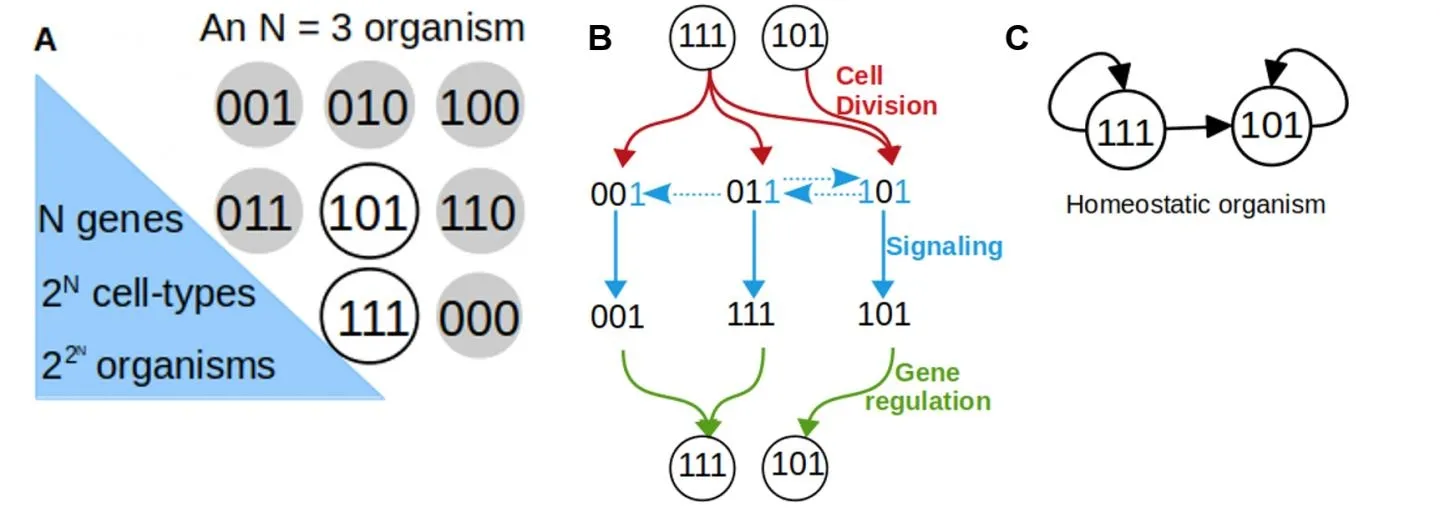
Three processes are common to biological development in all multicellular organisms: cell division, cellular signaling, and gene regulation. As such, this study's model generated millions of these rules and explored them in an unbiased way. The mappings generated by the model represent how one cell type converts into another during the lifetime of the organism. Traditionally, previous cell type maps based on single-cell transcriptomics are biased to be tree-like, with stem cells sitting at the root of the tree, and increasingly more specialized cells appearing downstream along the branches of the tree. However, the cell-type maps produced by the new mathematical model were far from tree-like; it was found that there were many cross-links between different branches of the cell types. These resulted in directed acyclic graphs, and tree lineages were found to be the least prevalent. This means that it is possible for multiple developmental routes to converge on the terminal cell type in the maps generated by the model.
Surprisingly, it was also found that many organisms produced by the mathematical model were endowed with the ability to regenerate lost cells, without any selection imposed by the authors. When a single cell type is isolated from the adult organism, single cell could transform into and replenish all the other cell types. This ability to generate all the cells of the body is called pluripotency, and these cells granted the organisms in the model the ability of whole-body regeneration. Interestingly, most tree-type lineages contained few pluripotent cells, in comparison to other graph types.
While mammals, including humans, are especially bad at regenerating damaged parts, many animals such as worms and hydra, are exceptionally good at this ability. In fact, whole-body regeneration occurs widely across the multicellular animal tree of life, and therefore it has been hypothesized that whole-body regeneration could be an epiphenomenon of biological development itself. The fact that pluripotency occurred in this very simplified model suggests that this trait is indeed likely to emerge due to the process of development itself, and no special extra components are required to put it in place.
In addition to these results, it is anticipated that the framework of this model can be used to study many more aspects of development. This generative model is simple and modular, and it can be easily expanded to explore important processes which were not included in the present study, such as the effect of the spatial arrangement of cells and the effect of cell death. The researchers further described some possible real-life experiments to test some of the predictions made by their mathematical model. It is hoped that the framework of this model will prove useful for uncovering new features of development, which may have a wide range of implications in developmental biology and regenerative medicine.
What is also remarkable is that only a handful of molecules and mechanisms that go into the development of a multicellular organism can generate such a huge diversity of forms and complexity. Recently, researchers from the Center for Soft and Living Matter within the Institute for Basic Science investigated how this is possible using a simple mathematical model. Through this work, they sought to answer two seemingly opposite questions: what are the limits of diversity that can be generated through development, and what common features are shared among all multicellular organisms during their development.
Three processes are common to biological development in all multicellular organisms: cell division, cellular signaling, and gene regulation. As such, this study's model generated millions of these rules and explored them in an unbiased way. The mappings generated by the model represent how one cell type converts into another during the lifetime of the organism. Traditionally, previous cell type maps based on single-cell transcriptomics are biased to be tree-like, with stem cells sitting at the root of the tree, and increasingly more specialized cells appearing downstream along the branches of the tree. However, the cell-type maps produced by the new mathematical model were far from tree-like; it was found that there were many cross-links between different branches of the cell types. These resulted in directed acyclic graphs, and tree lineages were found to be the least prevalent. This means that it is possible for multiple developmental routes to converge on the terminal cell type in the maps generated by the model.
Surprisingly, it was also found that many organisms produced by the mathematical model were endowed with the ability to regenerate lost cells, without any selection imposed by the authors. When a single cell type is isolated from the adult organism, single cell could transform into and replenish all the other cell types. This ability to generate all the cells of the body is called pluripotency, and these cells granted the organisms in the model the ability of whole-body regeneration. Interestingly, most tree-type lineages contained few pluripotent cells, in comparison to other graph types.
While mammals, including humans, are especially bad at regenerating damaged parts, many animals such as worms and hydra, are exceptionally good at this ability. In fact, whole-body regeneration occurs widely across the multicellular animal tree of life, and therefore it has been hypothesized that whole-body regeneration could be an epiphenomenon of biological development itself. The fact that pluripotency occurred in this very simplified model suggests that this trait is indeed likely to emerge due to the process of development itself, and no special extra components are required to put it in place.
In addition to these results, it is anticipated that the framework of this model can be used to study many more aspects of development. This generative model is simple and modular, and it can be easily expanded to explore important processes which were not included in the present study, such as the effect of the spatial arrangement of cells and the effect of cell death. The researchers further described some possible real-life experiments to test some of the predictions made by their mathematical model. It is hoped that the framework of this model will prove useful for uncovering new features of development, which may have a wide range of implications in developmental biology and regenerative medicine.
INFORMATION: