PRESS-NEWS.org - Press Release Distribution
PRESS RELEASES DISTRIBUTION

Australian researchers create quantum microscope that can see the impossible

Australian researchers create quantum microscope that can see the impossible
2021-06-09
(Press-News.org) In a major scientific leap, University of Queensland researchers have created a quantum microscope that can reveal biological structures that would otherwise be impossible to see.

This paves the way for applications in biotechnology, and could extend far beyond this into areas ranging from navigation to medical imaging.

The microscope is powered by the science of quantum entanglement, an effect Einstein described as "spooky interactions at a distance".

Professor Warwick Bowen, from UQ's Quantum Optics Lab and the ARC Centre of Excellence for Engineered Quantum Systems (EQUS), said it was the first entanglement-based sensor with performance beyond the best possible existing technology.

"This breakthrough will spark all sorts of new technologies - from better navigation systems to better MRI machines, you name it," Professor Bowen said.

"Entanglement is thought to lie at the heart of a quantum revolution.

"We've finally demonstrated that sensors that use it can supersede existing, non-quantum technology.

"This is exciting - it's the first proof of the paradigm-changing potential of entanglement for sensing."

Australia's Quantum Technologies Roadmap sees quantum sensors spurring a new wave of technological innovation in healthcare, engineering, transport and resources.

A major success of the team's quantum microscope was its ability to catapult over a 'hard barrier' in traditional light-based microscopy.

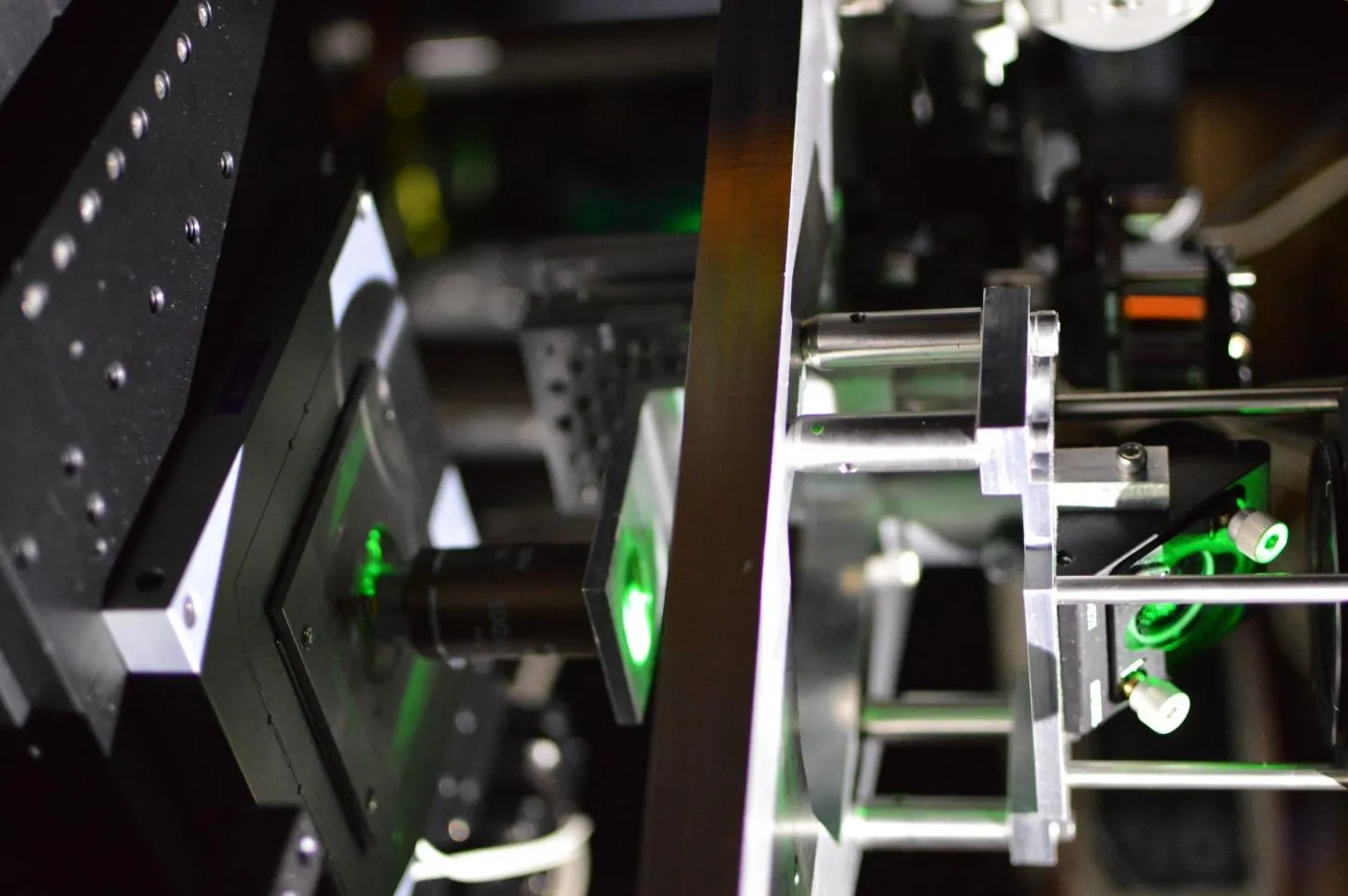
UQ team researchers (counter-clockwise from bottom-left) Caxtere Casacio, Warwick Bowen, Lars Madsen and Waleed Muhammad aligning the quantum microscope.

"The best light microscopes use bright lasers that are billions of times brighter than the sun," Professor Bowen said.

"Fragile biological systems like a human cell can only survive a short time in them and this is a major roadblock.

"The quantum entanglement in our microscope provides 35 per cent improved clarity without destroying the cell, allowing us to see minute biological structures that would otherwise be invisible.

"The benefits are obvious - from a better understanding of living systems, to improved diagnostic technologies."

Professor Bowen said there were potentially boundless opportunities for quantum entanglement in technology.

"Entanglement is set to revolutionise computing, communication and sensing," he said.

"Absolutely secure communication was demonstrated some decades ago as the first demonstration of absolute quantum advantage over conventional technologies.

"Computing faster than any possible conventional computer was demonstrated by Google two years ago, as the first demonstration of absolute advantage in computing.

"The last piece in the puzzle was sensing, and we've now closed that gap.

"This opens the door for some wide-ranging technological revolutions."

INFORMATION:

The research was supported by the United States Air Force Office of Scientific Research and the Australian Research Council. It is published in Nature (DOI: 10.1038/s41586-021-03528-w).


[Attachments] See images for this press release:
Australian researchers create quantum microscope that can see the impossible

ELSE PRESS RELEASES FROM THIS DATE:

Assessing feasibility concerns in climate mitigation scenarios

2021-06-09
While the IPCC is in the midst of the drafting cycle of the Sixth Assessment Report, whose publication will start in the second half of 2021 - one of the most relevant events for the global climate change community, there is an ongoing debate on how to assess the feasibility of ambitious climate mitigation scenarios developed through integrated assessment models and to what extent they are actually achievable in the real world. In their new study published in Environmental Research Letters, researchers from the RFF-CMCC European Institute on Economics and the Environment (EIEE) and IIASA developed a systematic ...

Are social, behavioral risk factors associated with mortality among us veterans with COVID-19?

2021-06-09
What The Study Did: An observational study of more than 27,000 veterans who received a positive test result for COVID-19 reports that risk factors such as housing problems, financial hardship, alcohol use, tobacco use and substance use weren't associated with higher mortality. Authors: J. Daniel Kelly, M.D., M.P.H., of the University of California, San Francisco, is the corresponding author. To access the embargoed study: Visit our For The Media website at this link https://media.jamanetwork.com/ (doi:10.1001/jamanetworkopen.2021.13031) Editor's Note: The article includes funding/support disclosures. Please ...

Association of rideshare use with alcohol-associated motor vehicle crash trauma

2021-06-09
What The Study Did: This study looked at whether there was an association between rideshare use, motor vehicle crash traumas and impaired driving convictions in Houston, Texas, by comparing traumas and convictions before and after the introduction of Uber. Authors: Christopher R. Conner, M.D., Ph.D., of the McGovern Medical School at the University of Texas Health Science Center at Houston, is the corresponding author. To access the embargoed study: Visit our For The Media website at this link https://media.jamanetwork.com/ (doi:10.1001/jamasurg.2021.2227) Editor's Note: The article includes funding/support disclosures. Please see the article for additional information, including other authors, ...

COVID vaccine linked to low platelet count, nationwide study suggests

2021-06-09
A condition that affects the blood, known as idiopathic thrombocytopenic purpura (ITP), may be associated the Oxford-AstraZeneca vaccine in rare cases, research suggests. The very small increased risk of the condition - which is characterised by low platelet counts - is estimated to be 11 per million doses, similar to figures seen in vaccines for flu and MMR. A low number of platelets - blood cells that help prevent blood loss when vessels are damaged - can result in no symptoms or can lead to an increased risk of bleeding or, in some cases, clotting. Researchers say that the increased chance of developing ITP after receiving the vaccine remains smaller than the risk of developing it because of Covid-19 and should ...

An atomic look at lithium-rich batteries

An atomic look at lithium-rich batteries
2021-06-09
Batteries have come a long way since Volta first stacked copper and zinc discs together 200 years ago. While the technology has continued to evolve from lead-acid to lithium-ion, many challenges still exist--like achieving higher density and suppressing dendrite growth. Experts are racing to address the growing, global need for energy-efficient and safe batteries. The electrification of heavy-duty vehicles and aircraft requires batteries with more energy density. A team of researchers believes a paradigm shift is necessary to make a significant impact in battery technology for these industries. ...

Meiosis: Mind the gap

Meiosis: Mind the gap
2021-06-09
Scientists from the lab of Franz Klein from the Department of Chromosome Biology at the Max Perutz Labs, a joint venture of the University of Vienna and the Medical University of Vienna, have now discovered that cells sometimes liberate DNA fragments at sites of paired, or double, DSBs. Whilst this presents an obvious risk of germline mutations as a consequence of erroneous repair or of integration of fragments from elsewhere at break sites, it may also be a source of evolutionary diversity. The study is published as a research article in Nature. Genetic information in humans is encoded in 23 chromosome pairs, where one pair consists of two slightly different copies or homologs. One is inherited from the father and one from the mother. Human gametes, however, are haploid - they start ...

Innovation projects can reinvent the UN

2021-06-09
Researchers at the University of Geneva (UNIGE) demonstrate that innovative projects spearheaded by United Nations (UN) country offices are remodeling the institution and expanding its role. Digital initiatives, particularly those scaled through headquarters, were shown to have the strongest impact, changing ways of working, embedding new skills, and restructuring teams across the UN. These findings, published in the Journal of Management Studies, highlight that fostering even single innovative projects could lead to fundamental transformations in the UN. How do International Organizations build innovation capabilities ...

Solving mystery of the four-headed echidna penis

Solving mystery of the four-headed echidna penis
2021-06-09
Scientists from the University of Melbourne and University of Queensland have revealed the mystery behind the unique reproductive parts of the much-loved echidna. In the paper, "The Unique Penile Morphology of the Short-Beaked Echidna, Tachyglossus aculeatus", the team detail how the male monotreme's testes never descend, have no scrotum, and when not in use, their penis is stored internally. They also detail how the echidna penis has four heads, which are actually rosette-like glans at the end. Just two of the four glans ever become functional during erection ...

A study analyzes the risk of karst groundwater contamination to human consumption

A study analyzes the risk of karst groundwater contamination to human consumption
2021-06-09
Led by Professor Andreas Hartmann, from the University of Freiburg (Germany), the researchers analyzed the presence of several pollutants in water from many karst aquifers of Europe, North Africa, and the Middle East, relating fast infiltration processes to an increased concentration of these substances. The findings of this research are published in the scientific journal Proceedings of the National Academy of Sciences (PNAS). This way, they warn that during rainfall events -when aquifers recharge, especially during autumn rainfall- the concentration of pollutants and pathogenic microorganisms can significantly exceed the safe levels, causing serious consequences for human consumption. "About one quarter of the ...

Brain alterations detected in obese children

2021-06-09
Obesity is generally linked to poor eating habits and the availability of tasty, high-calorie foods. However, a new study led by researchers from the Magnetic Resonance Imaging Research Unit in the Department of Radiology at Hospital del Mar and the Barcelona Institute for Global Health (ISGlobal), a centre supported by the "la Caixa" Foundation, has found that more elements are involved. Thanks to images obtained by functional magnetic resonance imaging, the researchers found that certain parts of the brains of obese children show alterations with respect to normal-weight or overweight children of the same age. ...

LAST 30 PRESS RELEASES:

Shingles vaccine linked to slower biological aging in older adults

A self-assembling shortcut to better organic solar cells

A two-week leap in breeding: Antarctic penguins’ striking climate adaptation

Climate risks to insurance and reinsurance of global supply chains

58% of patients affected by 2022 mpox outbreak report lasting physical symptoms

Golden Gate method enables rapid, fully-synthetic engineering of therapeutically relevant bacteriophages

Polar weather on Jupiter and Saturn hints at the planets’ interior details

Socio-environmental movements: key global guardians of biodiversity amid rising violence

Global warming and CO2 emissions 56 million years ago resulted in massive forest fires and soil erosion

Hidden order in quantum chaos: the pseudogap

Exploring why adapting to the environment is more difficult as people age

Society for Laboratory Automation and Screening welcomes new scientific director: Madeline M. Farley, Ph.D.

Austrian cow shows first case of flexible, multi-purpose tool use in cattle

Human nasal passages defend against the common cold and help determine how sick we get

Research alert: Spreading drug costs over the year may ease financial burden for Medicare cancer patients

Hospital partnership improves follow up scans, decreases long term risk after aortic repair

Layered hydrogen silicane for safe, lightweight, and energy-efficient hydrogen carrier

Observing positronium beam as a quantum matter wave for the first time

IEEE study investigates the effects of pointing error on quantum key distribution systems

Analyzing submerged fault structures to predict future earthquakes in Türkiye

Quantum ‘alchemy’ made feasible with excitons

‘Revoice’ device gives stroke patients their voice back

USF-led study: AI helps reveal global surge in floating algae

New method predicts asthma attacks up to five years in advance

Researchers publish first ever structural engineering manual for bamboo

National poll: Less than half of parents say swearing is never OK for kids

Decades of suffering: Long-term mental health outcomes of Kurdish chemical gas attacks

Interactional dynamics of self-assessment and advice in peer reflection on microteaching

When aging affects the young: Revealing the weight of caregiving on teenagers

Can Canada’s health systems handle increased demand during FIFA World Cup?

[Press-News.org] Australian researchers create quantum microscope that can see the impossible