Breathing new life into existing tech: FT-IR spectrometer shows molecular orientation
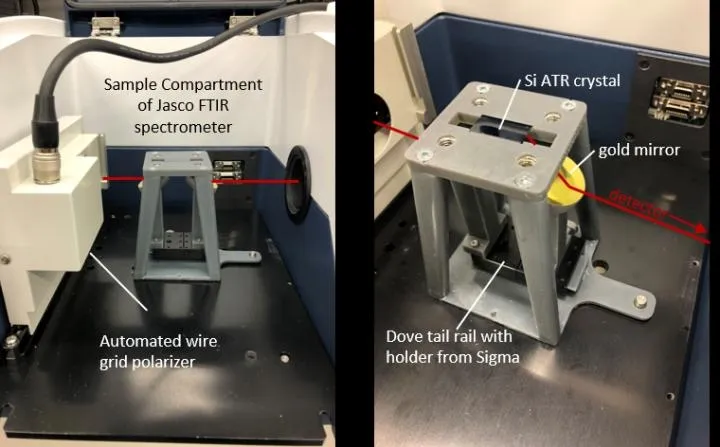
The equipment they used was a spectrometer that employs a technique called Fourier transform infrared spectroscopy (FT-IR) and polarized infrared light with an originally designed 3D-printed attenuated total reflectance (ATR) unit. FT-IR spectrometers are found in most laboratories in part because they show what molecules are found in a sample - but they have not been able to reveal the three-dimensional orientation of these molecules relative to the substrates. This is important to the manufacturing of thin-film devices that can be nanometers in size, as an unpredicted shift in molecular orientation at that level can cause the entire structure of the device to break down.
Conventionally, in FT-IR spectroscopy in transmission configuration, infrared light penetrates from the top of the sample like a skewer. This narrow point of entry and exit does not allow the sample enough interaction with the light to excite the molecules in their chemically bonded states. "We realized that by re-orienting the sample, we could introduce polarized light directly into the substrate of the thin film, generating an evanescent wave that heats up the sample, exciting certain molecules and betraying their orientation," states Bettina Baumgartner, a visiting researcher on the team, "we just needed a new kind of sample interface", adds Associate Professor Kenji Okada. This is where the team designed a brand-new ATR optical setup that bounces polarized infrared light through the entirety of the sample substrate allowing the team to observe the vibration of all molecules aligned with the electric field component of the infrared light, revealing their orientation. Any lab with a 3-D printer can make these ATR optical setups.
This method, which the team used to obtain the structural information of metal-organic framework thin film with a degree of crystal orientation comparable to X-ray structural analysis, is expected to be a useful method in many situations in materials science, such as where orientation control is linked to controlling physical properties, the functional improvement of porous materials used for CO2 capture, and the development of new heterogeneous catalysts.
INFORMATION:
About Osaka Prefecture University, Japan
Osaka Prefecture University (OPU) is one of the largest public universities in Japan.
OPU comprises three campuses, with a main campus in Sakai, Osaka. With four colleges for undergraduate students and seven graduate schools, the university offers stellar education in a myriad of fields like engineering, life and environmental sciences, science, economics, humanities and social sciences, and nursing. Not just this, the university also houses various international students, who can enrich their lives with opportunities for internships and exchange programs.
In April 2022, OPU will unite with Osaka City University (OCU) to form Japan's largest public university, Osaka Metropolitan University (tentative name).
For more details, please visit:
Osaka Prefecture University (OPU): https://www.osakafu-u.ac.jp/en
Osaka Metropolitan University (tentative name): https://www.upc-osaka.ac.jp/new-univ/en-research/
Funders
Grant-in Aid from Ministry of Education Culture Sports Science and Technology, PRESTO Japan Society for the Promotion of Science, International Fellowship for Research in Japan- Japan Society for the Promotion of Science, Precursory Research for Embryonic Science and Technology, Izumi Science and Technology Foundation, Cooperative Research Program of Institute for Catalysis- Hokkaido University