Transforming the layered ferromagnet F5GT for future spintronics
Record-high electron doping in a layered ferromagnet
Published 2021-06-28 · Original archive entry · Explore research explainers
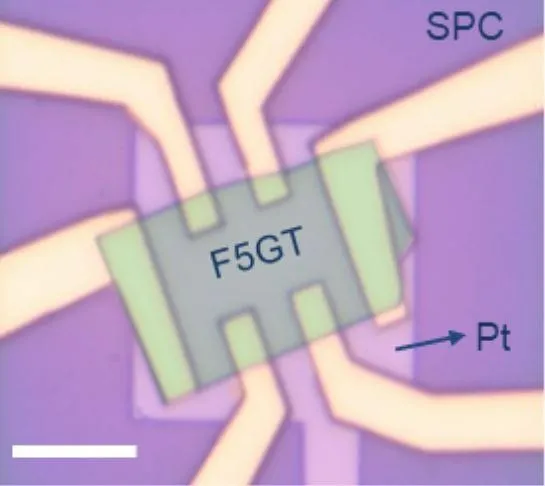
A RMIT-led international collaboration published this week has achieved record-high electron doping in a layered ferromagnet, causing magnetic phase transition with significant promise for future electronics
Control of magnetism (or spin directions) by electric voltage is vital for developing future, low-energy high-speed nano-electronic and spintronic devices, such as spin-orbit torque devices and spin field-effect transistors.
Ultra-high-charge, doping-induced magnetic phase transition in a layered ferromagnet allows promising applications in antiferromagnetic spintronic devices.
The FLEET collaboration of researchers at RMIT, UNSW, the University of Wollongong and FLEET partner High Magnetic Field Laboratory (China) demonstrates for the first time that ultra-high electron doping concentration (above 1021 cm-3) can be induced in the layered van der Waals (vdW) metallic material Fe5GeTe2 by proton intercalation, and can further cause a transition of the magnetic ground state from ferromagnetism to antiferromagnetism.
TUNING MAGNETISM IN THE VDW FERROMAGNET Fe5GeTe2 (F5GT)
The emergence of layered, vdW magnetic materials has expedited a growing search for novel vdW spintronic devices.
Compared to itinerant ferromagnets, antiferromagnets (AFMs) have unique advantages as building blocks of such future spintronic devices. Their robustness to stray magnetic fields makes them suitable for memory devices, and the AFM-based spin-orbit torque devices require a lower current density than that in ferromagnets.
However currently vdW itinerant antiferromagnets are still scarce.
Besides directly synthesizing a vdW antiferromagnet, another possible method toward this function is to induce a magnetic phase transition in an existing vdW itinerant ferromagnet.
"We chose to work with newly synthesised vdW itinerant ferromagnet Fe5GeTe2 (F5GT)" says the study's first author, FLEET Research Fellow Dr Cheng Tan (RMIT).
"Our previous experience on Fe3GeTe2 ( END
Control of magnetism (or spin directions) by electric voltage is vital for developing future, low-energy high-speed nano-electronic and spintronic devices, such as spin-orbit torque devices and spin field-effect transistors.
Ultra-high-charge, doping-induced magnetic phase transition in a layered ferromagnet allows promising applications in antiferromagnetic spintronic devices.
The FLEET collaboration of researchers at RMIT, UNSW, the University of Wollongong and FLEET partner High Magnetic Field Laboratory (China) demonstrates for the first time that ultra-high electron doping concentration (above 1021 cm-3) can be induced in the layered van der Waals (vdW) metallic material Fe5GeTe2 by proton intercalation, and can further cause a transition of the magnetic ground state from ferromagnetism to antiferromagnetism.
TUNING MAGNETISM IN THE VDW FERROMAGNET Fe5GeTe2 (F5GT)
The emergence of layered, vdW magnetic materials has expedited a growing search for novel vdW spintronic devices.
Compared to itinerant ferromagnets, antiferromagnets (AFMs) have unique advantages as building blocks of such future spintronic devices. Their robustness to stray magnetic fields makes them suitable for memory devices, and the AFM-based spin-orbit torque devices require a lower current density than that in ferromagnets.
However currently vdW itinerant antiferromagnets are still scarce.
Besides directly synthesizing a vdW antiferromagnet, another possible method toward this function is to induce a magnetic phase transition in an existing vdW itinerant ferromagnet.
"We chose to work with newly synthesised vdW itinerant ferromagnet Fe5GeTe2 (F5GT)" says the study's first author, FLEET Research Fellow Dr Cheng Tan (RMIT).
"Our previous experience on Fe3GeTe2 ( END