PRESS-NEWS.org - Press Release Distribution
PRESS RELEASES DISTRIBUTION

Making sense of antisense gene silencing

Making sense of antisense gene silencing
2021-07-06
(Press-News.org) Researchers from Tokyo Medical and Dental University (TMDU) find proteins that bind to and regulate tocopherol-conjugated heteroduplex oligonucleotides during gene silencing

Tokyo, Japan - Gene silencing therapies are used to interfere with, or "silence", the expression of genes that are associated with disorders. Now, a team at TMDU has uncovered some of the cellular mechanisms by which the silencing therapies act in cells.

Antisense oligonucleotide (ASO) therapies use small strands of DNA or RNA that are antisense, or complementary, to the associated gene to interfere with its expression. ASO therapies are already available for some diseases, particularly neurological disorders, but their use is at a very early stage. It is known that modifying ASOs chemically can improve the efficacy of the therapy. The team at TMDU had previously achieved gene silencing by attaching alpha-tocopherol (Toc) to ASOs. They then created Toc-HDOs by attaching Toc to DNA/RNA heteroduplex oligonucleotides, which are double-stranded molecules consisting of one strand of DNA and one strand of RNA. Toc-HDOs are more potent, stable, and efficiently taken up by target tissues than ASOs, and so have great therapeutic potential.

However, very little is known about the mechanism by which Toc-HDOs function. ASOs are known to interact with proteins at every step of the gene silencing process, but none have been identified for Toc-HDOs. The team also wanted to investigate the possibility that the therapeutic effects of Toc-HDO might occur through a different mechanism to other ASOs, leading to the increased potency.

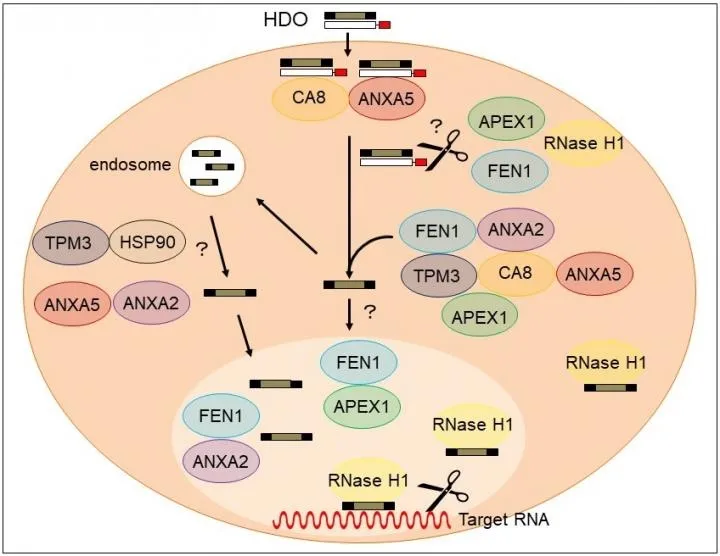
In this latest study, the researchers identified four proteins, annexin A5 (ANXA5), carbonic anhydrase 8 (CA8), apurinic/apyrimidinic endodeoxyribonuclease 1 (APEX1), and flap structure-specific endonuclease 1 (FEN1), all of which bind to Toc-HDO. "We injected mice with fluorescently-labelled Toc-HDOs to identify potential binding proteins," says lead author Ken Asada. "We then characterised the proteins further and showed that they are able to directly bind with Toc-HDOs in vitro."

The team demonstrated that these four proteins control the function of Toc-HDO and may bind together to form a complex to regulate gene silencing. "Tocopherol enhanced the binding activity of these proteins," says Takanori Yokota, senior author, "so this mechanism is a possible reason for the greater therapeutic potential shown by Toc-HDOs."

In this work, the researchers uncovered a novel biological mechanism, increasing understanding of how Toc-HDOs work to silence genes. This will allow the development of improved gene silencing therapies that are more potent and less toxic, advancing the field significantly.

INFORMATION:

The paper "Short DNA/RNA heteroduplex oligonucleotide interacting proteins are key regulators of target gene silencing" was published in Nucleic Acids Research at DOI: 10.1093/nar/gkab258


[Attachments] See images for this press release:
Making sense of antisense gene silencing

ELSE PRESS RELEASES FROM THIS DATE:

Microwave radiation features and lunar regolith parameters inversion of the Rümker region

Microwave radiation features and lunar regolith parameters inversion of the Rümker region
2021-07-06
China's lunar exploration project can be divided into three steps: "orbiting", "landing" and "returning". At present, the first two have been completed, and the third step, "return", will be achieved by the CE-5, which is the first sample return satellite of China and is expected to drill at a depth of no less than 2 m and bring back about 2 kg of scientific samples. In June 2017, the landing region of CE-5 lunar probe was selected as the Rümker region, which is located in the northern Oceanus Procellarum on the lunar near side and has a long volcanic history and complex geological composition. Because the geographical scope of the region is not clearly defined, the extent determined by the researchers is 35°-45°N ...

New approach to school transition

New approach to school transition
2021-07-06
The change from early years services into formal educational settings has long been considered an integral transition point for young people. Now research from Flinders University now asks, "Is service integration actually important to the children?" A recent paper, published in Children's Geographies, led by Flinders University PhD Dr Jennifer Fane, who is now based at Capilano University in Canada, actually seems to have little impact on children's experiences of this transition. The Australian Government has supported the Integrated Early Years Services since 2005, following what is considered best practice policy for supporting children and families. It is considered to constitute services that are connected ...

Kepler telescope glimpses population of free-floating planets

2021-07-06
Tantalising evidence has been uncovered for a mysterious population of "free-floating" planets, planets that may be alone in deep space, unbound to any host star. The results include four new discoveries that are consistent with planets of similar masses to Earth, published today in Monthly Notices of the Royal Astronomical Society. The study, led by Iain McDonald of the University of Manchester, UK, (now based at the Open University, UK) used data obtained in 2016 during the K2 mission phase of NASA's Kepler Space Telescope. During this two-month campaign, Kepler monitored a crowded field of millions ...

Sexual reproduction without mating

2021-07-06
Hannah Enders and Dr. Florian Hennicke describe the precise anatomy of these structures of the poplar mushroom in the Journal of Fungi of 19 May 2021. An edible wild mushroom One of the organisms attacked by the fungus Cyclocybe parasitica is the Tawa tree (Beilschmiedia tawa), which is relevant to the timber industry in New Zealand. Cyclocybe parasitica is widespread in the Pacific region and has long been known to the Maori, the indigenous people of New Zealand, under the name "Tawaka" as an edible wild mushroom. Biology student Hannah Elders, supervised by Florian Hennicke at ...

Muscles retain positional memory from fetal life

Muscles retain positional memory from fetal life
2021-07-06
A research collaboration based in Kumamoto University, Japan has discovered that muscles and the resident stem cells (satellite cells) responsible for muscle regeneration retain memory of their location in the body. This positional memory was found to be based on the expression pattern of the homeobox (Hox) gene cluster, which is responsible for shaping the body during fetal life. These findings are expected to provide clues to elucidate the pathogenesis of muscle diseases such as muscular dystrophy, in which the position of muscle vulnerability varies depending on the type of muscle, and to help develop regenerative ...

Sodium solid electrolyte combining high conductivity with electrochemical stability

Sodium solid electrolyte combining high conductivity with electrochemical stability
2021-07-06
Overview: A research team from the Department of Electrical and Electronic Information Engineering at Toyohashi University of Technology developed a chlorine (Cl) substituted Na3SbS4 solid electrolyte for use in all-solid-state sodium (Na) ion batteries. Compared to the sample without a Cl substitution, the ionic conductivity of the Na3SbS4 solid electrolyte where sulfur (S) was partially substituted with Cl improved by up to three times. The team also demonstrated that the Cl-substituted Na3SbS4 has a crystal structure framework that allows Na ions to move easier ...

Non-stop signal achieved in high-power Er3+-doped mid-infrared lasers

Non-stop signal achieved in high-power Er3+-doped mid-infrared lasers
2021-07-06
The Mid-infrared lasers (MIR) with high peak power and high repetition rate operating in the range of 2.7~3 μm have important application in laser surgery and optical parametric oscillator (OPO). A recent study conducted by SUN Dunlu's research group at the Hefei Institutes of Physical Science(HFIPS) of the Chinese Academy of Sciences (CAS) achieved high power, high efficiency and quasi-continuous mid-infrared laser in the free running and langasite [La3 Ga5 SiO14 (LGS)] Q-switched modes by using the Er3+ ions-doped YAP crystals as laser gain medium. Based on their previous research work on laser, the researchers further improved the laser performance of Er:YAP laser crystal by laser-diode (LD) side-pumping method, a Er:YAP crystal ...

Counting sheep and still awake? Mindfulness therapy may help bring on the zzz's

2021-07-06
Sleep problems are common in the general population with up to half of Singaporean adults reporting insufficient or unsatisfying sleep. Sleep quality tends to worsen with age and poor sleep is a modifiable risk factor for multiple disorders, including cardiovascular disease and cognitive impairment. Currently, insomnia is treated with either medication or psychological interventions. However, even frontline treatments such as cognitive-behavioural therapy have limitations - up to 40% of patients do not get relief from their insomnia symptoms after undergoing ...

Wallonia as an international reference for the timeline

Wallonia as an international reference for the timeline
2021-07-06
In 2016, researchers from the EDDyLab - Evolution & Diversity Dynamics Lab - at the University of Liège (Belgium) proposed a new definition of the geological boundary between the Devonian and Carboniferous periods (359 million years). This new definition has been tested by hundreds of researchers around the world and the results are now compiled in a special issue of the journal Palaeodiversity & Palaeoenvironments. Geological time is divided into periods (Cambrian, Carboniferous, Jurassic, etc.), together covering the 4.6 billion year history of the Earth. The many climatic, environmental and biological changes that have punctuated this history are recorded in the rock layers, forming an incredibly rich archive of the Earth's past. "The study of these successive ...

Why does Mercury have a big iron core?

Why does Mercury have a big iron core?
2021-07-06
Scientists from Tohoku University and the University of Maryland have pinpointed the strong magnetic field of the early sun as the reason behind the radial variation of rock and metal in rocky planets' cores. This magnetic field, which pulled small iron grains inward, explains Mercury's big iron core and why Mars has so little iron in its core. The details of their research were published in the journal Progress in Earth and Planetary Science on July 5, 2021. Planets have iron cores surrounded by a rocky shell, mostly made up of mantle and a thin skin of crust. The four inner planets of our Solar System, Mercury, Venus, Earth, and Mars have their own distinctive size and density. These ...

LAST 30 PRESS RELEASES:

Making lighter work of calculating fluid and heat flow

Normalizing blood sugar can halve heart attack risk

Lowering blood sugar cuts heart attack risk in people with prediabetes

Study links genetic variants to risk of blinding eye disease in premature infants

Non-opioid ‘pain sponge’ therapy halts cartilage degeneration and relieves chronic pain

AI can pick up cultural values by mimicking how kids learn

China’s ecological redlines offer fast track to 30 x 30 global conservation goal

Invisible indoor threats: emerging household contaminants and their growing risks to human health

Adding antibody treatment to chemo boosts outcomes for children with rare cancer

Germline pathogenic variants among women without a history of breast cancer

Tanning beds triple melanoma risk, potentially causing broad DNA damage

Unique bond identified as key to viral infection speed

Indoor tanning makes youthful skin much older on a genetic level

Mouse model sheds new light on the causes and potential solutions to human GI problems linked to muscular dystrophy

The Journal of Nuclear Medicine ahead-of-print tip sheet: December 12, 2025

Smarter tools for peering into the microscopic world

Applications open for funding to conduct research in the Kinsey Institute archives

Global measure underestimates the severity of food insecurity

Child survivors of critical illness are missing out on timely follow up care

Risk-based vs annual breast cancer screening / the WISDOM randomized clinical trial

University of Toronto launches Electric Vehicle Innovation Ontario to accelerate advanced EV technologies and build Canada’s innovation advantage

Early relapse predicts poor outcomes in aggressive blood cancer

American College of Lifestyle Medicine applauds two CMS models aligned with lifestyle medicine practice and reimbursement

Clinical trial finds cannabis use not a barrier to quitting nicotine vaping

Supplemental nutrition assistance program policies and food insecurity

Switching immune cells to “night mode” could limit damage after a heart attack, study suggests

URI-based Global RIghts Project report spotlights continued troubling trends in worldwide inhumane treatment

Neutrophils are less aggressive at night, explaining why nighttime heart attacks cause less damage than daytime events

Menopausal hormone therapy may not pose breast cancer risk for women with BRCA mutations

Mobile health tool may improve quality of life for adolescent and young adult breast cancer survivors

[Press-News.org] Making sense of antisense gene silencing