Tiny tools: Controlling individual water droplets as biochemical reactors
Scientists develop a method to better manipulate tiny droplets in lab-on-a-chip applications for biochemistry, cell culturing, and drug screening
Published 2021-07-07 · Original archive entry · Explore research explainers
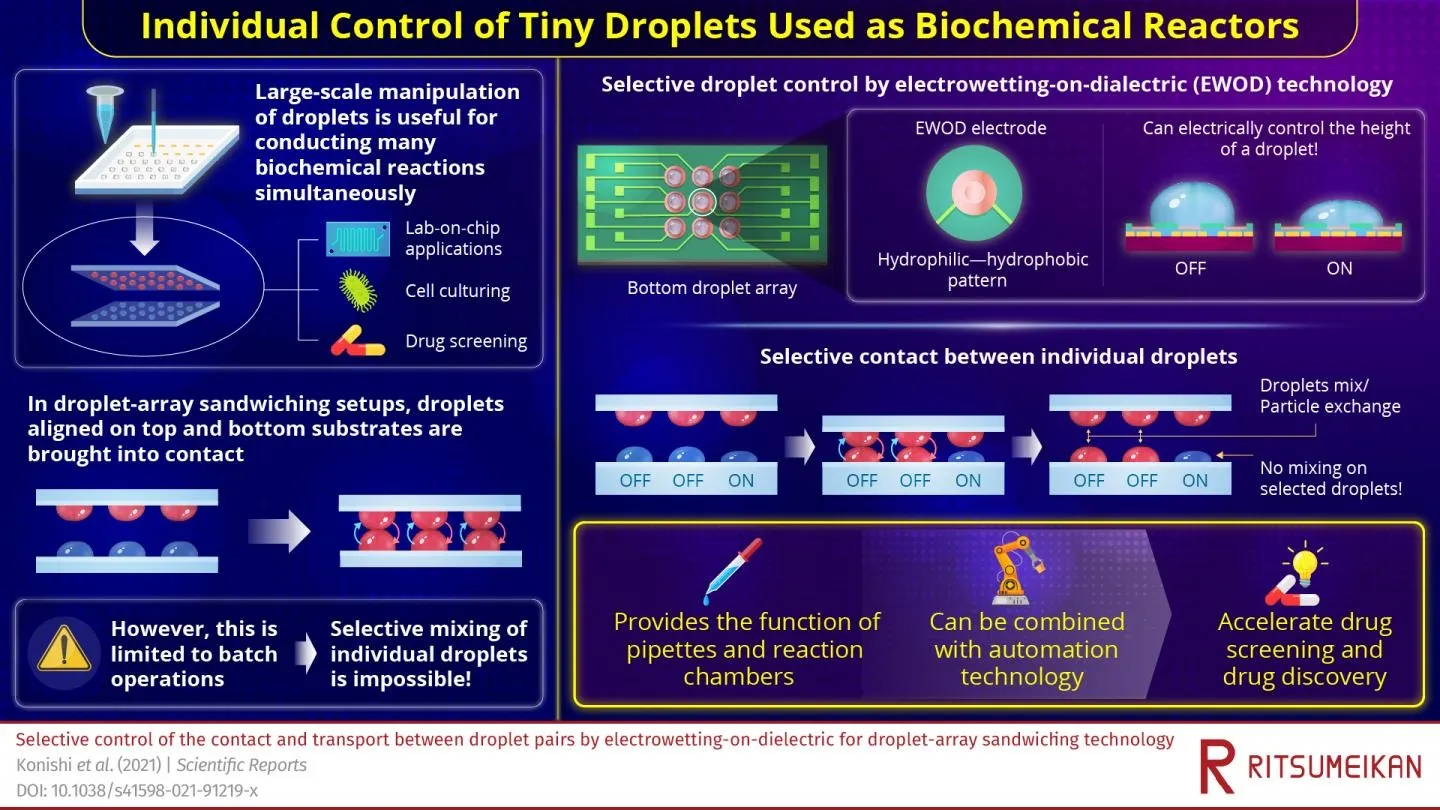
Miniaturization is rapidly reshaping the field of biochemistry, with emerging technologies such as microfluidics and "lab-on-a-chip" devices taking the world by storm. Chemical reactions that were normally conducted in flasks and tubes can now be carried out within tiny water droplets not larger than a few millionths of a liter. Particularly, in droplet-array sandwiching techniques, such tiny droplets are orderly laid out on two parallel flat surfaces opposite to each other. By bringing the top surface close enough to the bottom one, each top droplet makes contact with the opposite bottom droplet, exchanging chemicals and transferring particles or even cells. In quite a literal way, these droplets can act as small reaction chambers or cell cultures, and they can also fulfill the role of liquid-handling tools such as pipettes but on a much smaller scale.
The problem with droplet-array sandwiching is that there is no individual control of droplets; once the top surface is lowered, each droplet on the bottom surface necessarily makes contact with one on the top surface. In other words, this technology is limited to batch operations, which limits its versatility and makes it costlier. Could there be a simple way to select which droplets should make contact when the surfaces are brought closer together?
Thanks to Professor Satoshi Konishi and his colleagues at Ritsumeikan University, Japan, the answer is a resounding yes! In a recent study END
The problem with droplet-array sandwiching is that there is no individual control of droplets; once the top surface is lowered, each droplet on the bottom surface necessarily makes contact with one on the top surface. In other words, this technology is limited to batch operations, which limits its versatility and makes it costlier. Could there be a simple way to select which droplets should make contact when the surfaces are brought closer together?
Thanks to Professor Satoshi Konishi and his colleagues at Ritsumeikan University, Japan, the answer is a resounding yes! In a recent study END