Quantum crossover: How to distinguish single-particle and pair currents
A new method offers insights into quantum many-body systems and would help in developing superconducting materials.
Published 2023-03-07 · Original archive entry · Explore research explainers
If you cool down low-density atomic gas to ultralow temperatures (−273°C), you get a new state of matter called the Bose-Einstein Condensate (BEC). A BEC has strongly coupled two-atom molecules behaving like a collective wave following quantum mechanics. Now if you reduce the pairing strength between them—for example, by increasing the magnetic field—the atoms form “Cooper-pairs” according to Bardeen-Cooper-Schrieffer (BCS) theory—a Nobel Prize winner. The process is called BCS-BEC crossover. And the theory forms the basis of superfluids and superconductors, materials that do not display viscosity or electrical resistance. Hiroyuki Tajima and his team from the University of Tokyo proposed a new method to distinguish current carriers in the BCS-BEC crossover. The key is in the fluctuations of current.
You are reading this on your electronic device, thanks to electrons moving in a conductor—aka single-particle current. Your device may heat up due to the resistance caused by collisions of electrons in the conductor that dissipate electric energy as heat. But superconductors show zero resistance to current flow, saving lots of energy. This is possible because of paired electrons, which would have otherwise repelled each other due to their negative charge. In other words, the current in superconductors is mainly due to the pair-tunneling transport involving moving paired-current carriers rather than a single-particle current carrier.
Tajima and his team investigated the quantum transport phenomena using an ultracold Fermi atomic gas. It is an artificial quantum matter mimicking an electron or fermion system with adjustable interaction strength. “To understand non-trivial transport, we need to distinguish whether single-particle tunneling or pair tunneling is dominant in strongly interacting gas,” said Tajima. "The identification of single-particle tunneling and pair tunneling is vital for understanding quantum transport not only in cold atomic systems but also in high-temperature superconductors."
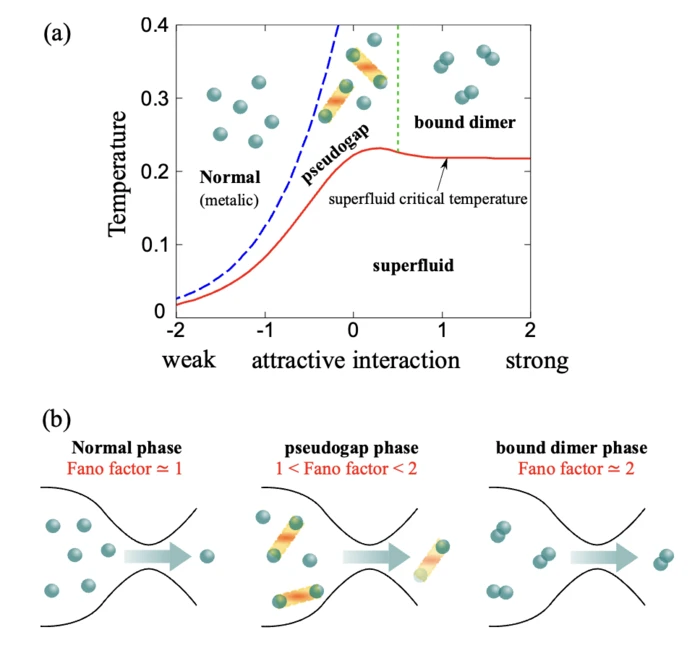
Because the researchers could control the interactions between particles, the atomic gas allowed them to systematically study quantum many-body physics. The gas shows a normal phase when the interaction strength between atoms is weak. In this phase, it behaves like a relatively good conductor such as a metal showing electrical resistance. So, one can expect a single-particle current (electron tunneling transport) under a chemical potential bias (voltage). If you increase the interaction strength, the gas crosses over to the bound dimer phase via an in-between pseudogap phase. The pseudogap phase is where the BCS-BEC crossover happens at low temperatures. At a critical temperature for a given interaction strength, the atomic gas becomes superfluid with no viscosity. Below the phase transition temperature, Cooper pairs form and lead to pair current. In the pseudogap phase, non-superfluid Cooper pairs form due to attractive interactions, which leads to anomalous current in this region. But in the bound dimer phase, pair current is predominant. Tajima’s team found a way to distinguish the current carriers in each phase by measuring an observable macroscopic property.
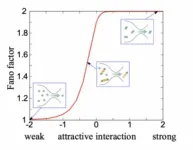
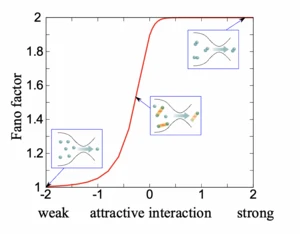
The team showed that the fluctuations of currents, quantified as the Fano factor, can distinguish single-particle- and pair-currents in a tunneling transport of strongly interacting Fermi gases. The Fano factor value is 1 for single-particle current and 2 for pair current. In the future, their approach can be applied to other unconventional superconductors and different many-body phenomena realized in cold atoms.
“Our results show that it is possible to identify the microscopic transport carriers from the macroscopic observables (i.e., current and its noise) even in strongly correlated quantum matter,” added Tajima.
“This collaboration happened completely through online discussions, which surprisingly enabled us to exchange interdisciplinary knowledge, resulting in this research.”
###
Related links
The School of Science, UTokyo: www.s.u-tokyo.ac.jp/en/
Tajima lab: https://sites.google.com/view/hiroyukitajima/home
END
You are reading this on your electronic device, thanks to electrons moving in a conductor—aka single-particle current. Your device may heat up due to the resistance caused by collisions of electrons in the conductor that dissipate electric energy as heat. But superconductors show zero resistance to current flow, saving lots of energy. This is possible because of paired electrons, which would have otherwise repelled each other due to their negative charge. In other words, the current in superconductors is mainly due to the pair-tunneling transport involving moving paired-current carriers rather than a single-particle current carrier.
Tajima and his team investigated the quantum transport phenomena using an ultracold Fermi atomic gas. It is an artificial quantum matter mimicking an electron or fermion system with adjustable interaction strength. “To understand non-trivial transport, we need to distinguish whether single-particle tunneling or pair tunneling is dominant in strongly interacting gas,” said Tajima. "The identification of single-particle tunneling and pair tunneling is vital for understanding quantum transport not only in cold atomic systems but also in high-temperature superconductors."
Because the researchers could control the interactions between particles, the atomic gas allowed them to systematically study quantum many-body physics. The gas shows a normal phase when the interaction strength between atoms is weak. In this phase, it behaves like a relatively good conductor such as a metal showing electrical resistance. So, one can expect a single-particle current (electron tunneling transport) under a chemical potential bias (voltage). If you increase the interaction strength, the gas crosses over to the bound dimer phase via an in-between pseudogap phase. The pseudogap phase is where the BCS-BEC crossover happens at low temperatures. At a critical temperature for a given interaction strength, the atomic gas becomes superfluid with no viscosity. Below the phase transition temperature, Cooper pairs form and lead to pair current. In the pseudogap phase, non-superfluid Cooper pairs form due to attractive interactions, which leads to anomalous current in this region. But in the bound dimer phase, pair current is predominant. Tajima’s team found a way to distinguish the current carriers in each phase by measuring an observable macroscopic property.
The team showed that the fluctuations of currents, quantified as the Fano factor, can distinguish single-particle- and pair-currents in a tunneling transport of strongly interacting Fermi gases. The Fano factor value is 1 for single-particle current and 2 for pair current. In the future, their approach can be applied to other unconventional superconductors and different many-body phenomena realized in cold atoms.
“Our results show that it is possible to identify the microscopic transport carriers from the macroscopic observables (i.e., current and its noise) even in strongly correlated quantum matter,” added Tajima.
“This collaboration happened completely through online discussions, which surprisingly enabled us to exchange interdisciplinary knowledge, resulting in this research.”
###
Related links
The School of Science, UTokyo: www.s.u-tokyo.ac.jp/en/
Tajima lab: https://sites.google.com/view/hiroyukitajima/home
END
Attachments