New insights into the origins of spinal muscular atrophy
Published 2023-03-22 · Original archive entry · Explore research explainers
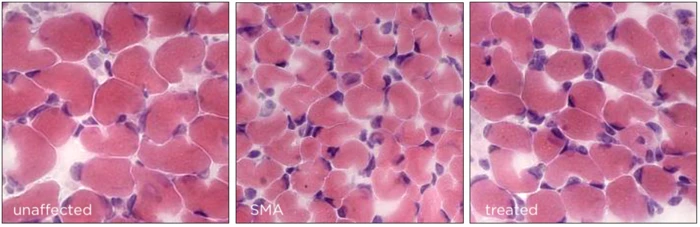
NEW YORK, NY--Columbia researchers have discovered how a genetic defect leads to spinal muscular atrophy (SMA), a critical piece of information about the disease that neurologists have been seeking for decades.
The discovery suggests a new way to treat SMA—a devastating childhood motor neuron disease that affects 1 in 6,000 children. In the most severe cases, and when left untreated, children born with SMA die within the first two years of life.
The researchers also used their finding to develop an experimental therapy that improved survival in mice with severe SMA by 30-fold, one of the greatest increases seen with any treatment in mouse models of SMA.
Why the finding matters
Almost all cases of SMA are caused by a mutation in a single gene—SMN1 (survival motor neuron 1)—that reduces the amount of SMN protein inside motor neurons. SMN protein deficiency harms the neurons, and eventually the neurons can no longer control the body's muscles.
SMA has no cure but is commonly treated with therapies that increase SMN production, including a gene therapy that inserts a new SMN gene into the motor neurons.
“For many patients, the therapies are fairly effective if given early in the course of the disease,” says Umrao Monani, PhD, an SMA researcher at Columbia University Vagelos College of Physicians and Surgeons who led the research team.
“But the treatments don’t work for everyone, they can have significant side effects, and since these therapies are only a few years old, we don’t know how long they will last. There’s clearly a need for new approaches.”
What the study found
In the search for a different kind of treatment, Monani’s team looked at mice with SMA and tried to uncover how SMN deficiency harms neurons—something that’s remained hidden from investigators for decades—so they could find a way to prevent the harm.
The researchers found that SMN deficiency usually harms neurons by impairing a different protein, Hspa8, that helps assemble a critical communication link between motor neurons and muscle cells.
With Hspa8 out of action, the communication links are never built and messages cannot be sent from the neuron to the muscle. Muscles cannot contract without receiving these messages and they eventually waste away.
But some mice with SMA, the team noticed, were stronger and less affected by the disease. These mice, the researchers learned, harbored a specific variant of the Hspa8 gene that was not impaired by SMN deficiency.
A potential new treatment pathway for SMA?
A treatment that mimics the protective effect of the Hspa8 variant could have a potent effect in people, Monani says, if the researchers’ mouse experiments are any indication.
Using an approach that converted Hspa8 into its variant form, the researchers found significant recovery of neuromuscular function and survival in mice with severe SMA. The treated mice survived roughly 300 days, compared to just 10 days for untreated mice.
“We’ve never seen such a big increase in survival in these mice before, even when treated with nusinersen, a current SMA treatment,” Monani says.
Further study is needed to determine how best to translate the findings into a new SMA treatment. "The simplest way would be to encapsulate the HSPA8 variant in a virus and deliver the gene therapy to patients, as we did with the mice,” says Monani. “Another possibility is to use viruses or small molecules to convert normal Hspa8 into the variant.”
The researchers are currently working to develop therapies that are suitable for testing in patients.
More information
The study was published in Neuron on March 1 and is titled “A spinal muscular atrophy modifier implicates the SMN protein in SNARE complex assembly at neuromuscular synapses(link is external and opens in a new window).”
The other contributors (all from Columbia unless noted): Jeong-Ki Kim, Narendra N. Jha, Tomoyuki Awano, Charlotte Caine, Kishore Gollapalli, Emily Welby (Medical College of Wisconsin), Seung-Soo Kim, Andrea Fuentes-Moliz (University of Seville School of Medicine, Spain), Xueyong Wang (Wright State University), Zhihua Feng (University of Southern California), Fusako Sera, Taishi Takeda, Shunichi Homma, Chien-Ping Ko (University of Southern California), Lucia Tabares (University of Seville School of Medicine), Allison D. Ebert (Medical College of Wisconsin), and Mark M. Rich (Wright State University).
###
Columbia University Irving Medical Center (CUIMC) is a clinical, research, and educational campus located in New York City. Founded in 1928, CUIMC was one of the first academic medical centers established in the United States of America. CUIMC is home to four professional colleges and schools that provide global leadership in scientific research, health and medical education, and patient care including the Vagelos College of Physicians and Surgeons, the Mailman School of Public Health, the College of Dental Medicine, the School of Nursing. For more information, please visit cuimc.columbia.edu.
END
The discovery suggests a new way to treat SMA—a devastating childhood motor neuron disease that affects 1 in 6,000 children. In the most severe cases, and when left untreated, children born with SMA die within the first two years of life.
The researchers also used their finding to develop an experimental therapy that improved survival in mice with severe SMA by 30-fold, one of the greatest increases seen with any treatment in mouse models of SMA.
Why the finding matters
Almost all cases of SMA are caused by a mutation in a single gene—SMN1 (survival motor neuron 1)—that reduces the amount of SMN protein inside motor neurons. SMN protein deficiency harms the neurons, and eventually the neurons can no longer control the body's muscles.
SMA has no cure but is commonly treated with therapies that increase SMN production, including a gene therapy that inserts a new SMN gene into the motor neurons.
“For many patients, the therapies are fairly effective if given early in the course of the disease,” says Umrao Monani, PhD, an SMA researcher at Columbia University Vagelos College of Physicians and Surgeons who led the research team.
“But the treatments don’t work for everyone, they can have significant side effects, and since these therapies are only a few years old, we don’t know how long they will last. There’s clearly a need for new approaches.”
What the study found
In the search for a different kind of treatment, Monani’s team looked at mice with SMA and tried to uncover how SMN deficiency harms neurons—something that’s remained hidden from investigators for decades—so they could find a way to prevent the harm.
The researchers found that SMN deficiency usually harms neurons by impairing a different protein, Hspa8, that helps assemble a critical communication link between motor neurons and muscle cells.
With Hspa8 out of action, the communication links are never built and messages cannot be sent from the neuron to the muscle. Muscles cannot contract without receiving these messages and they eventually waste away.
But some mice with SMA, the team noticed, were stronger and less affected by the disease. These mice, the researchers learned, harbored a specific variant of the Hspa8 gene that was not impaired by SMN deficiency.
A potential new treatment pathway for SMA?
A treatment that mimics the protective effect of the Hspa8 variant could have a potent effect in people, Monani says, if the researchers’ mouse experiments are any indication.
Using an approach that converted Hspa8 into its variant form, the researchers found significant recovery of neuromuscular function and survival in mice with severe SMA. The treated mice survived roughly 300 days, compared to just 10 days for untreated mice.
“We’ve never seen such a big increase in survival in these mice before, even when treated with nusinersen, a current SMA treatment,” Monani says.
Further study is needed to determine how best to translate the findings into a new SMA treatment. "The simplest way would be to encapsulate the HSPA8 variant in a virus and deliver the gene therapy to patients, as we did with the mice,” says Monani. “Another possibility is to use viruses or small molecules to convert normal Hspa8 into the variant.”
The researchers are currently working to develop therapies that are suitable for testing in patients.
More information
The study was published in Neuron on March 1 and is titled “A spinal muscular atrophy modifier implicates the SMN protein in SNARE complex assembly at neuromuscular synapses(link is external and opens in a new window).”
The other contributors (all from Columbia unless noted): Jeong-Ki Kim, Narendra N. Jha, Tomoyuki Awano, Charlotte Caine, Kishore Gollapalli, Emily Welby (Medical College of Wisconsin), Seung-Soo Kim, Andrea Fuentes-Moliz (University of Seville School of Medicine, Spain), Xueyong Wang (Wright State University), Zhihua Feng (University of Southern California), Fusako Sera, Taishi Takeda, Shunichi Homma, Chien-Ping Ko (University of Southern California), Lucia Tabares (University of Seville School of Medicine), Allison D. Ebert (Medical College of Wisconsin), and Mark M. Rich (Wright State University).
###
Columbia University Irving Medical Center (CUIMC) is a clinical, research, and educational campus located in New York City. Founded in 1928, CUIMC was one of the first academic medical centers established in the United States of America. CUIMC is home to four professional colleges and schools that provide global leadership in scientific research, health and medical education, and patient care including the Vagelos College of Physicians and Surgeons, the Mailman School of Public Health, the College of Dental Medicine, the School of Nursing. For more information, please visit cuimc.columbia.edu.
END
Attachments