Snowballing effects of beech leaf disease hurt helpful root fungi
Severe beech leaf disease infestation hurts trees’ relationships with helpful root mutualists, ectomycorrhizal fungi.
Published 2023-04-27 · Original archive entry · Explore research explainers
The American beech, Fagus grandifolia, is a North American staple and the dominant species in many northeastern forests. In 2012, a new disease was first spotted, infecting trees in northeastern Ohio. The worst afflicted had dark banding on their leaves, which emerged crumpled and leathery in the spring. Not until 2018 would experts discover the nematode pest, Litylenchus crenatae mccannii, overwintering in the buds of infected trees.
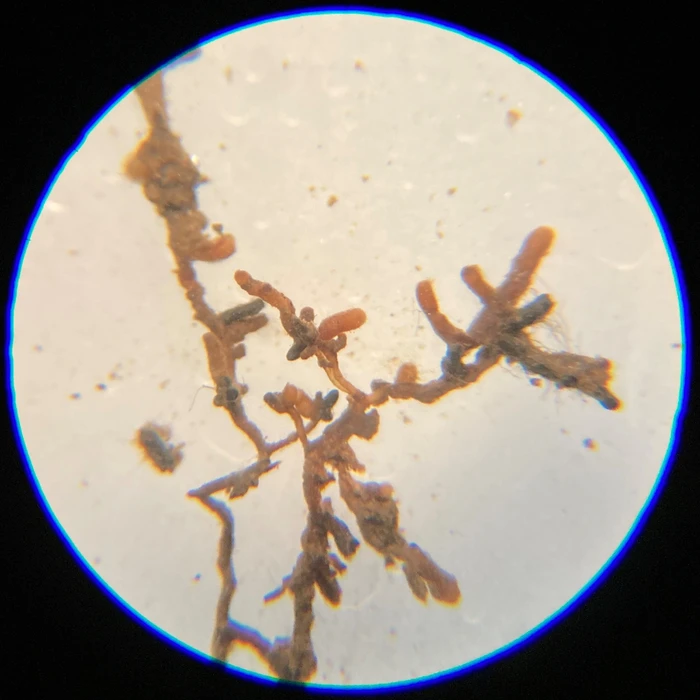
As it marches across the continent, researchers are still learning the full extent of the causes and consequences of beech leaf disease. In a new paper out this week in the Journal of Fungi, researchers at Holden Forests & Gardens in Kirtland, Ohio, found a new downstream effect of the disease: The roots of infected trees have fewer helpful fungal mutualists called ectomycorrhizal fungi.
That’s bad news for both the trees and for the fungi species they support. “It’s a really scary story when you think about all of the benefits that the tree is normally accruing from its fungal mutualists,” says Claudia Bashian-Victoroff, researcher at Holden Forests & Gardens and lead author of the new paper. “These trees are already under stress from beech leaf disease, so losing their mutualisms puts an added strain on tree health.”
These mutualists, the ectomycorrhizal fungi that colonize the trees’ roots from the soil, play an important role in tree health. They help the trees with nutrient and water acquisition, and recent research has even shown they can be important for resistance to pathogens in the soil.
“There hasn’t been much research that tells the full story, that looks at the whole ecology of a tree in terms of what it’s experiencing above ground and what it’s experiencing below ground,” says Bashian-Victoroff. “This is the first paper to connect the effects of beech leaf disease with mycorrhizal fungi.”
Why would a leaf disease have effects on fungi living in a tree’s roots? Beech leaf disease affects the leaves’ ability to photosynthesize, which means they’re not pulling in as much carbon dioxide and not making as much sugar. That sugar isn’t just the primary energy source for the tree, it’s also what they provide to the ectomycorrhizal fungi in their roots in exchange for its services. Damaged leaves means less photosynthesis, less sugar, and fewer ectomycorrhizal fungi colonizing the roots.
The researchers found the new link in a plantation of research trees at the Holden Arboretum, planted in 2006 at part of a U.S. Forest Service project to develop trees resistant to a different beech ailment, beech bark disease. The trees were planted from Maine and Michigan stock selected for potential resistance to the older disease. Now, the trees are succumbing to the new pest, beech leaf disease, as it spreads through the area, with different trees showing different severity of symptoms.
The team counted over 70,000 root tips, small segments of fine roots where the mycorrhizal fungi grow and exchange nutrients with the tree. They quantified and identified fungi across 30 trees and two seasons. They found a key difference in fall, after a full growing season: Trees with the most severe beech leaf disease symptoms had over 65% less of the healthy fungi in their roots compared to those with mild symptoms.
They also found that trees from Michigan — geographically closer to the study site and therefore a better match for growing conditions — had overall more ectomycorrhizal fungi than those from Maine, and that the fungal community composition from the two regions were notably different.
If beech leaf disease impairs the ability of the trees to associate with their mutualists, there could be cascading effects on forest health and function, with implications not just via beech tree losses but also via the losses of fungal diversity.
“Fungal mutualists are underappreciated and understudied, even among mycologists,” says Bashian-Victoroff. “The vast majority of research on fungi is on fungal pathogens, like the ones that disrupt agricultural systems. So focusing on fungi and what they do to help our ecosystems is extremely important.”
The study underscores the importance of understanding the complex interactions between trees and their root symbionts and emphasizes the need for continued research to develop effective strategies to combat the spread of beech leaf disease and protect these important forest ecosystems.
Citation: Bashian-Victoroff, Claudia, et al. "Beech Leaf Disease Severity Affects Ectomycorrhizal Colonization and Fungal Taxa Composition." Journal of Fungi 9.4 (2023): 497. https://doi.org/10.3390/jof904049
END
As it marches across the continent, researchers are still learning the full extent of the causes and consequences of beech leaf disease. In a new paper out this week in the Journal of Fungi, researchers at Holden Forests & Gardens in Kirtland, Ohio, found a new downstream effect of the disease: The roots of infected trees have fewer helpful fungal mutualists called ectomycorrhizal fungi.
That’s bad news for both the trees and for the fungi species they support. “It’s a really scary story when you think about all of the benefits that the tree is normally accruing from its fungal mutualists,” says Claudia Bashian-Victoroff, researcher at Holden Forests & Gardens and lead author of the new paper. “These trees are already under stress from beech leaf disease, so losing their mutualisms puts an added strain on tree health.”
These mutualists, the ectomycorrhizal fungi that colonize the trees’ roots from the soil, play an important role in tree health. They help the trees with nutrient and water acquisition, and recent research has even shown they can be important for resistance to pathogens in the soil.
“There hasn’t been much research that tells the full story, that looks at the whole ecology of a tree in terms of what it’s experiencing above ground and what it’s experiencing below ground,” says Bashian-Victoroff. “This is the first paper to connect the effects of beech leaf disease with mycorrhizal fungi.”
Why would a leaf disease have effects on fungi living in a tree’s roots? Beech leaf disease affects the leaves’ ability to photosynthesize, which means they’re not pulling in as much carbon dioxide and not making as much sugar. That sugar isn’t just the primary energy source for the tree, it’s also what they provide to the ectomycorrhizal fungi in their roots in exchange for its services. Damaged leaves means less photosynthesis, less sugar, and fewer ectomycorrhizal fungi colonizing the roots.
The researchers found the new link in a plantation of research trees at the Holden Arboretum, planted in 2006 at part of a U.S. Forest Service project to develop trees resistant to a different beech ailment, beech bark disease. The trees were planted from Maine and Michigan stock selected for potential resistance to the older disease. Now, the trees are succumbing to the new pest, beech leaf disease, as it spreads through the area, with different trees showing different severity of symptoms.
The team counted over 70,000 root tips, small segments of fine roots where the mycorrhizal fungi grow and exchange nutrients with the tree. They quantified and identified fungi across 30 trees and two seasons. They found a key difference in fall, after a full growing season: Trees with the most severe beech leaf disease symptoms had over 65% less of the healthy fungi in their roots compared to those with mild symptoms.
They also found that trees from Michigan — geographically closer to the study site and therefore a better match for growing conditions — had overall more ectomycorrhizal fungi than those from Maine, and that the fungal community composition from the two regions were notably different.
If beech leaf disease impairs the ability of the trees to associate with their mutualists, there could be cascading effects on forest health and function, with implications not just via beech tree losses but also via the losses of fungal diversity.
“Fungal mutualists are underappreciated and understudied, even among mycologists,” says Bashian-Victoroff. “The vast majority of research on fungi is on fungal pathogens, like the ones that disrupt agricultural systems. So focusing on fungi and what they do to help our ecosystems is extremely important.”
The study underscores the importance of understanding the complex interactions between trees and their root symbionts and emphasizes the need for continued research to develop effective strategies to combat the spread of beech leaf disease and protect these important forest ecosystems.
Citation: Bashian-Victoroff, Claudia, et al. "Beech Leaf Disease Severity Affects Ectomycorrhizal Colonization and Fungal Taxa Composition." Journal of Fungi 9.4 (2023): 497. https://doi.org/10.3390/jof904049
END
Attachments