PRESS-NEWS.org - Press Release Distribution
PRESS RELEASES DISTRIBUTION

Addiction scientists seek to better understand cocaine use disorder: ‘Stimulants are coming back’
Virginia Tech researchers at Fralin Biomedical Research Institute search for new ideas to help people fight cocaine habit

Addiction scientists seek to better understand cocaine use disorder: ‘Stimulants are coming back’
2023-05-14
(Press-News.org)

Nearly 2 percent of the U.S. population reported cocaine use in 2020, and the highly addictive substance was involved in nearly one in five overdose deaths, according to the Centers for Disease Control. 

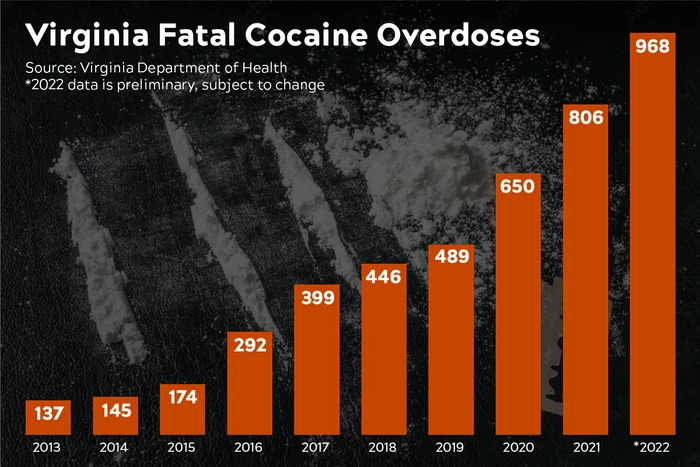
In Virginia, the number of cocaine-related overdoses has been increasing since 2013, with 968 fatal overdoses in 2022, according to preliminary data from the Virginia Department of Health, a 20 percent increase over 2021. Of those, four in five included fentanyl — prescription, illicit or analog — a driving force behind the fatalities.

Researchers at the Fralin Biomedical Research Institute at VTC are working to better understand cocaine use disorder and help reverse the national trend. 

"Stimulants are coming back. Cocaine use and addiction has been rising for more than a decade, with no robust treatment,” said Warren Bickel, a professor with the Fralin Biomedical Research Institute at VTC and director of the Addiction Recovery Research Center. “We need some new ideas.”

The study stresses the theory of reinforcer pathology, in which an individual places a higher value on immediate reward — for instance, for the way a substance makes them feel — and a lower value on future gains. For the study, researchers will use cocaine contingency management by providing cash or something of value to people who meet their treatment goals.

“When people do drugs, we know they give up their jobs, relationships, family, even their lives, but when they receive several dollars for drug-free urine samples, they become powerful. What explains that? Their temporal horizon. I give you money for a clean urine sample and right away you turn it around. The drugs lose value,” Bickel said.

The Addiction Recovery Research Center is recruiting adults who use cocaine for the paid research study on decision-making. Participants will be asked to visit the Roanoke lab 13 times over five weeks to undergo MRIs, report their cocaine use, take computerized assessments, and provide urine samples. The research, which is not a treatment study, is supported by a grant of more than $700,000 from the National Institute on Drug Abuse, part of the National Institutes of Health.

“We are asking people to participate for several weeks in a row, and we will learn whether tackling their short-term view of the future can be an added key to treating them,” Bickel said. “It is worthwhile to explore new ideas. New interventions are long overdue, and there is increasing evidence that this effort is an idea whose time has arrived. It is producing effects we want to measure.” 

Bickel also is director of the institute’s Center for Health Behaviors Research, a psychology professor with Virginia Tech’s College of Science, and a professor of psychiatry and behavioral medicine at the Virginia Tech Carilion School of Medicine. He is joined on the study by co-investigator Stephen M. LaConte, an associate professor at the Fralin Biomedical Research Institute.

LaConte says it's important to work alongside colleagues tackling substance use disorders and to use brain imaging to study the effects of cocaine use and changes to the brain during the intervention. "I am thankful to the participants who donate their time to come to the [institute] for our studies," he said. "Beyond funding the science that we do here, I am also grateful to our state and federal agencies for their work in helping to reduce the stigma surrounding addiction.”

Their goal is to positively impact public health by guiding innovative interventions that help decrease cocaine consumption.

END


[Attachments] See images for this press release:
Addiction scientists seek to better understand cocaine use disorder: ‘Stimulants are coming back’

ELSE PRESS RELEASES FROM THIS DATE:

University of Kentucky physicians push for standard-of-care opioid treatment for incarcerated patients

2023-05-13
In a recently published commentary, UK HealthCare physicians call for standard-of-care treatment for opioid use disorder (OUD) among patients who are incarcerated. The viewpoint article by Anna-Maria South, M.D., Laura Fanucchi, M.D., and Michelle Lofwall, M.D., published in JAMA April 24 highlights the barriers to initiating medication for opioid use disorder (MOUD) among people who are incarcerated. For patients with opioid use disorder, medications such as buprenorphine and methadone are considered by the medical community as standard of care treatments, as they alleviate withdrawal symptoms, reduce cravings and pain, ...

Fear of childbirth exacerbated by the COVID-19 pandemic

2023-05-13
The COVID-19 pandemic exacerbated fear of childbirth among pregnant people in the U.S., according to a new Dartmouth study. The researchers were particularly interested in understanding, from a U.S. context, which factors predict childbirth fear and how the pandemic has affected this fear and birth outcomes. The findings are published in Evolution, Medicine, and Public Health. "Our results showed really high rates of childbirth fear in our sample," says first author Zaneta Thayer '08, an associate professor of anthropology at Dartmouth. "Since there's no pre-pandemic U.S. data, we cannot compare our data to that context but we know that ...

Restoring control to a particular brain region may help to prevent return to use of opioids

Restoring control to a particular brain region may help to prevent return to use of opioids
2023-05-13
A team of neuroscientists at the Medical University of South Carolina (MUSC) has identified changes in the activity of brain cells known as pyramidal neurons, which contribute to drug seeking in a preclinical model of opioid use disorder. After access to heroin was stopped, these neurons became more excitable. The activity of these neurons was restored to normal by blocking the enzyme protein kinase A (PKA). Inhibiting this enzyme also reduced opioid-seeking behavior. Jacqueline McGinty, Ph.D., professor of neuroscience, and Saurabh Kokane, Ph.D., a postdoctoral scholar in McGinty’s laboratory, recently published their team’s findings in the Journal of Neuroscience. The risk ...

Stress hormone during pregnancy may improve early language development in children

2023-05-13
High levels of the stress hormone cortisol during the third trimester of pregnancy may improve speech and language skills in the first 3 years of a child’s life, according to research presented at the 25th European Congress of Endocrinology in Istanbul. The findings help researchers further understand the role cortisol plays in both fetal and child development. Language development during early childhood can indicate how well a baby’s nervous system was developed in the womb. Prenatal exposure to cortisol – a steroid hormone that helps the body respond to ...

Steroids linked to long-lasting heart disease risk and worse quality of life

2023-05-13
Anabolic steroids not only can cause serious side effects during use, such as heart failure and depression, but can continue being harmful years after stopping, according to two studies presented at the 25th European Congress of Endocrinology in Istanbul. These studies, supported by the Novo Nordisk Foundation, were carried out by researchers from the Copenhagen University Hospital Rigshospitalet who investigated the impact of anabolic steroids in former users. Anabolic steroids – synthetic hormones ...

Low levels of vitamin D linked to long COVID

2023-05-13
Long COVID risk has been found to increase with low levels of vitamin D, according to research presented at the 25th European Congress of Endocrinology in Istanbul. The findings suggest that individuals should have their vitamin D levels checked after COVID-19. Also known as post COVID-19 syndrome, long COVID is a new condition in which the effects of COVID-19 last for more than 12 weeks after contracting the initial infection. Studies have shown that it affects 50-70% of patients previously hospitalised for COVID-19, yet very little is known about the condition. One risk factor for worse outcomes for hospitalised COVID-19 patients, such as intubation and mechanical ventilation ...

Accelerated delivery of transcranial magnetic stimulation is safe and effective

2023-05-12
May 12, 2023 — Accelerated schedules for repetitive transcranial magnetic stimulation (rTMS) can be offered to patients experiencing treatment-resistant major depressive disorder (MDD), a group of clinician–researchers and neuroscientists have concluded. The group cautions that such treatment should be proposed only after detailed discussion with patients about acceleration being an alternate form of rTMS scheduling, with documentation of informed consent. The recommendations are published in a ...

Amino acid PET successfully differentiates recurrent brain metastases, reducing invasive procedures and overtreatment

Amino acid PET successfully differentiates recurrent brain metastases, reducing invasive procedures and overtreatment
2023-05-12
Reston, VA—A newly published meta-analysis indicates that amino acid PET can accurately differentiate recurrent or progressive brain metastases from treatment-related changes. A specificity of 84 percent suggests that it may reduce the number of invasive procedures and overtreatment in patients who in fact experience treatment-related changes. This research was published in the May issue of The Journal of Nuclear Medicine. Brain metastases occur in 20 to 40 percent of all cancer patients and are most likely ...

Is it too late to change your mind? Study reveals ‘developmental window’ for thinking styles

2023-05-12
Key takeaways Researchers studied the way different generations in Romania determined the truth of information following the country’s transition from authoritarianism to democracy. Those who were born and raised after the transition were more likely than older cohorts to compare and evaluate different perspectives before deciding who is right. The factors associated with the youngest generation’s style of thinking were greater exposure to formal education and social media.​​​​​ While people change and learn throughout life, experts recognize ...

TVT 2023 late-breaking science announced

2023-05-12
NEW YORK – May 12, 2023 – The Cardiovascular Research Foundation (CRF) announced that TVT: The Structural Heart Summit will feature 15 Late-Breaking Clinical Science studies. An annual meeting featuring cutting-edge research and techniques for structural heart interventions, TVT will take place June 7-10, 2023, at the Phoenix Convention Center – West in Phoenix, Arizona. TVT has become the epicenter of innovation and collaboration in the structural heart arena over its 16-year history. The meeting brings together world-renowned experts and master operators to help translate novel discoveries into practical therapies for patients with valvular heart disease. TVT’s ...

LAST 30 PRESS RELEASES:

Scientists show how to predict world’s deadly scorpion hotspots

ASU researchers to lead AAAS panel on water insecurity in the United States

ASU professor Anne Stone to present at AAAS Conference in Phoenix on ancient origins of modern disease

Proposals for exploring viruses and skin as the next experimental quantum frontiers share US$30,000 science award

ASU researchers showcase scalable tech solutions for older adults living alone with cognitive decline at AAAS 2026

Scientists identify smooth regional trends in fruit fly survival strategies

Antipathy toward snakes? Your parents likely talked you into that at an early age

Sylvester Cancer Tip Sheet for Feb. 2026

Online exposure to medical misinformation concentrated among older adults

Telehealth improves access to genetic services for adult survivors of childhood cancers

Outdated mortality benchmarks risk missing early signs of famine and delay recognizing mass starvation

Newly discovered bacterium converts carbon dioxide into chemicals using electricity

Flipping and reversing mini-proteins could improve disease treatment

Scientists reveal major hidden source of atmospheric nitrogen pollution in fragile lake basin

Biochar emerges as a powerful tool for soil carbon neutrality and climate mitigation

Tiny cell messengers show big promise for safer protein and gene delivery

AMS releases statement regarding the decision to rescind EPA’s 2009 Endangerment Finding

Parents’ alcohol and drug use influences their children’s consumption, research shows

Modular assembly of chiral nitrogen-bridged rings achieved by palladium-catalyzed diastereoselective and enantioselective cascade cyclization reactions

Promoting civic engagement

AMS Science Preview: Hurricane slowdown, school snow days

Deforestation in the Amazon raises the surface temperature by 3 °C during the dry season

Model more accurately maps the impact of frost on corn crops

How did humans develop sharp vision? Lab-grown retinas show likely answer

Sour grapes? Taste, experience of sour foods depends on individual consumer

At AAAS, professor Krystal Tsosie argues the future of science must be Indigenous-led

From the lab to the living room: Decoding Parkinson’s patients movements in the real world

Research advances in porous materials, as highlighted in the 2025 Nobel Prize in Chemistry

Sally C. Morton, executive vice president of ASU Knowledge Enterprise, presents a bold and practical framework for moving research from discovery to real-world impact

Biochemical parameters in patients with diabetic nephropathy versus individuals with diabetes alone, non-diabetic nephropathy, and healthy controls

[Press-News.org] Addiction scientists seek to better understand cocaine use disorder: ‘Stimulants are coming back’
Virginia Tech researchers at Fralin Biomedical Research Institute search for new ideas to help people fight cocaine habit