NASA’s Webb identifies the earliest strands of the cosmic web
Published 2023-06-29 · Original archive entry · Explore research explainers
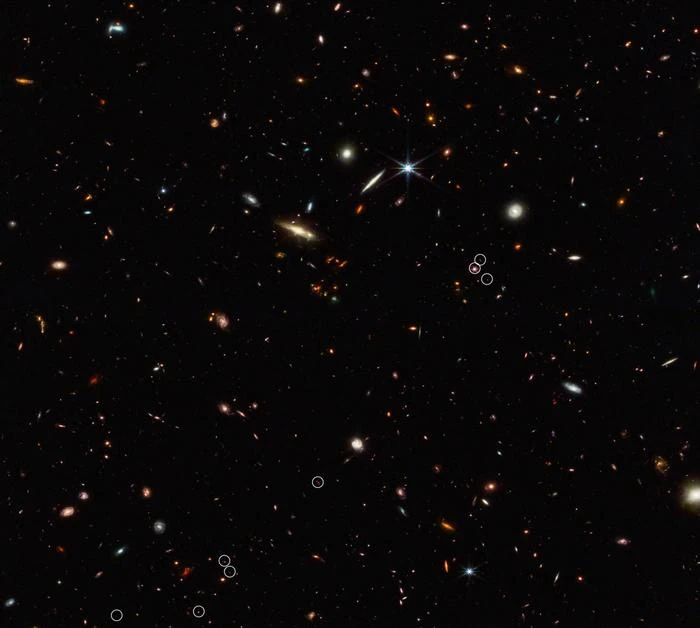
Galaxies are not scattered randomly across the universe. They gather together not only into clusters, but into vast interconnected filamentary structures with gigantic barren voids in between. This “cosmic web” started out tenuous and became more distinct over time as gravity drew matter together.
Astronomers using NASA’s James Webb Space Telescope have discovered a thread-like arrangement of 10 galaxies that existed just 830 million years after the big bang. The 3 million light-year-long structure is anchored by a luminous quasar – a galaxy with an active, supermassive black hole at its core. The team believes the filament will eventually evolve into a massive cluster of galaxies, much like the well-known Coma Cluster in the nearby universe.
“I was surprised by how long and how narrow this filament is,” said team member Xiaohui Fan of the University of Arizona in Tucson. “I expected to find something, but I didn't expect such a long, distinctly thin structure.”
“This is one of the earliest filamentary structures that people have ever found associated with a distant quasar,” added Feige Wang of the University of Arizona in Tucson, the principal investigator of this program.
This discovery is from the ASPIRE project (A SPectroscopic survey of biased halos In the Reionization Era), whose main goal is to study the cosmic environments of the earliest black holes. In total, the program will observe 25 quasars that existed within the first billion years after the big bang, a time known as the Epoch of Reionization.
“The last two decades of cosmology research have given us a robust understanding of how the cosmic web forms and evolves. ASPIRE aims to understand how to incorporate the emergence of the earliest massive black holes into our current story of the formation of cosmic structure,” explained team member Joseph Hennawi of the University of California, Santa Barbara.
Growing Monsters
Another part of the study investigates the properties of eight quasars in the young universe. The team confirmed that their central black holes, which existed less than a billion years after the big bang, range in mass from 600 million to 2 billion times the mass of our Sun. Astronomers continue seeking evidence to explain how these black holes could grow so large so fast.
“To form these supermassive black holes in such a short time, two criteria must be satisfied. First, you need to start growing from a massive ‘seed’ black hole. Second, even if this seed starts with a mass equivalent to a thousand Suns, it still needs to accrete a million times more matter at the maximum possible rate for its entire lifetime,” explained Wang.
“These unprecedented observations are providing important clues about how black holes are assembled. We have learned that these black holes are situated in massive young galaxies that provide the reservoir of fuel for their growth,” said Jinyi Yang of the University of Arizona, who is leading the study of black holes with ASPIRE.
Webb also provided the best evidence yet of how early supermassive black holes potentially regulate the formation of stars in their galaxies. While supermassive black holes accrete matter, they also can power tremendous outflows of material. These winds can extend far beyond the black hole itself, on a galactic scale, and can have a significant impact on the formation of stars.
“Strong winds from black holes can suppress the formation of stars in the host galaxy. Such winds have been observed in the nearby universe but have never been directly observed in the Epoch of Reionization,” said Yang. “The scale of the wind is related to the structure of the quasar. In the Webb observations, we are seeing that such winds existed in the early universe.”
These results were published in two papers in The Astrophysical Journal Letters on June 29.
The James Webb Space Telescope is the world's premier space science observatory. Webb will solve mysteries in our solar system, look beyond to distant worlds around other stars, and probe the mysterious structures and origins of our universe and our place in it. Webb is an international program led by NASA with its partners, ESA (European Space Agency), and CSA (Canadian Space Agency).
END
Astronomers using NASA’s James Webb Space Telescope have discovered a thread-like arrangement of 10 galaxies that existed just 830 million years after the big bang. The 3 million light-year-long structure is anchored by a luminous quasar – a galaxy with an active, supermassive black hole at its core. The team believes the filament will eventually evolve into a massive cluster of galaxies, much like the well-known Coma Cluster in the nearby universe.
“I was surprised by how long and how narrow this filament is,” said team member Xiaohui Fan of the University of Arizona in Tucson. “I expected to find something, but I didn't expect such a long, distinctly thin structure.”
“This is one of the earliest filamentary structures that people have ever found associated with a distant quasar,” added Feige Wang of the University of Arizona in Tucson, the principal investigator of this program.
This discovery is from the ASPIRE project (A SPectroscopic survey of biased halos In the Reionization Era), whose main goal is to study the cosmic environments of the earliest black holes. In total, the program will observe 25 quasars that existed within the first billion years after the big bang, a time known as the Epoch of Reionization.
“The last two decades of cosmology research have given us a robust understanding of how the cosmic web forms and evolves. ASPIRE aims to understand how to incorporate the emergence of the earliest massive black holes into our current story of the formation of cosmic structure,” explained team member Joseph Hennawi of the University of California, Santa Barbara.
Growing Monsters
Another part of the study investigates the properties of eight quasars in the young universe. The team confirmed that their central black holes, which existed less than a billion years after the big bang, range in mass from 600 million to 2 billion times the mass of our Sun. Astronomers continue seeking evidence to explain how these black holes could grow so large so fast.
“To form these supermassive black holes in such a short time, two criteria must be satisfied. First, you need to start growing from a massive ‘seed’ black hole. Second, even if this seed starts with a mass equivalent to a thousand Suns, it still needs to accrete a million times more matter at the maximum possible rate for its entire lifetime,” explained Wang.
“These unprecedented observations are providing important clues about how black holes are assembled. We have learned that these black holes are situated in massive young galaxies that provide the reservoir of fuel for their growth,” said Jinyi Yang of the University of Arizona, who is leading the study of black holes with ASPIRE.
Webb also provided the best evidence yet of how early supermassive black holes potentially regulate the formation of stars in their galaxies. While supermassive black holes accrete matter, they also can power tremendous outflows of material. These winds can extend far beyond the black hole itself, on a galactic scale, and can have a significant impact on the formation of stars.
“Strong winds from black holes can suppress the formation of stars in the host galaxy. Such winds have been observed in the nearby universe but have never been directly observed in the Epoch of Reionization,” said Yang. “The scale of the wind is related to the structure of the quasar. In the Webb observations, we are seeing that such winds existed in the early universe.”
These results were published in two papers in The Astrophysical Journal Letters on June 29.
The James Webb Space Telescope is the world's premier space science observatory. Webb will solve mysteries in our solar system, look beyond to distant worlds around other stars, and probe the mysterious structures and origins of our universe and our place in it. Webb is an international program led by NASA with its partners, ESA (European Space Agency), and CSA (Canadian Space Agency).
END