Displays controlled by flexible fins and liquid droplets more versatile, efficient than LED screens
Published 2023-06-30 · Original archive entry · Explore research explainers
CHAMPAIGN, Ill. — Flexible displays that can change color, convey information and even send veiled messages via infrared radiation are now possible, thanks to new research from the University of Illinois Urbana-Champaign. Engineers inspired by the morphing skins of animals like chameleons and octopuses have developed capillary-controlled robotic flapping fins to create switchable optical and infrared light multipixel displays that are 1,000 times more energy efficient than light-emitting devices.
The new study led by mechanical science and engineering professor Sameh Tawfick demonstrates how bendable fins and fluids can simultaneously switch between straight or bent and hot and cold by controlling the volume and temperature of tiny fluid-filled pixels. Varying the volume of fluids within the pixels can change the directions in which the flaps flip – similar to old-fashioned flip clocks – and varying the temperature allows the pixels to communicate via infrared energy.
The study findings are published in the journal Science Advances.
Tawfick’s interest in the interaction of elastic and capillary forces – or elasto-capillarity – started as a graduate student, spanned the basic science of hair wetting and led to his research in soft robotic displays at Illinois.
“An everyday example of elasto-capillarity is what happens to our hair when we get in the shower,” Tawfick said. “When our hair gets wet, it sticks together and bends or bundles as capillary forces are applied and released when it dries out.”
In the lab, the team created small boxes, or pixels, a few millimeters in size, that contain fins made of a flexible polymer that bend when the pixels are filled with fluid and drained using a system of tiny pumps. The pixels can have single or multiple fins and are arranged into arrays that form a display to convey information, Tawfick said.
Click here to see a video of a single-fin arrangement
Click here to see a video of a four-fin arrangement
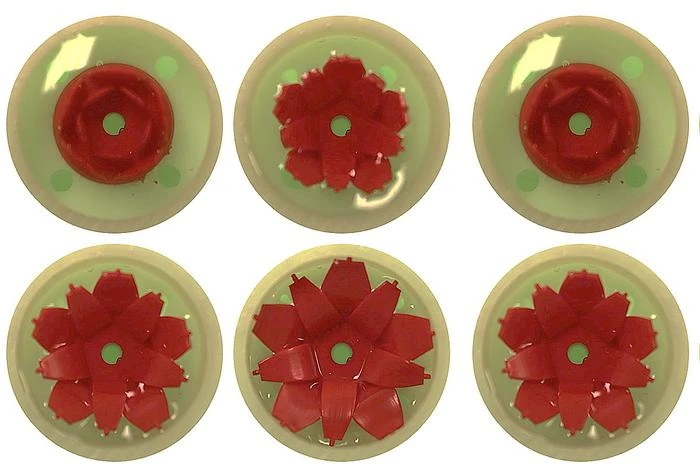
“We are not limited to cubic pixel boxes, either,” Tawfick said. “The fins can be arranged in various orientations to create different images, even along curved surfaces. The control is precise enough to achieve complex motions, like simulating the opening of a flower bloom.”
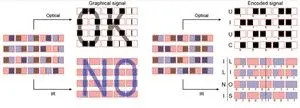
The study reports that another feature of the new displays is the ability to send two simultaneous signals – one that can be seen with the human eye and another that can only be seen with an infrared camera.
“Because we can control the temperature of these individual droplets, we can display messages that can only be seen using an infrared device,” Tawfick said, “Or we can send two different messages at the same time.”
However, there are a few limitations to the new displays, Tawfick said.
While building the new devices, the team found that the tiny pumps needed to control the pixel fluids were not commercially available, and the entire device is sensitive to gravity – meaning that it only works while in a horizontal position.
“Once we turn the display by 90 degrees, the performance is greatly degraded, which is detrimental to applications like billboards and other signs intended for the public,” Tawfick said. “The good news is, we know that when liquid droplets become small enough, they become insensitive to gravity, like when you see a rain droplet sticking on your window and it doesn’t fall. We have found that if we use fluid droplets that are five times smaller, gravity will no longer be an issue.”
The team said that because the science behind gravity’s effect on droplets is well understood, it will provide the focal point for their next application of the emerging technology.
Tawfick said he is very excited to see where this technology is headed because it brings a fresh idea to a big market space of large reflective displays. “We have developed a whole new breed of displays that require minimal energy, are scaleable and even flexible enough to be placed onto curved surfaces.”
Illinois researchers Jonghyun Ha, Yun Seong Kim, Chengzhang Li, Jonghyun Hwang, Sze Chai Leung and Ryan Siu also participated in this research.
The Airforce Office of Scientific Research and the National Science Foundation supported this research.
Editor’s notes:
To reach Sameh Tawfick, call (217) 244-6303; email tawfick@illinois.edu.
The paper “Polymorphic display and texture integrated systems controlled by capillarity” is available online. DOI: 10.1126/sciadv.adh1321
END
The new study led by mechanical science and engineering professor Sameh Tawfick demonstrates how bendable fins and fluids can simultaneously switch between straight or bent and hot and cold by controlling the volume and temperature of tiny fluid-filled pixels. Varying the volume of fluids within the pixels can change the directions in which the flaps flip – similar to old-fashioned flip clocks – and varying the temperature allows the pixels to communicate via infrared energy.
The study findings are published in the journal Science Advances.
Tawfick’s interest in the interaction of elastic and capillary forces – or elasto-capillarity – started as a graduate student, spanned the basic science of hair wetting and led to his research in soft robotic displays at Illinois.
“An everyday example of elasto-capillarity is what happens to our hair when we get in the shower,” Tawfick said. “When our hair gets wet, it sticks together and bends or bundles as capillary forces are applied and released when it dries out.”
In the lab, the team created small boxes, or pixels, a few millimeters in size, that contain fins made of a flexible polymer that bend when the pixels are filled with fluid and drained using a system of tiny pumps. The pixels can have single or multiple fins and are arranged into arrays that form a display to convey information, Tawfick said.
Click here to see a video of a single-fin arrangement
Click here to see a video of a four-fin arrangement
“We are not limited to cubic pixel boxes, either,” Tawfick said. “The fins can be arranged in various orientations to create different images, even along curved surfaces. The control is precise enough to achieve complex motions, like simulating the opening of a flower bloom.”
The study reports that another feature of the new displays is the ability to send two simultaneous signals – one that can be seen with the human eye and another that can only be seen with an infrared camera.
“Because we can control the temperature of these individual droplets, we can display messages that can only be seen using an infrared device,” Tawfick said, “Or we can send two different messages at the same time.”
However, there are a few limitations to the new displays, Tawfick said.
While building the new devices, the team found that the tiny pumps needed to control the pixel fluids were not commercially available, and the entire device is sensitive to gravity – meaning that it only works while in a horizontal position.
“Once we turn the display by 90 degrees, the performance is greatly degraded, which is detrimental to applications like billboards and other signs intended for the public,” Tawfick said. “The good news is, we know that when liquid droplets become small enough, they become insensitive to gravity, like when you see a rain droplet sticking on your window and it doesn’t fall. We have found that if we use fluid droplets that are five times smaller, gravity will no longer be an issue.”
The team said that because the science behind gravity’s effect on droplets is well understood, it will provide the focal point for their next application of the emerging technology.
Tawfick said he is very excited to see where this technology is headed because it brings a fresh idea to a big market space of large reflective displays. “We have developed a whole new breed of displays that require minimal energy, are scaleable and even flexible enough to be placed onto curved surfaces.”
Illinois researchers Jonghyun Ha, Yun Seong Kim, Chengzhang Li, Jonghyun Hwang, Sze Chai Leung and Ryan Siu also participated in this research.
The Airforce Office of Scientific Research and the National Science Foundation supported this research.
Editor’s notes:
To reach Sameh Tawfick, call (217) 244-6303; email tawfick@illinois.edu.
The paper “Polymorphic display and texture integrated systems controlled by capillarity” is available online. DOI: 10.1126/sciadv.adh1321
END
Attachments