Astrophysicists propose a new way of measuring cosmic expansion: lensed gravitational waves
Published 2023-06-30 · Original archive entry · Explore research explainers
(Santa Barbara, Calif.) — The universe is expanding; we’ve had evidence of that for about a century. But just how quickly celestial objects are receding from each other is still up for debate.
It’s no small feat to measure the rate at which objects move away from each other across vast distances. Since the discovery of cosmic expansion, its rate has been measured and re-measured with increasing precision, with some of the latest values ranging from 67.4 up to 76.5 kilometers per second per megaparsec, which relates the recession velocity (in kilometers per second) to the distance (in megaparsecs).
The discrepancy between different measurements of cosmic expansion is called the “Hubble tension.” Some have called it a crisis in cosmology. But for UC Santa Barbara theoretical astrophysicist Tejaswi Venumadhav Nerella and colleagues at the Tata Institute of Fundamental Research in Bangalore, India, and the Inter-University Center for Astronomy and Astrophysics in Pune, India, it is an exciting time.
Since the first detection of gravitational waves in 2015, detectors have been significantly improved and are poised to yield a rich haul of signals in the coming years. Nerella and his colleagues have come up with a method to use these signals to measure the universe’s expansion, and perhaps help to settle the debate once and for all. “A major scientific goal of future detectors is to deliver a comprehensive catalog of gravitational wave events, and this will be a completely novel use of the remarkable dataset,” said Nerella, co-author of a paper published in Physical Review Letters.
Measurements of the cosmic expansion rate boil down to velocity and distance. Astronomers use two kinds of methods to measure distances: the first start with objects with a known length (“standard rulers”) and look at how big they appear in the sky. These "objects" are features in cosmic background radiation, or in the distribution of galaxies in the universe.
A second class of methods starts with objects of known luminosity (“standard candles”) and measures their distances from Earth using their apparent brightness. These distances are connected to those of farther bright objects and so on, which builds up a chain of measurement schemes that is often called the “cosmic distance ladder.” Incidentally, gravitational waves themselves can also help measure cosmic expansion, since the energy released by the collision of neutron stars or black holes can be used to estimate the distance to these objects.
The method that Nerella and his co-authors propose belongs to the second class but uses gravitational lensing. This is a phenomenon that occurs when massive objects warp spacetime, and bend waves of all kinds that travel near the objects. In rare cases, lensing can produce multiple copies of the same gravitational wave signal that reach Earth at different times — the delays between the signals for a population of multiple imaged events can be used to calculate the universe’s expansion rate, according to the researchers.
“We understand very well just how sensitive gravitational wave detectors are, and there are no astrophysical sources of confusion, so we can properly account for what gets into our catalog of events,” Nerella said. “The new method has sources of error that are complementary to those of existing methods, which makes it a good discriminator.”
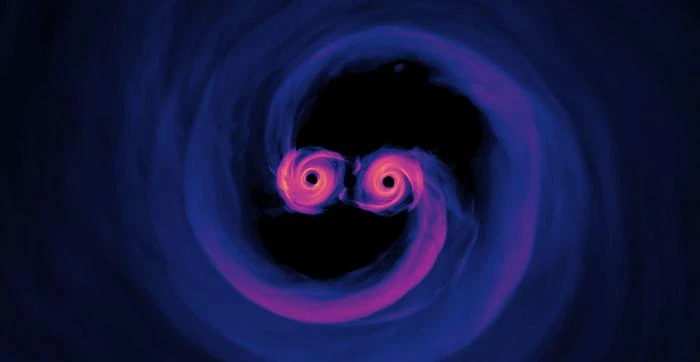
The sources of these signals would be binary black holes: systems of two black holes that orbit each other and ultimately merge, releasing massive amounts of energy in the form of gravitational waves. We haven’t yet detected strongly lensed examples of these signals, but the upcoming generation of ground-based detectors is expected to have the necessary level of sensitivity.
“We expect the first observation of lensed gravitational waves in the next few years,” said study co-author Parameswaran Ajith. Additionally, these future detectors should be able to see farther into space and detect weaker signals.
The authors expect these advanced detectors to start their search for merging black holes in the next decade. They anticipate recording signals from a few million black hole pairs, a small fraction (about 10,000) of which will appear multiple times in the same detector due to gravitational lensing. The distribution of the delays between these repeat appearances encodes the Hubble expansion rate.
According to lead author Souvik Jana, unlike other methods of measurement, this method does not rely on knowing the exact locations of, or the distances to, these binary black holes. The only requirement is to accurately identify a sufficiently large number of these lensed signals. The researchers add that observations of lensed gravitational waves can even provide clues on other cosmological questions, such as the nature of the invisible dark matter that makes up much of the energy content of the universe.
END
It’s no small feat to measure the rate at which objects move away from each other across vast distances. Since the discovery of cosmic expansion, its rate has been measured and re-measured with increasing precision, with some of the latest values ranging from 67.4 up to 76.5 kilometers per second per megaparsec, which relates the recession velocity (in kilometers per second) to the distance (in megaparsecs).
The discrepancy between different measurements of cosmic expansion is called the “Hubble tension.” Some have called it a crisis in cosmology. But for UC Santa Barbara theoretical astrophysicist Tejaswi Venumadhav Nerella and colleagues at the Tata Institute of Fundamental Research in Bangalore, India, and the Inter-University Center for Astronomy and Astrophysics in Pune, India, it is an exciting time.
Since the first detection of gravitational waves in 2015, detectors have been significantly improved and are poised to yield a rich haul of signals in the coming years. Nerella and his colleagues have come up with a method to use these signals to measure the universe’s expansion, and perhaps help to settle the debate once and for all. “A major scientific goal of future detectors is to deliver a comprehensive catalog of gravitational wave events, and this will be a completely novel use of the remarkable dataset,” said Nerella, co-author of a paper published in Physical Review Letters.
Measurements of the cosmic expansion rate boil down to velocity and distance. Astronomers use two kinds of methods to measure distances: the first start with objects with a known length (“standard rulers”) and look at how big they appear in the sky. These "objects" are features in cosmic background radiation, or in the distribution of galaxies in the universe.
A second class of methods starts with objects of known luminosity (“standard candles”) and measures their distances from Earth using their apparent brightness. These distances are connected to those of farther bright objects and so on, which builds up a chain of measurement schemes that is often called the “cosmic distance ladder.” Incidentally, gravitational waves themselves can also help measure cosmic expansion, since the energy released by the collision of neutron stars or black holes can be used to estimate the distance to these objects.
The method that Nerella and his co-authors propose belongs to the second class but uses gravitational lensing. This is a phenomenon that occurs when massive objects warp spacetime, and bend waves of all kinds that travel near the objects. In rare cases, lensing can produce multiple copies of the same gravitational wave signal that reach Earth at different times — the delays between the signals for a population of multiple imaged events can be used to calculate the universe’s expansion rate, according to the researchers.
“We understand very well just how sensitive gravitational wave detectors are, and there are no astrophysical sources of confusion, so we can properly account for what gets into our catalog of events,” Nerella said. “The new method has sources of error that are complementary to those of existing methods, which makes it a good discriminator.”
The sources of these signals would be binary black holes: systems of two black holes that orbit each other and ultimately merge, releasing massive amounts of energy in the form of gravitational waves. We haven’t yet detected strongly lensed examples of these signals, but the upcoming generation of ground-based detectors is expected to have the necessary level of sensitivity.
“We expect the first observation of lensed gravitational waves in the next few years,” said study co-author Parameswaran Ajith. Additionally, these future detectors should be able to see farther into space and detect weaker signals.
The authors expect these advanced detectors to start their search for merging black holes in the next decade. They anticipate recording signals from a few million black hole pairs, a small fraction (about 10,000) of which will appear multiple times in the same detector due to gravitational lensing. The distribution of the delays between these repeat appearances encodes the Hubble expansion rate.
According to lead author Souvik Jana, unlike other methods of measurement, this method does not rely on knowing the exact locations of, or the distances to, these binary black holes. The only requirement is to accurately identify a sufficiently large number of these lensed signals. The researchers add that observations of lensed gravitational waves can even provide clues on other cosmological questions, such as the nature of the invisible dark matter that makes up much of the energy content of the universe.
END