Synchronizing your internal clocks may help mitigate jet lag, effects of aging
A hearty breakfast instead of a midnight snack could lead to better sleep when traveling
Published 2023-09-05 · Original archive entry · Explore research explainers
WASHINGTON, Sept. 5, 2023 -- Traveling to faraway places is a great way to seek out new experiences, but jet lag can be an unpleasant side effect. Adjusting to a new time zone is often accompanied by fatigue, difficulty sleeping, and a host of other problems that can turn an otherwise exciting adventure into a miserable trip.
Jet lag is caused by a difference between the circadian system — the body’s internal clock — and the surrounding environment. Around the turn of the century, scientists began to recognize that the body has multiple internal clocks, calibrated in different ways, and that jet lag-like symptoms can result when these clocks drift out of sync with each other. This can happen in several ways and grows more prevalent with age.
In Chaos, from AIP Publishing, a team of scientists from Northwestern University and the Santa Fe Institute developed a theoretical model to study the interactions between multiple internal clocks under the effects of aging and disruptions like jet lag.
Modern research has shown that circadian clocks are present in almost every cell and tissue in the body. Each relies on its own set of cues to calibrate; the brain’s clock depends on sunlight, for instance, while the peripheral organs calibrate at mealtime.
“Conflicting signals, such as warm weather during a short photoperiod or nighttime eating — eating when your brain is about to rest — can confuse internal clocks and cause desynchrony,” said author Yitong Huang.
At this point, little is known about how the body’s various internal clocks affect each other. The added complexity of accounting for multiple clocks means researchers tend to use simplified models.
“Most studies primarily focus on one particular time cue or a single clock,” said Huang. “Important gaps remain in our understanding of the synchronization of multiple clocks under conflicting time cues.”
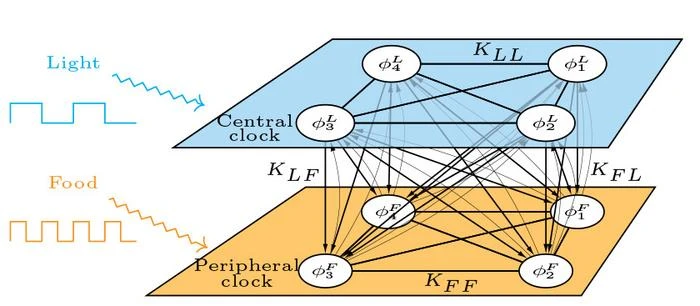
Huang and her colleagues took a different approach, building a mathematical framework that accounts for this complex interplay between systems. Their model features two populations of coupled oscillators that mimic the natural rhythms of circadian cycles. Each oscillator influences the others while simultaneously adjusting based on unique external cues.
Using this model, the team was able to explore how such a coupled system could be disrupted and what makes the effect worse. They found that common symptoms of aging, such as weaker signals between circadian clocks and a lower sensitivity to light, result in a system that is more vulnerable to disruptions and slower to recover.
They also landed on a new method to speed up recovery from jet lag and similar disruptions. According to their results, the way to better sleep is through the stomach.
“Having a larger meal in the early morning of the new time zone can help overcome jet lag,” says Huang. “Constantly shifting meal schedules or having a meal at night is discouraged, as it can lead to misalignment between internal clocks.”
The authors plan to investigate the other side of the equation and identify the factors that result in more resilient internal clocks. Such discoveries could result in recommendations to prevent jet lag in the first place, or to keep the circadian system healthy into old age.
The article, "A minimal model of peripheral clocks reveals differential circadian re-entrainment in aging," is authored by Yitong Huang, Yuanzhao Zhang, and Rosemary Braun. It will appear in Chaos on Sept. 5, 2023 (DOI: 10.1063/5.0157524). After that date, it can be accessed at https://doi.org/10.1063/5.0157524.
ABOUT THE JOURNAL
Chaos is devoted to increasing the understanding of nonlinear phenomena in all areas of science and engineering and describing their manifestations in a manner comprehensible to researchers from a broad spectrum of disciplines. See https://pubs.aip.org/aip/cha.
###
END
Jet lag is caused by a difference between the circadian system — the body’s internal clock — and the surrounding environment. Around the turn of the century, scientists began to recognize that the body has multiple internal clocks, calibrated in different ways, and that jet lag-like symptoms can result when these clocks drift out of sync with each other. This can happen in several ways and grows more prevalent with age.
In Chaos, from AIP Publishing, a team of scientists from Northwestern University and the Santa Fe Institute developed a theoretical model to study the interactions between multiple internal clocks under the effects of aging and disruptions like jet lag.
Modern research has shown that circadian clocks are present in almost every cell and tissue in the body. Each relies on its own set of cues to calibrate; the brain’s clock depends on sunlight, for instance, while the peripheral organs calibrate at mealtime.
“Conflicting signals, such as warm weather during a short photoperiod or nighttime eating — eating when your brain is about to rest — can confuse internal clocks and cause desynchrony,” said author Yitong Huang.
At this point, little is known about how the body’s various internal clocks affect each other. The added complexity of accounting for multiple clocks means researchers tend to use simplified models.
“Most studies primarily focus on one particular time cue or a single clock,” said Huang. “Important gaps remain in our understanding of the synchronization of multiple clocks under conflicting time cues.”
Huang and her colleagues took a different approach, building a mathematical framework that accounts for this complex interplay between systems. Their model features two populations of coupled oscillators that mimic the natural rhythms of circadian cycles. Each oscillator influences the others while simultaneously adjusting based on unique external cues.
Using this model, the team was able to explore how such a coupled system could be disrupted and what makes the effect worse. They found that common symptoms of aging, such as weaker signals between circadian clocks and a lower sensitivity to light, result in a system that is more vulnerable to disruptions and slower to recover.
They also landed on a new method to speed up recovery from jet lag and similar disruptions. According to their results, the way to better sleep is through the stomach.
“Having a larger meal in the early morning of the new time zone can help overcome jet lag,” says Huang. “Constantly shifting meal schedules or having a meal at night is discouraged, as it can lead to misalignment between internal clocks.”
The authors plan to investigate the other side of the equation and identify the factors that result in more resilient internal clocks. Such discoveries could result in recommendations to prevent jet lag in the first place, or to keep the circadian system healthy into old age.
The article, "A minimal model of peripheral clocks reveals differential circadian re-entrainment in aging," is authored by Yitong Huang, Yuanzhao Zhang, and Rosemary Braun. It will appear in Chaos on Sept. 5, 2023 (DOI: 10.1063/5.0157524). After that date, it can be accessed at https://doi.org/10.1063/5.0157524.
ABOUT THE JOURNAL
Chaos is devoted to increasing the understanding of nonlinear phenomena in all areas of science and engineering and describing their manifestations in a manner comprehensible to researchers from a broad spectrum of disciplines. See https://pubs.aip.org/aip/cha.
###
END
Attachments