PRESS-NEWS.org - Press Release Distribution
PRESS RELEASES DISTRIBUTION

Apoptotic cells may drive cell death in hair follicles during regression cycle
Apoptotic cells may drive cell death in hair follicles during regression cycle
2023-10-23
(Press-News.org)

“Revealing the stem cell niche self-renewal dynamics is important not only for understanding tissue homeostasis but also for understanding the initiation of cancer [7].”

BUFFALO, NY- October 23, 2023 – A new research paper was published in Oncotarget's Volume 14 on October 19, 2023, entitled, “Apoptotic cells may drive cell death in hair follicles during their regression cycle.”

Intravital microscopy in live mice has shown that the elimination of epithelial cells during hair follicle regression involves supra-basal cell differentiation and basal cell apoptosis through synergistic action of TGF-β (transforming growth factor) and mesenchymal-epithelial interactions. In this process the basal epithelial cells are not internally committed to death and the mesenchymal dermal papilla (DP) plays an essential role in death induction. Given that DP cells are not necessary for completion of the cycle, only for its initiation, it is still an open question as to the mechanism that leads to the propagation of apoptosis towards the regenerative stem cell population.

In their new study, researchers Bradley D. Keister, Kailin R. Mesa and Krastan B. Blagoev from the National Science Foundation, The Jane Coffin Childs Memorial Fund for Medical Research, Yale School of Medicine, Johns Hopkins University, Bulgarian Academy of Sciences, and Sorbonne Université performed a quantitative analysis of the length of hair follicles to investigate their regression cycle. 

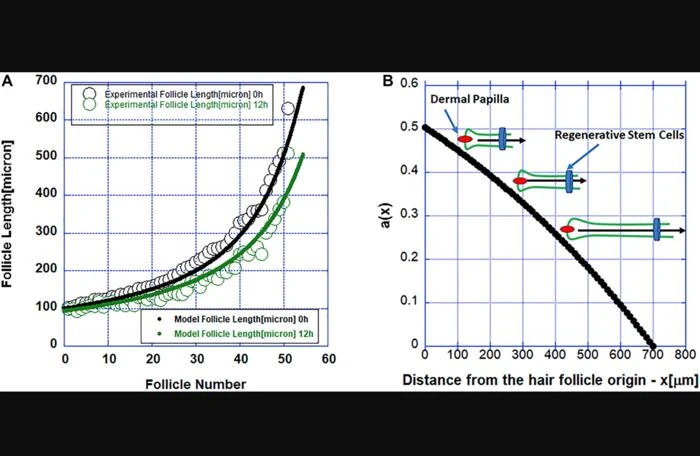
“In this paper we introduced a mathematical model of the hair follicle regression cycle that postulates that the regression is initiated by the dermal papilla, but that this signal affects only the cells adjacent to it.”

The data are consistent with a propagation mechanism driven by apoptotic cells inducing apoptosis in their neighboring cells. The observation that the apoptosis slows down as the apoptotic front approaches the stem cells at the end of the follicle is consistent with a gradient of a pro-survival signal sent by these stem cells. An experiment that can falsify this mechanism is proposed.

“In conclusion, hair follicle regression may be governed by cell-cell induced programmed cell death, which slows down as the stem cell compartment is approached and does not affect the stem cell compartment from which the growth phase is initiated. The class of models introduced here can be used to describe the renewal kinetics of other stem cell niches like the intestinal stem cell niche [18].”


Read the full study: DOI: https://doi.org/10.18632/oncotarget.28529 

Correspondence to: Krastan B. Blagoev

Email: kblagoev@nsf.gov 

Keywords: hair follicle, stem cells, regression cycle, mathematical model, analysis
 

About Oncotarget: Oncotarget (a primarily oncology-focused, peer-reviewed, open access journal) aims to maximize research impact through insightful peer-review; eliminate borders between specialties by linking different fields of oncology, cancer research and biomedical sciences; and foster application of basic and clinical science.

To learn more about Oncotarget, visit Oncotarget.com and connect with us on social media:

X, formerly known as Twitter  Facebook  YouTube  Instagram  LinkedIn  Pinterest  LabTube Soundcloud  

Sign up for free Altmetric alerts about this article: https://oncotarget.altmetric.com/details/email_updates?id=10.18632%2Foncotarget.28529 

Click here to subscribe to Oncotarget publication updates.

For media inquiries, please contact: media@impactjournals.com.


Oncotarget Journal Office

6666 East Quaker Str., Suite 1A

Orchard Park, NY 14127

Phone: 1-800-922-0957 (option 2)

###

END

[Attachments] See images for this press release:
Apoptotic cells may drive cell death in hair follicles during regression cycle Apoptotic cells may drive cell death in hair follicles during regression cycle 2 Apoptotic cells may drive cell death in hair follicles during regression cycle 3

ELSE PRESS RELEASES FROM THIS DATE:

$3.6 million NIH award funds research to treat painful diabetic neuropathy

$3.6 million NIH award funds research to treat painful diabetic neuropathy
2023-10-23
COLUMBUS, Ohio – A $3.6 million award from the National Institutes of Health will allow neurosurgical, neurology and neuroscience researchers at The Ohio State University Wexner Medical Center and College of Medicine to test a novel diagnosis and treatment combination for painful diabetic neuropathy. The approach combines spinal cord stimulation with measurement of small fiber nerve activity using a patent-pending device called Detecting Early Neuropathy (DEN). Diabetes is a growing health concern worldwide, ...

Superdeep diamonds provide a window on supercontinent growth

Superdeep diamonds provide a window on supercontinent growth
2023-10-23
Washington, DC—Diamonds contain evidence of the mantle rocks that helped buoy and grow the ancient supercontinent Gondwana from below, according to new research from a team of scientists led by Suzette Timmerman—formerly of the University of Alberta and now at the University of Bern—and including Carnegie’s Steven Shirey, Michael Walter, and Andrew Steele. Their findings, published in Nature, demonstrate that superdeep diamonds can provide a window through space and time into the supercontinent growth and formation ...

American Cancer Society awards pilot funding to University of Cincinnati Cancer Center for early-stage investigators

American Cancer Society awards pilot funding to University of Cincinnati Cancer Center for early-stage investigators
2023-10-23
The American Cancer Society has awarded the University of Cincinnati Cancer Center an Institutional Research Grant. Cancer Center member David Plas, PhD, is primary investigator for the grant, with members Maria Czyzyk-Krzeska, MD, PhD, and Kathryn Wikenheiser-Brokamp, MD, PhD, serving as co-principal investigators. The American Cancer Society awards Institutional Research Grants to academic and nonprofit organizations that have a track record of outstanding cancer research and a pool of experienced researchers who can mentor junior faculty. The purpose is to support early-stage ...

Climate is increasing risk of high toxin concentrations in Northern US lakes

Climate is increasing risk of high toxin concentrations in Northern US lakes
2023-10-23
Washington, DC— As climate change warms the Earth, higher-latitude regions will be at greater risk for toxins produced by algal blooms, according to new research led by Carnegie’s Anna Michalak, Julian Merder, and Gang Zhao. Their findings, published in Nature Water, identify water temperatures of 20 to 25 degrees Celsius (68 to 77 degrees Fahrenheit) as being at the greatest risk for developing dangerous levels of a common algae-produced toxin called microcystin.   Harmful algal blooms result when bodies of water get overloaded with nitrogen and phosphorus ...

Breastfeeding in the setting of substance use

Breastfeeding in the setting of substance use
2023-10-23
The Academy of Breastfeeding Medicine (ABM) has released new literature-based recommendations related to breastfeeding in the setting of substance use and substance use disorder (SUD) treatments. The new clinical protocol is published in the peer-reviewed journal Breastfeeding Medicine. Click here to read the article now. Miriam Harris, MD and Elisha Wachman, MD, from Boston Medical Center, and coauthors, provide breastfeeding recommendations in the setting of non-prescribed opioid, stimulant, sedative-hypnotic, alcohol, nicotine, and cannabis use, and SUD treatments. They also offer guidance on the use of toxicology testing in breastfeeding ...

New exoplanet-informed research sets clearer bounds on the search for radio technosignatures

New exoplanet-informed research sets clearer bounds on the search for radio technosignatures
2023-10-23
A new study leverages the NASA Exoplanet Archive and planetary system simulations to make narrowband SETI searches more efficient. October 23, 2023, Mountain View, CA -- In a new study published in the Astronomical Journal, researchers used the known population of exoplanets and extrapolated to the much larger, unknown population of exoplanets to set better thresholds for planetary effects on signals from ETIs (extraterrestrial intelligences). The prior recommendation for the threshold “drift rate” contribution, caused by a planet’s motion around its host star, was 200 nHz. In this work, lead ...

Navigating the future of skin health: The 14Th International Conference on Skin Ageing & Challenges 2023

Navigating the future of skin health: The 14Th International Conference on Skin Ageing & Challenges 2023
2023-10-23
Lisbon, Portugal – 23 October, 2023 The International Society of Microbiota (ISM) is proud to present the 14th International Conference on Skin Ageing & Challenges 2023. This monumental event will unfold at the Altis Grand Hotel in Lisbon, Portugal, and virtually, on November 9-10, 2023. Skin ageing, a multifaceted issue combining both basic research, mechanistic, clinical aspects and health concerns, is gaining significant attention in the scientific community. This year’s conference promises to be a beacon of innovation, ...

Gut fungi's lasting impact on severe COVID-19 immune response

2023-10-23
Certain gut-dwelling fungi flourish in severe cases of COVID-19, amplifying the excessive inflammation that drives this disease while also causing long-lasting changes in the immune system, according to a new study led by investigators at Weill Cornell Medicine and NewYork-Presbyterian. This discovery identifies a group of patients who may benefit from specialized, but yet-to-be determined treatments. Utilizing patient samples and preclinical models, the research team determined that the growth of fungi in the intestinal ...

Who were the first modern humans to settle in Europe?

Who were the first modern humans to settle in Europe?
2023-10-23
Before modern humans settled definitively in Europe, other human populations left Africa for Europe beginning approximately 60,000 years ago, albeit without settling for the long term. This was due to a major climatic crisis 40,000 years ago, combined with a super-eruption originating from the Phlegraean Fields volcanic area near current-day Naples, subsequently precipitating a decline in ancient European populations. To determine who the first modern humans to settle definitively in Europe were, a team led by CNRS scientists1 analysed the genome of two skull ...

Alem & Narayanan advancing infectious disease capabilities through Biomedical Research Laboratory core support

2023-10-23
Alem & Narayanan Advancing Infectious Disease Capabilities Through Biomedical Research Laboratory Core Support Farhang Alem, Interim Director of the Biomedical Research Laboratory, Institute for Biohealth Innovation, and Aarthi Narayanan, Professor, Biology, received funding for the project: "Advancing Infectious Disease Capabilities through BRL Core Support." As part of this project, Alem and Narayanan will: 1) implement a comprehensive BSL-3 facilities preventative maintenance and upgrade plan to ensure continuity of operations, compliance with federal regulations, and a safe and secure facility; 2) enhance safety ...

LAST 30 PRESS RELEASES:

Making lighter work of calculating fluid and heat flow

Normalizing blood sugar can halve heart attack risk

Lowering blood sugar cuts heart attack risk in people with prediabetes

Study links genetic variants to risk of blinding eye disease in premature infants

Non-opioid ‘pain sponge’ therapy halts cartilage degeneration and relieves chronic pain

AI can pick up cultural values by mimicking how kids learn

China’s ecological redlines offer fast track to 30 x 30 global conservation goal

Invisible indoor threats: emerging household contaminants and their growing risks to human health

Adding antibody treatment to chemo boosts outcomes for children with rare cancer

Germline pathogenic variants among women without a history of breast cancer

Tanning beds triple melanoma risk, potentially causing broad DNA damage

Unique bond identified as key to viral infection speed

Indoor tanning makes youthful skin much older on a genetic level

Mouse model sheds new light on the causes and potential solutions to human GI problems linked to muscular dystrophy

The Journal of Nuclear Medicine ahead-of-print tip sheet: December 12, 2025

Smarter tools for peering into the microscopic world

Applications open for funding to conduct research in the Kinsey Institute archives

Global measure underestimates the severity of food insecurity

Child survivors of critical illness are missing out on timely follow up care

Risk-based vs annual breast cancer screening / the WISDOM randomized clinical trial

University of Toronto launches Electric Vehicle Innovation Ontario to accelerate advanced EV technologies and build Canada’s innovation advantage

Early relapse predicts poor outcomes in aggressive blood cancer

American College of Lifestyle Medicine applauds two CMS models aligned with lifestyle medicine practice and reimbursement

Clinical trial finds cannabis use not a barrier to quitting nicotine vaping

Supplemental nutrition assistance program policies and food insecurity

Switching immune cells to “night mode” could limit damage after a heart attack, study suggests

URI-based Global RIghts Project report spotlights continued troubling trends in worldwide inhumane treatment

Neutrophils are less aggressive at night, explaining why nighttime heart attacks cause less damage than daytime events

Menopausal hormone therapy may not pose breast cancer risk for women with BRCA mutations

Mobile health tool may improve quality of life for adolescent and young adult breast cancer survivors

[Press-News.org] Apoptotic cells may drive cell death in hair follicles during regression cycle