Extremely rare bird captured on film
Published 2023-12-12 · Original archive entry · Explore research explainers
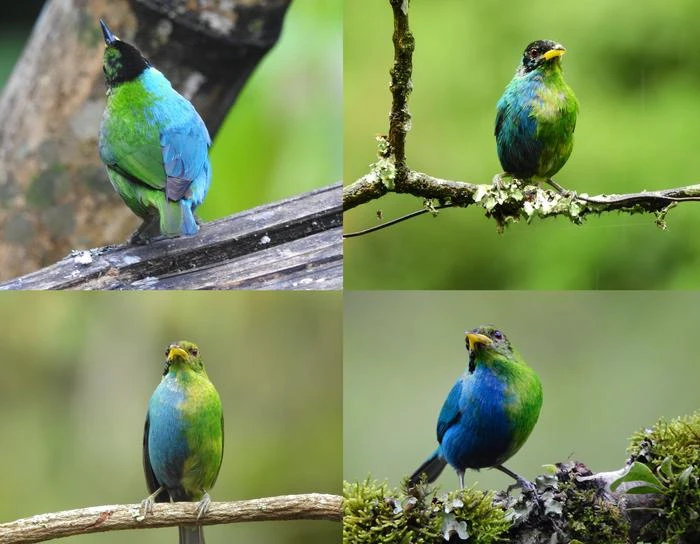
A striking and extremely rare half female, half male bird has been spotted by a University of Otago zoologist.
Sesquicentennial Distinguished Professor Hamish Spencer was holidaying in Colombia when an amateur ornithologist John Murillo pointed out a wild Green Honeycreeper with distinct half green, or female, and half blue, male, plumage.
“Many birdwatchers could go their whole lives and not see a bilateral gynandromorph in any species of bird. The phenomenon is extremely rare in birds, I know of no examples from New Zealand ever.
“It is very striking, I was very privileged to see it,” Professor Spencer says.
Photographs of the bird make the discovery even more significant as they are “arguably the best of a wild bilateral gynandromorphic bird of any species ever”.
A report on the find, only the second recorded example of gynandromorphism in the species in more than 100 years, has just been published in the Journal of Field Ornithology.
Professor Spencer says gynandromorphs – animals with both male and female characteristics in a species that usually have separate sexes – are important for our understanding of sex determination and sexual behaviour in birds.
The main groups in which the phenomenon has been recorded include animal species which feature strong sexual dimorphism; most often insects, especially butterflies, crustaceans, spiders, even lizards and rodents.
“This particular example of bilateral gynandromorphy – male one side and female the other – shows that, as in several other species, either side of the bird can be male or female.
“The phenomenon arises from an error during female cell division to produce an egg, followed by double-fertilization by two sperm,” he explains.
He hopes the novel discovery will inspire people to “treasure exceptions” as they always reveal something interesting.
“Be always on the lookout for oddities – who will find the first New Zealand example of a bilateral gynandromorph in a bird?”
END
Sesquicentennial Distinguished Professor Hamish Spencer was holidaying in Colombia when an amateur ornithologist John Murillo pointed out a wild Green Honeycreeper with distinct half green, or female, and half blue, male, plumage.
“Many birdwatchers could go their whole lives and not see a bilateral gynandromorph in any species of bird. The phenomenon is extremely rare in birds, I know of no examples from New Zealand ever.
“It is very striking, I was very privileged to see it,” Professor Spencer says.
Photographs of the bird make the discovery even more significant as they are “arguably the best of a wild bilateral gynandromorphic bird of any species ever”.
A report on the find, only the second recorded example of gynandromorphism in the species in more than 100 years, has just been published in the Journal of Field Ornithology.
Professor Spencer says gynandromorphs – animals with both male and female characteristics in a species that usually have separate sexes – are important for our understanding of sex determination and sexual behaviour in birds.
The main groups in which the phenomenon has been recorded include animal species which feature strong sexual dimorphism; most often insects, especially butterflies, crustaceans, spiders, even lizards and rodents.
“This particular example of bilateral gynandromorphy – male one side and female the other – shows that, as in several other species, either side of the bird can be male or female.
“The phenomenon arises from an error during female cell division to produce an egg, followed by double-fertilization by two sperm,” he explains.
He hopes the novel discovery will inspire people to “treasure exceptions” as they always reveal something interesting.
“Be always on the lookout for oddities – who will find the first New Zealand example of a bilateral gynandromorph in a bird?”
END
Attachments