The role of oxidized tryptophan residues in repairing damaged photosystem II protein
Researchers discover the recognition mechanism behind the repair of photosystem II reaction center protein D1 by FtsH protease
Published 2023-12-18 · Original archive entry · Explore research explainers
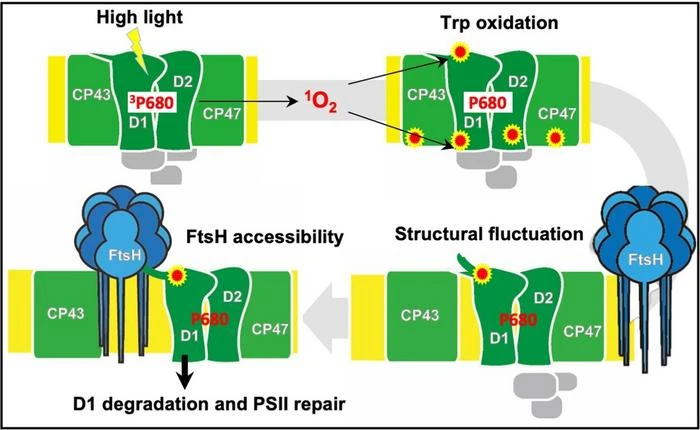
Photosynthesis refers to the fundamental biological process of the conversion of light energy into chemical energy by chlorophyll (a green pigment) containing plants. This seemingly routine process in plants sustains all the biological life and activities on Earth. First reaction of photosynthesis occurs at a site called photosystem II (PSII), present on the thylakoid membrane in the chloroplast where light energy is transferred to chlorophyll molecules. PSII is made up of a complex group of proteins, including the D1 and D2 reaction center proteins.
Light energy plays an important role in photosynthesis. However, a high amount of light energy can cause photo-oxidative damage in PSII, particularly to the D1 protein. The affected D1 protein is then broken down by FtsH—a protein-digesting enzyme—and a completely new D1 protein is synthesized in its place. However, how is the photo-damaged D1 protein recognized and selectively degraded by FtsH remains a mystery.
Recently, a team of researchers worked to uncover the signaling and recognition process underlying the FtsH-led D1 protein degradation event. The research team led by, Professor Wataru Sakamoto from the Institute of Plant Science and Resources (IPSR), Okayama University, Japan along with Dr. Yusuke Kato, from the Faculty of Agriculture, Setsunan University, Japan, and Dr. Shin-Ichiro Ozawa from the IPSR, Okayama University, Japan, employed an innovative combination of plant biotechnology and mass-spectrometry techniques to study the photo-oxidative repair mechanism. Their research findings were published in the eLife journal on November 21, 2023.
“The damaged photosystem-II can be understood as akin to a broken down industrial machine that needs to be repaired or replaced. I was drawn to this critical aspect of the repair/replacement process occurring during the photosynthesis, particularly the exact mechanism of this damage recognition and subsequent degradation by proteases,” says Professor Wataru Sakamoto, explaining the motivation behind this study.
The team examined the recognition mechanism by tracking the presence of oxidized tryptophan amino acid residues (Trp) in the D1 protein, particularly the N-terminal Trp-14 residue. They further understood the intricate details of the D1 protein recognition by FtsH by studying the oxidative post-translational modification (OPTM) of Trp-14 residues in a variety of modified mutant species of Arabidopsis (a model plant species) and Chlamydomonas (green algae). The researchers also used molecular dynamics (a computer-based simulation experiment) to study the functional aspects of the Trp-14 oxidation.
They observed that in addition to critically damaging the D1 protein, excess light oxidized 2 Trp residues in D1 of Arabidopsis and 4 Trp residues in Chlamydomonas, via OPTM, which marks the D1 protein for degradation by FtsH. Moreover, Arabidopsis mutant species lacking FtsH had more oxidative Trp residues in D1 and the replacement of Trp-14 to phenylalanine (Phe) in D1 of Chlamydomonas accelerated the degradation of D1 by FtsH.
“This study reveals that oxidative modification of specific amino acids can help in recognizing a damaged protein and lead to the ensuing repair mechanism. Understanding the functional aspects that sustain photosynthesis is important for our global environment, and improving the efficiency of photosynthesis processes may contribute to enhanced tolerant varieties of crops in the future,” concludes Dr. Sakamoto. We cannot wait to see what doors this research opens for improved crop cultivation!
About Okayama University, Japan
As one of the leading universities in Japan, Okayama University aims to create and establish a new paradigm for the sustainable development of the world. Okayama University offers a wide range of academic fields, which become the basis of integrated graduate schools. This not only allows us to conduct the most advanced and up-to-date research, but also provides an enriching educational experience.
Website: https://www.okayama-u.ac.jp/index_e.html
About Professor Wataru Sakamoto from Okayama University, Japan
Dr. Wataru Sakamoto is a Professor at the Institute of Plant Science and Resources (IPSR), Okayama University, Okayama, Japan. He is a part of the Plant Light Acclimation Research Group, which focuses on the research areas of light adaptation in plants, plant molecular genetics, and pollen mitosis. He received his Ph.D. degree from The University of Tokyo and completed his postdoctoral training at the Boyce Thomson Institute, Cornell University, USA. Over the last two decades, he has published numerous articles that have been cited over 8,100 times.
END
Light energy plays an important role in photosynthesis. However, a high amount of light energy can cause photo-oxidative damage in PSII, particularly to the D1 protein. The affected D1 protein is then broken down by FtsH—a protein-digesting enzyme—and a completely new D1 protein is synthesized in its place. However, how is the photo-damaged D1 protein recognized and selectively degraded by FtsH remains a mystery.
Recently, a team of researchers worked to uncover the signaling and recognition process underlying the FtsH-led D1 protein degradation event. The research team led by, Professor Wataru Sakamoto from the Institute of Plant Science and Resources (IPSR), Okayama University, Japan along with Dr. Yusuke Kato, from the Faculty of Agriculture, Setsunan University, Japan, and Dr. Shin-Ichiro Ozawa from the IPSR, Okayama University, Japan, employed an innovative combination of plant biotechnology and mass-spectrometry techniques to study the photo-oxidative repair mechanism. Their research findings were published in the eLife journal on November 21, 2023.
“The damaged photosystem-II can be understood as akin to a broken down industrial machine that needs to be repaired or replaced. I was drawn to this critical aspect of the repair/replacement process occurring during the photosynthesis, particularly the exact mechanism of this damage recognition and subsequent degradation by proteases,” says Professor Wataru Sakamoto, explaining the motivation behind this study.
The team examined the recognition mechanism by tracking the presence of oxidized tryptophan amino acid residues (Trp) in the D1 protein, particularly the N-terminal Trp-14 residue. They further understood the intricate details of the D1 protein recognition by FtsH by studying the oxidative post-translational modification (OPTM) of Trp-14 residues in a variety of modified mutant species of Arabidopsis (a model plant species) and Chlamydomonas (green algae). The researchers also used molecular dynamics (a computer-based simulation experiment) to study the functional aspects of the Trp-14 oxidation.
They observed that in addition to critically damaging the D1 protein, excess light oxidized 2 Trp residues in D1 of Arabidopsis and 4 Trp residues in Chlamydomonas, via OPTM, which marks the D1 protein for degradation by FtsH. Moreover, Arabidopsis mutant species lacking FtsH had more oxidative Trp residues in D1 and the replacement of Trp-14 to phenylalanine (Phe) in D1 of Chlamydomonas accelerated the degradation of D1 by FtsH.
“This study reveals that oxidative modification of specific amino acids can help in recognizing a damaged protein and lead to the ensuing repair mechanism. Understanding the functional aspects that sustain photosynthesis is important for our global environment, and improving the efficiency of photosynthesis processes may contribute to enhanced tolerant varieties of crops in the future,” concludes Dr. Sakamoto. We cannot wait to see what doors this research opens for improved crop cultivation!
About Okayama University, Japan
As one of the leading universities in Japan, Okayama University aims to create and establish a new paradigm for the sustainable development of the world. Okayama University offers a wide range of academic fields, which become the basis of integrated graduate schools. This not only allows us to conduct the most advanced and up-to-date research, but also provides an enriching educational experience.
Website: https://www.okayama-u.ac.jp/index_e.html
About Professor Wataru Sakamoto from Okayama University, Japan
Dr. Wataru Sakamoto is a Professor at the Institute of Plant Science and Resources (IPSR), Okayama University, Okayama, Japan. He is a part of the Plant Light Acclimation Research Group, which focuses on the research areas of light adaptation in plants, plant molecular genetics, and pollen mitosis. He received his Ph.D. degree from The University of Tokyo and completed his postdoctoral training at the Boyce Thomson Institute, Cornell University, USA. Over the last two decades, he has published numerous articles that have been cited over 8,100 times.
END
Attachments