(Press-News.org) Gender, culture, and age all appear to play a role in how emojis are interpreted, according to a study published February 14, 2024 in the open-access journal PLOS ONE by Yihua Chen, Xingchen Yang and colleagues from the University of Nottingham, UK.
Stylized images of faces expressing different emotions, emojis can add both emotional nuance as well as potential ambiguity to electronic messages.
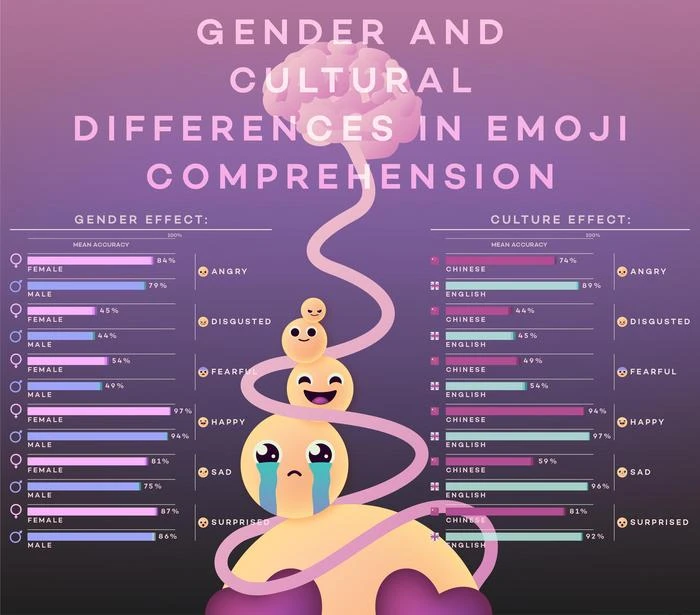
To understand how gender, age, and culture may influence emoji interpretation, Chen, Yang and colleagues recruited a group of 253 Chinese and 270 UK adults (51 percent women and 49 percent men, ranging in age from 18 to 84 years old) to review 24 different emojis the authors selected to represent six basic emotional states: happy, disgusted, fearful, sad, surprised, and angry. (Each of the six studied emojis was represented four times, using emojis from the Apple, Windows, Android, and WeChat platforms, all of which are slightly different from one another.)
The researchers assessed how often participants’ interpretations of the emojis’ meanings matched the emotion labels assigned by the study authors. They found that the older the participant, the less their interpretations matched the labels for surprised, fearful, sad and angry emojis. Women’s interpretations of happy, fearful, sad and angry emojis were more likely to match the labels than men’s. UK participants’ interpretations were more likely than Chinese participants’ to match the assigned labels for all but the disgusted emoji.
Since only six basic emoji types were used, they may not correspond exactly with emojis as used in real life with access to all potential emoji types. (For instance, the emoji chosen to represent “disgust” in this study is classified as “confounded face” on Unicode.org, which possibly explains why there was difficulty across all participants in classifying this face.)
The results underscore the importance of context when using emojis—for instance, the possibility that the “smile” emoji categorized as “happy” in this study is not always used to signify happiness, especially for Chinese participants. Furthermore, some demographic differences were partially mediated by participants' familiarity with a particular emoji; future studies should examine individual differences in the interpretation of a wider selection of frequently used emoji both in and out of context. The authors note the ambiguity of emojis is a topic worth further research, especially when communicating across gender, age, or cultures.
#####
In your coverage please use this URL to provide access to the freely available article in PLOS ONE: https://journals.plos.org/plosone/article?id=10.1371/journal.pone.0297379
Citation: Chen Y, Yang X, Howman H, Filik R (2024) Individual differences in emoji comprehension: Gender, age, and culture. PLoS ONE 19(2): e0297379. https://doi.org/10.1371/journal.pone.0297379
Author Countries: UK
Funding: The authors received no specific funding for this work.
END
Emojis are differently interpreted depending on gender, culture, and age of viewer
Senders of Valentine’s messages featuring emojis might consider potential for misinterpretation by their loved one
2024-02-14
ELSE PRESS RELEASES FROM THIS DATE:
Global health photographers navigate murky ethical waters for clients
2024-02-14
Global health photography is often caught between photojournalistic intentions of accurately reflect local communities, and marketing directives to create attention-grabbing imagery, according to a study published February 14, 2024 in the open-access journal PLOS Global Public Health by Arsenii Alenichev from Oxford Population Health, the University of Oxford, United Kingdom, and colleagues. Standing at such representational crossroads, photographers are forced to engage with numerous—and often unresolvable — ethical and practical dilemmas.
Photographers ...
New immunotherapy for multiple myeloma proves in the lab to be more effective than CAR-T treatment already in use
2024-02-14
Researchers at the Spanish National Cancer Research Center (CNIO) and the 12 de Octubre University Hospital have developed a new cell-based immunotherapy to treat multiple myeloma
The new immunotherapy is based on STAb cells and has yet to pass clinical trials.
The study is published in Science Translational Medicine, with head of the H12O-CNIO Cancer Immunotherapy Clinical Research Unit Luis Álvarez-Vallina as senior author.
Immunotherapy is already improving treatment options for many cancer types, but research groups keep exploring ...
Liver cancer: a promising avenue for more effective immunotherapies
2024-02-14
Laval, February 14, 2024 – A research team of Canadian and French scientists, led by INRS professor Maya Saleh, has been investigating immunotherapy resistance in certain patients with hepatocellular carcinoma (HCC) associated with steatotic liver disease. The findings are published in the journal Cell Reports.
Hepatocellular carcinoma is associated with known risk factors such as chronic hepatitis B or C infection, alcohol abuse, and metabolic dysfunction. It is the most common type of liver cancer. ...
The program of the 17th World Congress on Polyphenols Applications 2024 is now released: Advancing polyphenols research
2024-02-14
The 17th World Congress on Polyphenols Applications 2024, scheduled for September 19-20, 2024, at Università degli Studi di Milano Statale in Italy, has revealed its program. This congress aims to bridge the latest scientific research on polyphenols with their potential to promote health.
Goals
The Polyphenols Applications 2024 Congress aims to share novel insights into polyphenols and their impact on human health, with the goal of finding practical ways to enhance well-being.
Highlighted Program
Polyphenols in Health & Diseases: Understanding the effects of polyphenols on health.
Polyphenols, Microbiota & ...
Join the World Mitochondria Society in Berlin for their 15th Annual Meeting: Emerging Trends & Strategies
2024-02-14
The 15th World Congress on Targeting Mitochondria is set to take place in Berlin from October 28-30, 2024, promising a platform for front-line discussions and major insights into mitochondrial research.
Prof. Volkmar Weissig, president of the World Mitochondria Society stated: "In this 15th edition, we'll explore the fundamental and mechanistic research of mitochondria. But what really sets this year apart is our special focus on how mitochondria can be applied in real-world medical settings. We'll be ...
Novel drug combination shows promise for advanced her2-negative breast cancer
2024-02-14
FOR IMMEDIATE RELEASE
A novel three-drug combination achieved notable responses in patients with advanced HER2-negative breast cancer, according to new research directed by investigators from the Johns Hopkins Kimmel Cancer Center. The treatment included a histone deacetylase (HDAC) inhibitor — a drug that causes a chemical change to stop tumor cells from dividing — with two types of immunotherapy known as checkpoint inhibitors, which unharness the power of the immune response against cancer.
The multicenter ...
Key genes linked to DNA damage and human disease uncovered
2024-02-14
More than one hundred key genes linked to DNA damage have been uncovered through systematic screening of nearly 1,000 genetically modified mouse lines, in a new study published today (14 February) in Nature.
The work provides insights into cancer progression and neurodegenerative diseases as well as a potential therapeutic avenue in the form of a protein inhibitor.
The genome contains all the genes and genetic material within an organism's cells. When the genome is stable, cells can accurately replicate and divide, passing on correct genetic ...
New study finds Black birthing people prefer Black obstetric providers due to experiences of discrimination and fear of dying during pregnancy or childbirth
2024-02-14
UNDER EMBARGO UNTIL: Feb. 14, 2024, 11:45 AM EST
Media Contacts: Karen Addis, APR, karen@addispr.com, +1 (301) 787-2394; Kerri Wade, MPA, kwade@smfm.org, +1 (202) 236-1780
National Harbor, Md. -- Data from the Centers for Disease Control and Prevention demonstrate that Black women in the United States are three times more likely to die from a pregnancy-related cause than are white women. Health disparities among people of color are the result of broader social and economic inequities rooted in racism and discrimination.
In a new study to be presented today at the Society for Maternal-Fetal Medicine’s (SMFM) annual meeting, The Pregnancy Meeting™, researchers ...
SLAS Life Sciences and Technology Awards announced
2024-02-14
Boston, MA (February 13, 2024) – Science and technology awards were announced during the SLAS2024 International Conference and Exhibition, the annual flagship event of the Society for Laboratory Automation and Screening, which attracted a record-setting 7500 attendees and 400 exhibitors. Each year SLAS recognizes several exceptional presenters and exhibitors who represent the best of the Society’s programs and mission. The complete list of the 2024 award descriptions and winners follow:
SLAS Innovation Award
The most ...
Is the Amazon forest approaching a tipping point?
2024-02-14
Global warming may be interacting with regional rainfall and deforestation to accelerate forest loss in the Amazon, pushing it towards partial or total collapse.
Research published today [14 February 2024] in Nature, has identified the potential thresholds of these stressors, showing where their combined effects could produce a ‘tipping point’ - in which the forest is so fragile that just a small disturbance could cause an abrupt shift in the state of the ecosystem.
The study was led by the Federal University ...
LAST 30 PRESS RELEASES:
Making lighter work of calculating fluid and heat flow
Normalizing blood sugar can halve heart attack risk
Lowering blood sugar cuts heart attack risk in people with prediabetes
Study links genetic variants to risk of blinding eye disease in premature infants
Non-opioid ‘pain sponge’ therapy halts cartilage degeneration and relieves chronic pain
AI can pick up cultural values by mimicking how kids learn
China’s ecological redlines offer fast track to 30 x 30 global conservation goal
Invisible indoor threats: emerging household contaminants and their growing risks to human health
Adding antibody treatment to chemo boosts outcomes for children with rare cancer
Germline pathogenic variants among women without a history of breast cancer
Tanning beds triple melanoma risk, potentially causing broad DNA damage
Unique bond identified as key to viral infection speed
Indoor tanning makes youthful skin much older on a genetic level
Mouse model sheds new light on the causes and potential solutions to human GI problems linked to muscular dystrophy
The Journal of Nuclear Medicine ahead-of-print tip sheet: December 12, 2025
Smarter tools for peering into the microscopic world
Applications open for funding to conduct research in the Kinsey Institute archives
Global measure underestimates the severity of food insecurity
Child survivors of critical illness are missing out on timely follow up care
Risk-based vs annual breast cancer screening / the WISDOM randomized clinical trial
University of Toronto launches Electric Vehicle Innovation Ontario to accelerate advanced EV technologies and build Canada’s innovation advantage
Early relapse predicts poor outcomes in aggressive blood cancer
American College of Lifestyle Medicine applauds two CMS models aligned with lifestyle medicine practice and reimbursement
Clinical trial finds cannabis use not a barrier to quitting nicotine vaping
Supplemental nutrition assistance program policies and food insecurity
Switching immune cells to “night mode” could limit damage after a heart attack, study suggests
URI-based Global RIghts Project report spotlights continued troubling trends in worldwide inhumane treatment
Neutrophils are less aggressive at night, explaining why nighttime heart attacks cause less damage than daytime events
Menopausal hormone therapy may not pose breast cancer risk for women with BRCA mutations
Mobile health tool may improve quality of life for adolescent and young adult breast cancer survivors
[Press-News.org] Emojis are differently interpreted depending on gender, culture, and age of viewerSenders of Valentine’s messages featuring emojis might consider potential for misinterpretation by their loved one