PRESS-NEWS.org - Press Release Distribution
PRESS RELEASES DISTRIBUTION

Ai finds key signs that predict patient survival across dementia types
Findings support early identification of high-risk patients, enabling more targeted and personalized care

Ai finds key signs that predict patient survival across dementia types
2024-02-28
(Press-News.org) New York, NY [February 28, 2024]—Researchers at the Icahn School of Medicine at Mount Sinai and others have harnessed the power of machine learning to identify key predictors of mortality in dementia patients.

The study, published in the February 28 online issue of Communications Medicine [10.1038/s43856-024-00437-7], addresses critical challenges in dementia care by pinpointing patients at high risk of near-term death and uncovers the factors that drive this risk. Unlike previous studies that focused on diagnosing dementia, this research delves into predicting patient prognosis, shedding light on mortality risks and contributing factors in various kinds of dementia.

Dementia has emerged as a major cause of death in societies with increasingly aging populations. However, predicting the exact timing of death in dementia cases is challenging due to the variable progression of cognitive decline affecting the body’s normal functions, say the researchers.

"Our findings are significant as they illustrate the potential of machine learning models to accurately anticipate mortality risk in dementia patients over varying timeframes," said corresponding author Kuan-lin Huang, PhD, Assistant Professor of Genetics and Genomic Sciences at Icahn Mount Sinai. “By pinpointing a concise set of clinical features, including performance on neuropsychological and other available testing, our models empower health care providers to make more informed decisions about patient care, potentially leading to more tailored and timely interventions."

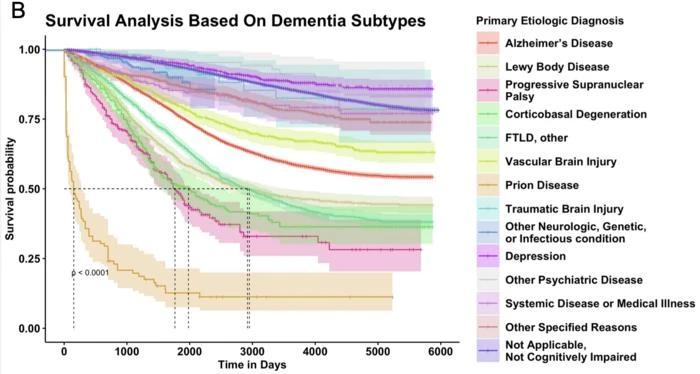
Using data from the U.S. National Alzheimer’s Coordinating Center that included 45,275 participants and 163,782 visit records, the study created machine learning models based on clinical and neurocognitive features. These models predicted mortality at one, three, five, and 10 years. The study developed specific models for eight types of dementia through stratified analyses.

The study also found that neuropsychological test results were a better predictor of mortality risk in dementia patients than age-related factors such as cancer and heart disease, underscoring dementia's significant role in mortality among those with neurodegenerative conditions.

"The implications of our research extend beyond clinical practice, as it underscores the value of machine learning in unraveling the complexities of diseases like dementia. This study lays the groundwork for future investigations into predictive modeling in dementia care,” says Dr. Huang. “However, while machine learning holds great promise for improving dementia care, it's important to remember that these models aren't crystal balls for individual outcomes. Many factors, both personal and medical, shape a patient's journey."

Next, the research team plans to refine their models by incorporating treatment effects and genetic data and exploring advanced deep-learning techniques for even more precise predictions.

Given the aging population, dementia has emerged as an increasingly pressing public health concern, ranking as the seventh leading cause of death and the fourth most burdensome disease or injury in the United States in 2016, based on years of life lost. As of 2022, Alzheimer’s and other dementias cost an estimated $1 trillion annually, impacting approximately 6.5 million Americans and 57.4 million people worldwide, with projections suggesting a tripling by 2050.

The paper is titled “Machine learning models identify predictive features of patient mortality across dementia types.”

The remaining authors on the paper are Jimmy Zhang (currently at Columbia University); Luo Song (currently an MD candidate at The University of Queensland, Australia); Zachary Miller (University of Washington, Seattle); and Kwun C. G. Chan, PhD (University of Washington, Seattle).

Please see Communications Medicine [10.1038/s43856-024-00437-7] for funding details.

-####-

About the Icahn School of Medicine at Mount Sinai

The Icahn School of Medicine at Mount Sinai is internationally renowned for its outstanding research, educational, and clinical care programs. It is the sole academic partner for the eight- member hospitals* of the Mount Sinai Health System, one of the largest academic health systems in the United States, providing care to a large and diverse patient population.  

Ranked 13th nationwide in National Institutes of Health (NIH) funding and among the 99th percentile in research dollars per investigator according to the Association of American Medical Colleges, Icahn Mount Sinai has a talented, productive, and successful faculty. More than 3,000 full-time scientists, educators, and clinicians work within and across 44 academic departments and 36 multidisciplinary institutes, a structure that facilitates tremendous collaboration and synergy. Our emphasis on translational research and therapeutics is evident in such diverse areas as genomics/big data, virology, neuroscience, cardiology, geriatrics, as well as gastrointestinal and liver diseases. 

Icahn Mount Sinai offers highly competitive MD, PhD, and Master’s degree programs, with current enrollment of approximately 1,300 students. It has the largest graduate medical education program in the country, with more than 2,000 clinical residents and fellows training throughout the Health System. In addition, more than 550 postdoctoral research fellows are in training within the Health System. 

A culture of innovation and discovery permeates every Icahn Mount Sinai program. Mount Sinai’s technology transfer office, one of the largest in the country, partners with faculty and trainees to pursue optimal commercialization of intellectual property to ensure that Mount Sinai discoveries and innovations translate into healthcare products and services that benefit the public.

Icahn Mount Sinai’s commitment to breakthrough science and clinical care is enhanced by academic affiliations that supplement and complement the School’s programs.

Through the Mount Sinai Innovation Partners (MSIP), the Health System facilitates the real-world application and commercialization of medical breakthroughs made at Mount Sinai. Additionally, MSIP develops research partnerships with industry leaders such as Merck & Co., AstraZeneca, Novo Nordisk, and others.

The Icahn School of Medicine at Mount Sinai is located in New York City on the border between the Upper East Side and East Harlem, and classroom teaching takes place on a campus facing Central Park. Icahn Mount Sinai’s location offers many opportunities to interact with and care for diverse communities. Learning extends well beyond the borders of our physical campus, to the eight hospitals of the Mount Sinai Health System, our academic affiliates, and globally.

------------------------------------------------------- 

* Mount Sinai Health System member hospitals: The Mount Sinai Hospital; Mount Sinai Beth Israel; Mount Sinai Brooklyn; Mount Sinai Morningside; Mount Sinai Queens; Mount Sinai South Nassau; Mount Sinai West; and New York Eye and Ear Infirmary of Mount Sinai.


END


[Attachments] See images for this press release:
Ai finds key signs that predict patient survival across dementia types Ai finds key signs that predict patient survival across dementia types 2 Ai finds key signs that predict patient survival across dementia types 3

ELSE PRESS RELEASES FROM THIS DATE:

Light stimulates a new twist for synthetic chemistry

Light stimulates a new twist for synthetic chemistry
2024-02-28
Molecules that are induced by light to rotate bulky groups around central bonds could be developed into photo-activated bioactive systems, molecular switches, and more. Researchers at Hokkaido University, led by Assistant Professor Akira Katsuyama and Professor Satoshi Ichikawa at the Faculty of Pharmaceutical Sciences, have extended the toolkit of synthetic chemistry by making a new category of molecules that can be induced to undergo an internal rotation on interaction with light. Similar processes are believed to be important in some natural biological systems. Synthetic versions might ...

More than just neurons: A new model for studying human brain inflammation

More than just neurons: A new model for studying human brain inflammation
2024-02-28
LA JOLLA (February 28, 2024)—The brain is typically depicted as a complex web of neurons sending and receiving messages. But neurons only make up half of the human brain. The other half—roughly 85 billion cells—are non-neuronal cells called glia. The most common type of glial cells are astrocytes, which are important for supporting neuronal health and activity. Despite this, most existing laboratory models of the human brain fail to include astrocytes at sufficient levels or at all, which limits the models’ utility for studying ...

Urgent need to develop best practices to advance use of AI in cardiovascular care

2024-02-28
Statement Highlights: The American Heart Association encourages research and development of artificial intelligence (AI) and other related tools and services that may support and enable more precise approaches to cardiovascular and stroke research, prevention and care. Academia, industry and governments worldwide are pouring resources into developing AI-based tools to transform how and when health care is delivered. While promising research is beginning to emerge in many areas of cardiovascular medicine, AI-based tools, algorithms and systems of care have not yet been proven to improve care enough to justify widespread use. AI and machine learning digital tools currently exist that ...

Smoking cannabis associated with increased risk of heart attack, stroke

2024-02-28
Smoking cannabis associated with increased risk of heart attack, stroke NIH-funded observational study shows risk grows sharply with more frequent use   Frequent cannabis smoking may significantly increase a person’s risk for heart attack and stroke, according to an observational study supported by the National Institutes of Health. The study, published in the Journal of the American Heart Association, uses data from nearly 435,000 American adults, and is among the largest ever to explore the relationship ...

NYUAD researchers highlight a potential flaw in operating room ventilation that increases risk of infection by COVID-19

2024-02-28
●    Simple modifications to ventilation systems improve airflow, making operations safer for both patients and surgical teams ●    This research was conducted in close collaboration with a team of surgeons from Cleveland Clinic Abu Dhabi (CCAD) Abu Dhabi, UAE, February 28, 2024: NYU Abu Dhabi (NYUAD) engineers studying ventilation systems in surgical operating theaters have found that traditional ventilation systems may inadvertently facilitate the circulation of aerosolized pathogen-carrying particles. This, as a result, puts surgical teams at a higher risk of infection by COVID-19 and other airborne diseases. Using basic engineering tools, including ...

Climate change shrinking fish

Climate change shrinking fish
2024-02-28
Fish weight in the western North Pacific Ocean dipped in the 2010s due to warmer water limiting food supplies, according to a new study at the University of Tokyo. Researchers analyzed the individual weight and overall biomass of 13 species of fish. In the 1980s and 2010s, the fish were lighter. They attributed the first period of weight loss to greater numbers of Japanese sardine, which increased competition with other species for food. During the 2010s, while the number of Japanese sardine and chub mackerel moderately increased, the effect of climate change warming the ocean appears to have resulted ...

Yeast and kelp flies can replace fishmeal in feed

Yeast and kelp flies can replace fishmeal in feed
2024-02-28
Kelp flies and marine yeast cultivated on by-products from the seafood industry can be used in feed for farmed salmon. Replacing fishmeal and soybeans can create more sustainable and circular food production, according to a thesis from the University of Gothenburg. Food from aquaculture, such as farmed fish, is the food industry’s fastest growing sector. One key reason is that this is a nutritious and protein-rich food that is generally more sustainably produced than protein from land animals. However, fish farming also has challenges. One is obtaining sufficient amounts of sustainable high-quality feed. Currently, fish feed accounts for about ...

Meltwater in the North Atlantic can lead to European summer heatwaves, study finds

2024-02-28
Scientists from the National Oceanography Centre (NOC) have discovered that increased meltwater in the North Atlantic can trigger a chain of events leading to hotter and drier European summers. The paper, which will be published in the European Geosciences Union’s open access journal Weather and Climate Dynamics, suggests that European summer weather is predictable months to years in advance, due to higher levels of freshwater in the North Atlantic. Discussing the implications, lead author Marilena Oltmanns, Research Scientist at the National Oceanography Centre, said: “While the UK and northern Europe experienced unusually cool and wet weather in Summer 2023, Greenland experienced ...

A threat to what is ours: How Japanese people react to perceived territorial infringements

A threat to what is ours: How Japanese people react to perceived territorial infringements
2024-02-28
Osaka, Japan – Throughout the world, it is common for threats to national sovereignty or territorial integrity to stir up strong emotions among the public. Now, researchers from Japan have found that the strength of the reaction to such threats can break down along political lines in interesting ways. In a study published in Peace and Conflict: Journal of Peace Psychology, researchers from Osaka University have revealed that the Japanese public is highly sensitive to what are known as “collective ownership ...

Experiment captures why pottery forms are culturally distinct

Experiment captures why pottery forms are culturally distinct
2024-02-28
Potters of different cultural backgrounds learn new types differently, producing cultural differences even in the absence of differential cultural evolution. The Kobe University-led research has implications for how we evaluate the difference of archaeological artifacts across cultures. Cultural artifacts differ between cultures but are relatively stable within cultures. This makes pottery, and in particular its form, an important archaeological indicator to determine the presence of different cultural groups in specific locations and how they influenced each other over time. But where do such culturally stable variations arise from? The typical explanation for this is through “selective ...

LAST 30 PRESS RELEASES:

Eye for trouble: Automated counting for chromosome issues under the microscope

The vast majority of US rivers lack any protections from human activities, new research finds

Ultrasound-responsive in situ antigen "nanocatchers" open a new paradigm for personalized tumor immunotherapy

Environmental “superbugs” in our rivers and soils: new one health review warns of growing antimicrobial resistance crisis

Triple threat in greenhouse farming: how heavy metals, microplastics, and antibiotic resistance genes unite to challenge sustainable food production

Earthworms turn manure into a powerful tool against antibiotic resistance

AI turns water into an early warning network for hidden biological pollutants

Hidden hotspots on “green” plastics: biodegradable and conventional plastics shape very different antibiotic resistance risks in river microbiomes

Engineered biochar enzyme system clears toxic phenolic acids and restores pepper seed germination in continuous cropping soils

Retail therapy fail? Online shopping linked to stress, says study

How well-meaning allies can increase stress for marginalized people

Commercially viable biomanufacturing: designer yeast turns sugar into lucrative chemical 3-HP

Control valve discovered in gut’s plumbing system

George Mason University leads phase 2 clinical trial for pill to help maintain weight loss after GLP-1s

Hop to it: research from Shedd Aquarium tracks conch movement to set new conservation guidance

Weight loss drugs and bariatric surgery improve the body’s fat ‘balance:’ study

The Age of Fishes began with mass death

TB harnesses part of immune defense system to cause infection

Important new source of oxidation in the atmosphere found

A tug-of-war explains a decades-old question about how bacteria swim

Strengthened immune defense against cancer

Engineering the development of the pancreas

The Journal of Nuclear Medicine ahead-of-print tip sheet: Jan. 9, 2026

Mount Sinai researchers help create largest immune cell atlas of bone marrow in multiple myeloma patients

Why it is so hard to get started on an unpleasant task: Scientists identify a “motivation brake”

Body composition changes after bariatric surgery or treatment with GLP-1 receptor agonists

Targeted regulation of abortion providers laws and pregnancies conceived through fertility treatment

Press registration is now open for the 2026 ACMG Annual Clinical Genetics Meeting

Understanding sex-based differences and the role of bone morphogenetic protein signaling in Alzheimer’s disease

Breakthrough in thin-film electrolytes pushes solid oxide fuel cells forward

[Press-News.org] Ai finds key signs that predict patient survival across dementia types
Findings support early identification of high-risk patients, enabling more targeted and personalized care