PRESS-NEWS.org - Press Release Distribution
PRESS RELEASES DISTRIBUTION

Novel motion simulator reveals key role of air flow in rodent navigation
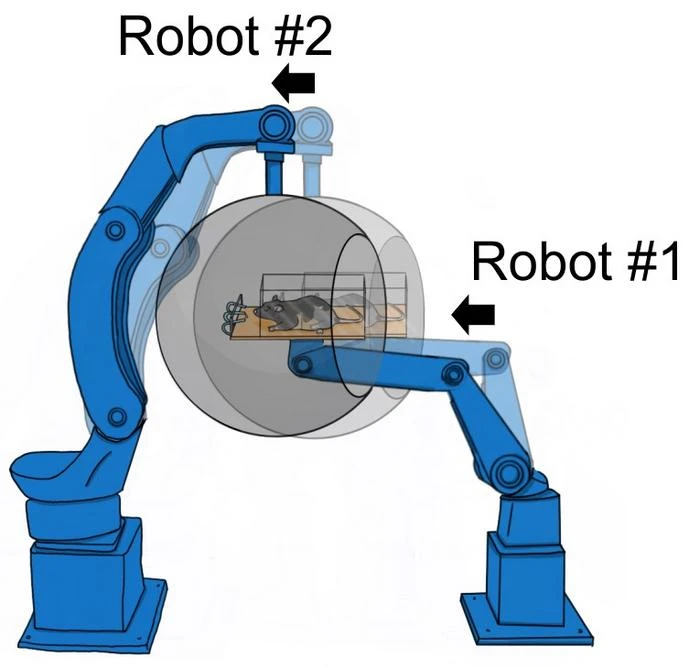
Built by researchers at Bar-Ilan University, the simulator revealed that rats are highly sensitive to small currents of air and use this sensory input, combined with their sense of balance, to enhance their perception of self-motion

Novel motion simulator reveals key role of air flow in rodent navigation
2024-08-29
(Press-News.org)

How are rodents able to navigate pitch-black subway tunnels or other dark environments so adeptly, despite not being able to rely on vision?  

With the assistance of a novel motion simulator, researchers at Bar-Ilan University in Israel have discovered that rats rely on airflow to navigate their surroundings. When they move, the flow of air relative to their bodies provides crucial information, complementary to their sense of balance, to perceive their own motion in space. This might explain their agility in the dark as they scurry through pipes and tunnels, turn corners, and effortlessly travel from one location to another, all while knowing exactly where they’re headed.

In order to interact in the world, humans, and animals alike must consistently perceive where they are moving in space. Without this crucial ability, functioning, or even standing without falling would be virtually impossible. To accomplish this feat, the brain must perform a number of tasks, but how it does so remains an open question in scientific research.

Prof. Adam Zaidel, head of the Multisensory Processing Lab at Bar-Ilan University's Gonda (Goldschmied) Multidisciplinary Brain Research Center, MSc student Lior Polat, and lab manager and postdoctoral researcher Tamar Harpaz sought to understand the phenomenon and built the motion simulator, a one-of-a-kind system unique to Zaidel's lab, using a pair of synchronized industrial robotic arms.  

During the investigation the rodents experienced motion stimuli and were trained to report on their perceived direction of motion. The research revealed that rats are highly sensitive to small currents of air and use this sensory input, combined with their sense of balance, to enhance their perception of motion. This is the first time that airflow has been identified as a critical cue for self-motion perception in rodents. The findings were published on August 29 in the journal Current Biology.

"The new motion simulator builds on paradigms established for testing primates but offers complementary and distinct advantages by studying rodents," says Prof. Zaidel. "The findings highlight the significance of airflow in self-motion perception, prompting further questions about the extent to which this cue is important for other species, including humans."

Prof. Zaidel adds, "Air is all around us, and often goes unnoticed. We would not typically think of air as an important cue for perceiving self-motion in space. But, with these findings in mind, airflow likely plays a more important role in perception and navigation than previously considered."

These findings mark a significant advancement in the study of sensory perception and brain function. As Prof. Zaidel and his team delve deeper, they hope to uncover further insights into the mechanisms within the brain that perform these functions.

This research was supported by grants to Prof. Zaidel from the Israeli Centers of Research Excellence and the Israel Science Foundation.


END


[Attachments] See images for this press release:
Novel motion simulator reveals key role of air flow in rodent navigation

ELSE PRESS RELEASES FROM THIS DATE:

Combo immunotherapy produces distinct waves of cancer-fighting T cells with each dose

2024-08-29
PHILADELPHIA – A new tool for monitoring immune health patterns over time has revealed how a pair of checkpoint inhibitor therapies works together to recruit new cancer-fighting T cells with every infusion. Findings from the use of the new tool, developed by researchers at the University of Pennsylvania Perelman School of Medicine and Penn Medicine’s Abramson Cancer Center (ACC), were published today in Cancer Cell. The study challenges fundamental assumptions about how a common immunotherapy ...

Finding new targets for blocking chronic hepatitis

Finding new targets for blocking chronic hepatitis
2024-08-29
Researchers from Tokyo Medical and Dental University (TMDU) determine how a protein called A20 can regulate the inflammatory response to suppress chronic hepatitis Tokyo, Japan – Many individuals worldwide suffer from chronic liver disease (CLD), which poses significant concerns for its tendency to lead to hepatocellular carcinoma or liver failure. CLD is characterized by inflammation and fibrosis. Certain liver cells, called hepatic stellate cells (HSCs), contribute to both these characteristics, but how they are specifically involved in the inflammatory response is not ...

New Microbiology Society Publish and Read consortium deal now available to science institutions and hospitals across Germany

2024-08-29
The Microbiology Society, one of the largest microbiology societies in Europe, is pleased to announce a new three year Publish and Read offering with German consortium ZB Med – Information Centre for Life Sciences, available to its 400 member institutions and 2,000 hospitals. This agreement was established in partnership with HARRASSOWITZ, the Society’s representative agency in Germany. From 2025, member institutions can join this consortium-wide Publish and Read agreement to enjoy discounted pricing. For participating institutions, the ...

Atomic force microscopy upgrade captures 3D images of calcite dissolving

Atomic force microscopy upgrade captures 3D images of calcite dissolving
2024-08-29
Researchers at Nano Life Science Institute (WPI-NanoLSI), Kanazawa University, implement modifications to their high-speed atomic force microscopy that simultaneously improve resolution and speed, while enabling direct measurements of 3D structures to provide conclusive evidence of a contested hydration layer forming as calcite dissolves. Understanding the dissolution processes of minerals can provide key insights into geochemical processes. Attempts to explain some of the observations during the dissolution of calcite (CaCO3) have led to the hypothesis that a hydration layer forms, although this has been contested. Hydration layers are also ...

New research unveils cellular pathways to Alzheimer’s and alternative brain aging

2024-08-29
A new study has found an answer for a long-lasting question in aging research - Is Alzheimer’s disease-dementia a form of accelerated aging or is there a different path that can lead us to healthier brain aging? In an international effort, the researchers mapped 1.65 million cells from 437 aging brains, and uncovered distinct paths of cellular change in the aging brains, with one leading to Alzheimer’s disease and the other to an alternative form brain aging. They also point to  specific cell signatures predicted to advance disease once they appear in the aging ...

JMIR Medical Informatics is inviting submissions for a new theme issue titled: "Advancing Digital Health: Real-World Implementation and Strategic Insights from Industry-Driven Innovation"

JMIR Medical Informatics is inviting submissions for a new theme issue titled: Advancing Digital Health: Real-World Implementation and Strategic Insights from Industry-Driven Innovation
2024-08-29
Toronto- August 27, 2024 - JMIR Publications invites submissions to a new theme issue titled “Advancing Digital Health: Real-World Implementation and Strategic Insights from Industry-Driven Innovation” in JMIR Medical Informatics, a leading peer-reviewed journal indexed in PubMed with a unique focus on clinical informatics and the digitization of care processes. The health care landscape is transforming rapidly, driven by technological innovation and the pressing need for more efficient, accessible and patient-centric health care solutions.  Yet, the health IT industry grapples with ...

Terasaki Institute scientist awarded 2024 NARSAD Young Investigator Grant

Terasaki Institute scientist awarded 2024 NARSAD Young Investigator Grant
2024-08-29
LOS ANGELES, August 29, 2024 — Yangzhi Zhu, Ph.D., Assistant Professor at the Terasaki Institute for Biomedical Innovation (TIBI), has been awarded the prestigious 2024 NARSAD Young Investigator Grant for his groundbreaking work on a lab-on-a-contact lens (LoCL) system. This innovative technology is designed to monitor mental health by providing real-time, non-invasive tracking of panels of key biomarkers, from the wearer’s tears. Mental health disorders, such as anxiety and depression, affect nearly a billion ...

A breakthrough in diagnosing hydrocephalus: Multimodality approaches enhance accuracy and reduce costs

A breakthrough in diagnosing hydrocephalus: Multimodality approaches enhance accuracy and reduce costs
2024-08-29
A recent case report published in Cyborg Bionic Systems details the diagnosis of Idiopathic Normal Pressure Hydrocephalus (iNPH) using multimodality diagnostic approaches, highlighting significant advancements in medical diagnostics and patient care. The study conducted by a team of researchers from Tianjin Medical University General Hospital, Tianjin, China, presents a comprehensive case study of a 68-year-old male patient diagnosed with iNPH, showcasing the effectiveness of these advanced diagnostic techniques. iNPH is a condition characterized by the accumulation of cerebrospinal fluid (CSF) causing ventricular dilation, ...

This tiny backyard bug does the fastest backflips on earth

This tiny backyard bug does the fastest backflips on earth
2024-08-29
Move over, Sonic. There’s a new spin-jumping champion in town – the globular springtail (Dicyrtomina minuta). This diminutive hexapod backflips into the air, spinning to over 60 times its body height in the blink of an eye, and a new study features the first in-depth look at its jumping prowess. Globular springtails are tiny, usually only a couple millimeters in body length. They don’t fly, bite or sting. But they can jump. In fact, jumping is their go-to (and only) plan for avoiding predators. And they excel at it – to the naked eye it seems as though they vanish entirely when they take off. “When globular springtails ...

Climate change increases foodborne illness risk from raw produce

2024-08-29
Highlights: Salmonella enterica causes disease in 1.2 million people in the U.S. annually. The most common way people get infected is by consuming contaminated fresh produce. New research shows that bacterial leaf spot of lettuce and high humidity promote S. enterica growth in lettuce, and climate change is predicted to increase humid periods. Washington, D.C.—Climate change will increase the risk of the foodborne illness from Salmonella enterica, according to a new study. The research was published today in Applied and Environmental Microbiology, a journal of the American Society for Microbiology.  S. enterica causes disease in 1.2 million people in the ...

LAST 30 PRESS RELEASES:

Making lighter work of calculating fluid and heat flow

Normalizing blood sugar can halve heart attack risk

Lowering blood sugar cuts heart attack risk in people with prediabetes

Study links genetic variants to risk of blinding eye disease in premature infants

Non-opioid ‘pain sponge’ therapy halts cartilage degeneration and relieves chronic pain

AI can pick up cultural values by mimicking how kids learn

China’s ecological redlines offer fast track to 30 x 30 global conservation goal

Invisible indoor threats: emerging household contaminants and their growing risks to human health

Adding antibody treatment to chemo boosts outcomes for children with rare cancer

Germline pathogenic variants among women without a history of breast cancer

Tanning beds triple melanoma risk, potentially causing broad DNA damage

Unique bond identified as key to viral infection speed

Indoor tanning makes youthful skin much older on a genetic level

Mouse model sheds new light on the causes and potential solutions to human GI problems linked to muscular dystrophy

The Journal of Nuclear Medicine ahead-of-print tip sheet: December 12, 2025

Smarter tools for peering into the microscopic world

Applications open for funding to conduct research in the Kinsey Institute archives

Global measure underestimates the severity of food insecurity

Child survivors of critical illness are missing out on timely follow up care

Risk-based vs annual breast cancer screening / the WISDOM randomized clinical trial

University of Toronto launches Electric Vehicle Innovation Ontario to accelerate advanced EV technologies and build Canada’s innovation advantage

Early relapse predicts poor outcomes in aggressive blood cancer

American College of Lifestyle Medicine applauds two CMS models aligned with lifestyle medicine practice and reimbursement

Clinical trial finds cannabis use not a barrier to quitting nicotine vaping

Supplemental nutrition assistance program policies and food insecurity

Switching immune cells to “night mode” could limit damage after a heart attack, study suggests

URI-based Global RIghts Project report spotlights continued troubling trends in worldwide inhumane treatment

Neutrophils are less aggressive at night, explaining why nighttime heart attacks cause less damage than daytime events

Menopausal hormone therapy may not pose breast cancer risk for women with BRCA mutations

Mobile health tool may improve quality of life for adolescent and young adult breast cancer survivors

[Press-News.org] Novel motion simulator reveals key role of air flow in rodent navigation
Built by researchers at Bar-Ilan University, the simulator revealed that rats are highly sensitive to small currents of air and use this sensory input, combined with their sense of balance, to enhance their perception of self-motion