New research finds how fighting female flies focus on their foes
Published 2024-12-12 · Original archive entry · Explore research explainers
In most research labs, the scientists are on the same page about why they’re pursuing a research project.
But the Rubin Lab at HHMI's Janelia Research Campus isn’t an ordinary research lab.
The lab is examining how aggression affects vision in female fruit flies, but Janelia Senior Group Leader Gerry Rubin doesn’t care too much about the specific answer. Instead, he simply wants to see if the neuroscience research tools that he spent the last decade building are adequate to uncover the underlying mechanisms at play.
Postdoc Katie Schretter, on the other hand, is interested in understanding how neurons in the fly brain work together to help the fly focus on its opponent – information that will enable Schretter to pursue more questions about how social behaviors are regulated.
The new research led by Rubin and Schretter satisfies both motivations: it uses pioneering tools developed at Janelia to show how aggressive female fruit flies’ vision is regulated to focus on what’s important. Using the fruit fly connectome – a wiring diagram of all the brain’s neurons and their connections – and genetically modified flies, the researchers uncovered how the insects’ neurons and circuits work together to flexibly control visual information in different situations.
Uncovering how a social behavior like aggression controls vision in fruit flies at the level of neurons and circuits could provide insight into similar mechanisms in other animals, including humans. Increased knowledge about the link between sensory information and social behaviors could potentially help scientists better understand and treat neuropsychiatric and neurodevelopmental disorders.
“Understanding and modelling how multisensory cues come in and how that’s being integrated into social behaviors enables future research in other species and could facilitate the discovery of particular targets for treatment,” Schretter says.
Focusing on fighting flies
The researchers had previously identified a group of neurons that promote aggression in female fruit flies, leading them to fight, and found that these neurons intersect pathways that transmit visual information. This provided a perfect jumping-off point for the scientists to use the connectome to examine the exact neurons and circuits the fly brain uses to adjust its visual attention based on its current needs.
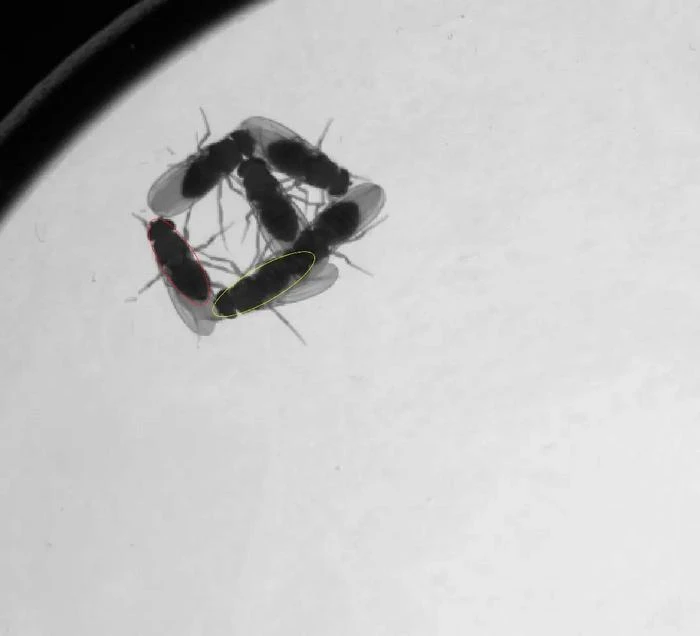
Much like when driving on a busy highway, we need to pay attention to the cars around us rather than the scenery, female flies in a state of aggression must pay attention to the nearby fly they are about to fight rather than, say, looking around for food.
Using the fruit fly connectome developed by Janelia researchers and collaborators, the team discovered how the aggression-promoting neurons are connected to neurons that regulate visual input. This suggests that the aggression neurons are moderating the flow of visual information so the fly can focus on what’s important.
Armed with this knowledge, the researchers then used genetically modified fruit flies developed by Rubin and others at Janelia to turn different neurons on or off, to further probe how this regulation happens.
The team found that the aggression neurons use three distinct mechanisms to regulate vision. One circuit contains excitatory inputs that integrate both specific visual features and the fly’s internal state. Another circuit modulates information coming from the fly’s optic lobe, and a third mechanism serves as a toggle switch, increasing the transmission of visual information from one subset of neurons and decreasing transmission from another.
These multiple circuit mechanisms give the fly freedom and flexibility to regulate its attention towarddifferent parts of its visual environment, depending on the context. The team also found that analogous circuits are active in male fruit flies during courtship, suggesting that different social behaviors could share circuit mechanisms.
In addition to providing insight into how aggression affects vision, the new work provides a framework for using the connectome to identify the neurons and circuits that underlie social behaviors – information that would have been difficult to obtain without the wiring diagram.
For Schretter, the research provides a jumping-off point for further studies of how environmental factors shape behavior.
“For me, as more of a behaviorist, these central questions I had coming into my PhD and postdoc – how do sensory information and internal factors regulate behavior, all those types of questions – can now be examined at a previously unimaginable level,” Schretter says. “We now have tools to go after them very precisely.”
For Rubin, the new work provides a sense of closure. Now that he’s seen firsthand that the tools he built work, he’s turning his attention to other research projects.
“It shows you that people can be doing the same work, motivated by totally different things, and the outcome can drive them in totally different directions,” Rubin says.
END
But the Rubin Lab at HHMI's Janelia Research Campus isn’t an ordinary research lab.
The lab is examining how aggression affects vision in female fruit flies, but Janelia Senior Group Leader Gerry Rubin doesn’t care too much about the specific answer. Instead, he simply wants to see if the neuroscience research tools that he spent the last decade building are adequate to uncover the underlying mechanisms at play.
Postdoc Katie Schretter, on the other hand, is interested in understanding how neurons in the fly brain work together to help the fly focus on its opponent – information that will enable Schretter to pursue more questions about how social behaviors are regulated.
The new research led by Rubin and Schretter satisfies both motivations: it uses pioneering tools developed at Janelia to show how aggressive female fruit flies’ vision is regulated to focus on what’s important. Using the fruit fly connectome – a wiring diagram of all the brain’s neurons and their connections – and genetically modified flies, the researchers uncovered how the insects’ neurons and circuits work together to flexibly control visual information in different situations.
Uncovering how a social behavior like aggression controls vision in fruit flies at the level of neurons and circuits could provide insight into similar mechanisms in other animals, including humans. Increased knowledge about the link between sensory information and social behaviors could potentially help scientists better understand and treat neuropsychiatric and neurodevelopmental disorders.
“Understanding and modelling how multisensory cues come in and how that’s being integrated into social behaviors enables future research in other species and could facilitate the discovery of particular targets for treatment,” Schretter says.
Focusing on fighting flies
The researchers had previously identified a group of neurons that promote aggression in female fruit flies, leading them to fight, and found that these neurons intersect pathways that transmit visual information. This provided a perfect jumping-off point for the scientists to use the connectome to examine the exact neurons and circuits the fly brain uses to adjust its visual attention based on its current needs.
Much like when driving on a busy highway, we need to pay attention to the cars around us rather than the scenery, female flies in a state of aggression must pay attention to the nearby fly they are about to fight rather than, say, looking around for food.
Using the fruit fly connectome developed by Janelia researchers and collaborators, the team discovered how the aggression-promoting neurons are connected to neurons that regulate visual input. This suggests that the aggression neurons are moderating the flow of visual information so the fly can focus on what’s important.
Armed with this knowledge, the researchers then used genetically modified fruit flies developed by Rubin and others at Janelia to turn different neurons on or off, to further probe how this regulation happens.
The team found that the aggression neurons use three distinct mechanisms to regulate vision. One circuit contains excitatory inputs that integrate both specific visual features and the fly’s internal state. Another circuit modulates information coming from the fly’s optic lobe, and a third mechanism serves as a toggle switch, increasing the transmission of visual information from one subset of neurons and decreasing transmission from another.
These multiple circuit mechanisms give the fly freedom and flexibility to regulate its attention towarddifferent parts of its visual environment, depending on the context. The team also found that analogous circuits are active in male fruit flies during courtship, suggesting that different social behaviors could share circuit mechanisms.
In addition to providing insight into how aggression affects vision, the new work provides a framework for using the connectome to identify the neurons and circuits that underlie social behaviors – information that would have been difficult to obtain without the wiring diagram.
For Schretter, the research provides a jumping-off point for further studies of how environmental factors shape behavior.
“For me, as more of a behaviorist, these central questions I had coming into my PhD and postdoc – how do sensory information and internal factors regulate behavior, all those types of questions – can now be examined at a previously unimaginable level,” Schretter says. “We now have tools to go after them very precisely.”
For Rubin, the new work provides a sense of closure. Now that he’s seen firsthand that the tools he built work, he’s turning his attention to other research projects.
“It shows you that people can be doing the same work, motivated by totally different things, and the outcome can drive them in totally different directions,” Rubin says.
END