Bringing the power of tabletop precision lasers for quantum science to the chip scale
Published 2024-12-12 · Original archive entry · Explore research explainers
For experiments that require ultra-precise measurements and control over atoms — think two-photon atomic clocks, cold-atom interferometer sensors and quantum gates — lasers are the technology of choice, the more spectrally pure (emitting a single color/frequency), the better. Conventional lab-scale laser technology currently achieves this ultra low-noise, stable light via bulky, costly tabletop systems designed to generate, harness and emit photons within a narrow spectral range.
But what if these atomic applications could be lifted from their current confines in labs and on benchtops? This advancement is at the heart of the effort at UC Santa Barbara engineering professor Daniel Blumenthal’s lab, where his team seeks to recreate the performance of these lasers on lightweight devices that can fit in the palm of your hand.
“These smaller lasers will enable scalable laser solutions for actual quantum systems, as well as lasers for portable, field-deployable and space-based quantum sensors,” said Andrei Isichenko, a graduate student researcher in Blumenthal’s lab. “This will impact technology spaces such as quantum computing with neutral atoms and trapped ions and also cold atom quantum sensors such as atomic clocks and gravimeters.”
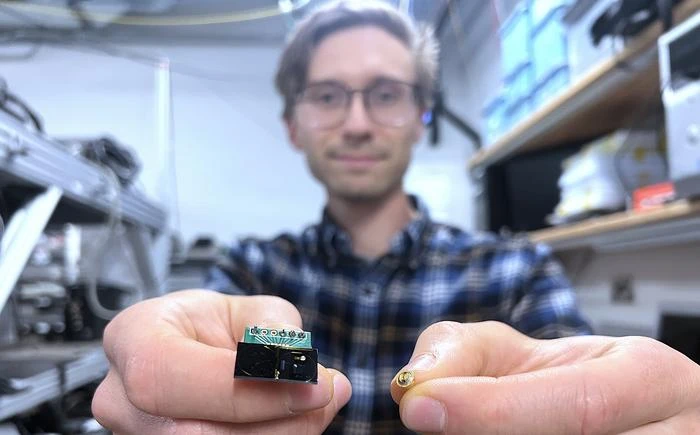
In a paper in the journal Scientific Reports, Blumenthal, Isichenko and team present a development in this direction with a chip-scale ultra-low-linewidth self-injection locked 780 nm laser. This roughly matchbox-sized device, say the researchers, can perform better than current, narrow-linewidth 780 nm lasers, for a fraction of the cost to manufacture, and the space to hold them.
Lassoing the Laser
The atom motivating the laser development is rubidium, so chosen because of well-known properties that make it ideal for a variety of high-precision applications. The stability of its D2 optical transition lends the atom well to atomic clocks; the atom’s sensitivity also makes it a popular choice for sensors and cold atom physics. By passing a laser through a vapor of rubidium atoms as the atomic reference, a near infrared laser can take on the characteristic of the stable atomic transition.
“You can use the atomic transition lines to lasso the laser,” noted Blumenthal, the paper's senior author. “In other words, by locking the laser to the atomic transition line, the laser more or less takes on the characteristics of that atomic transition in terms of stability.”
But a fancy red light does not a precision laser make. For a light of the desired quality, “noise” must be removed. Blumenthal describes this as a tuning fork versus guitar strings.
“If you have a tuning fork and hit a C note, it’s probably a pretty perfect C,” he explained. “But if you strum a C on a guitar, you can hear other tones in there.” Similarly, lasers may incorporate different frequencies (colors) that generate extra “tones.” To create the desired single frequency — pure deep-red light in this case — tabletop systems incorporate additional components to further calm down the laser light. The challenge for the researchers was to integrate all that functionality and performance onto a chip.
The team used a combination of a commercially available Fabry-Perot laser diode, some of the world’s lowest-loss waveguides (fabricated in Blumenthal’s lab); as well as highest quality factor resonators, all fabricated in a silicon nitride platform. By doing so, they were able to duplicate the performance of bulky, tabletop systems — and their device, according to their tests, can outperform some tabletop lasers as well as previously reported integrated lasers by four orders of magnitude in key metrics such as frequency noise and linewidth .
“The significance of the low linewidth values is that we can achieve a compact laser without sacrificing laser performance,” Isichenko explained. “In some ways the performance is improved compared to conventional lasers because of full chip-scale integration. These linewidths help us better interact with atomic systems, eliminating contributions from the laser noise to fully resolve the atomic signal in response to, for example, the environment they are sensing.” Low linewidths — in terms of this project a record-low sub-Hz fundamental and a sub-KHz integral — are indicative of the laser technology’s stability and ability to overcome noise from both external and internal sources.
Further benefits of this technology include the cost — it uses a $50 diode, and employs a cost-effective and scalable fabrication process that is created using a CMOS compatible wafer scale process that draws from the electronic chip fabrication world.
The success of this technology means that it will be possible to deploy these high-performance, precision, low-cost photonics integrated lasers in a variety of situations in and out of the lab, including quantum experiments, atomic timekeeping and the sensing of the faintest of signals, such as the shifts of gravitational acceleration around the Earth.
“You can put these on satellites to make a gravitational map of the Earth and around the Earth with a certain amount of precision,” Blumenthal said. “You could measure sea level rise, changes in sea ice and earthquakes by sensing the gravitational fields around the Earth.” The compactness, low-power consumption and light weight is a “perfect fit,” he added, for technology to be deployed in space.
END
But what if these atomic applications could be lifted from their current confines in labs and on benchtops? This advancement is at the heart of the effort at UC Santa Barbara engineering professor Daniel Blumenthal’s lab, where his team seeks to recreate the performance of these lasers on lightweight devices that can fit in the palm of your hand.
“These smaller lasers will enable scalable laser solutions for actual quantum systems, as well as lasers for portable, field-deployable and space-based quantum sensors,” said Andrei Isichenko, a graduate student researcher in Blumenthal’s lab. “This will impact technology spaces such as quantum computing with neutral atoms and trapped ions and also cold atom quantum sensors such as atomic clocks and gravimeters.”
In a paper in the journal Scientific Reports, Blumenthal, Isichenko and team present a development in this direction with a chip-scale ultra-low-linewidth self-injection locked 780 nm laser. This roughly matchbox-sized device, say the researchers, can perform better than current, narrow-linewidth 780 nm lasers, for a fraction of the cost to manufacture, and the space to hold them.
Lassoing the Laser
The atom motivating the laser development is rubidium, so chosen because of well-known properties that make it ideal for a variety of high-precision applications. The stability of its D2 optical transition lends the atom well to atomic clocks; the atom’s sensitivity also makes it a popular choice for sensors and cold atom physics. By passing a laser through a vapor of rubidium atoms as the atomic reference, a near infrared laser can take on the characteristic of the stable atomic transition.
“You can use the atomic transition lines to lasso the laser,” noted Blumenthal, the paper's senior author. “In other words, by locking the laser to the atomic transition line, the laser more or less takes on the characteristics of that atomic transition in terms of stability.”
But a fancy red light does not a precision laser make. For a light of the desired quality, “noise” must be removed. Blumenthal describes this as a tuning fork versus guitar strings.
“If you have a tuning fork and hit a C note, it’s probably a pretty perfect C,” he explained. “But if you strum a C on a guitar, you can hear other tones in there.” Similarly, lasers may incorporate different frequencies (colors) that generate extra “tones.” To create the desired single frequency — pure deep-red light in this case — tabletop systems incorporate additional components to further calm down the laser light. The challenge for the researchers was to integrate all that functionality and performance onto a chip.
The team used a combination of a commercially available Fabry-Perot laser diode, some of the world’s lowest-loss waveguides (fabricated in Blumenthal’s lab); as well as highest quality factor resonators, all fabricated in a silicon nitride platform. By doing so, they were able to duplicate the performance of bulky, tabletop systems — and their device, according to their tests, can outperform some tabletop lasers as well as previously reported integrated lasers by four orders of magnitude in key metrics such as frequency noise and linewidth .
“The significance of the low linewidth values is that we can achieve a compact laser without sacrificing laser performance,” Isichenko explained. “In some ways the performance is improved compared to conventional lasers because of full chip-scale integration. These linewidths help us better interact with atomic systems, eliminating contributions from the laser noise to fully resolve the atomic signal in response to, for example, the environment they are sensing.” Low linewidths — in terms of this project a record-low sub-Hz fundamental and a sub-KHz integral — are indicative of the laser technology’s stability and ability to overcome noise from both external and internal sources.
Further benefits of this technology include the cost — it uses a $50 diode, and employs a cost-effective and scalable fabrication process that is created using a CMOS compatible wafer scale process that draws from the electronic chip fabrication world.
The success of this technology means that it will be possible to deploy these high-performance, precision, low-cost photonics integrated lasers in a variety of situations in and out of the lab, including quantum experiments, atomic timekeeping and the sensing of the faintest of signals, such as the shifts of gravitational acceleration around the Earth.
“You can put these on satellites to make a gravitational map of the Earth and around the Earth with a certain amount of precision,” Blumenthal said. “You could measure sea level rise, changes in sea ice and earthquakes by sensing the gravitational fields around the Earth.” The compactness, low-power consumption and light weight is a “perfect fit,” he added, for technology to be deployed in space.
END