Bioinspired weather-responsive adaptive shading
Published 2025-01-14 · Original archive entry · Explore research explainers
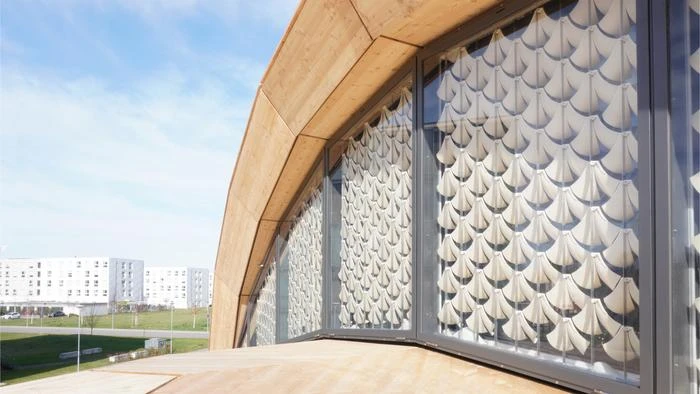
Pine cones as a model: Researchers at the universities of Stuttgart and Freiburg have developed a new, energy-autonomous facade system that adapts passively to the weather. The journal Nature Communications has published the research results.
"Most attempts at weather responsiveness in architectural facades rely heavily on elaborate technical devices. Our research explores how we can harness the responsiveness of the material itself through advanced computational design and additive manufacturing," says Professor Achim Menges, head of the Institute for Computational Design and Construction (ICD) and spokesperson for the Cluster of Excellence Integrative Computational Design and Construction for Architecture (IntCDC) at the University of Stuttgart. "We are achieving a shading system that opens and closes autonomously in response to changes in the weather, without the need for operational energy or any mechatronic elements. The bio-material structure itself is the machine."
Using bioinspired design, natural materials, and widely accessible technologies, researchers at the universities of Stuttgart and Freiburg have developed the "Solar Gate" facade system – the first weather-responsive, adaptive shading system that operates without electrical energy. The scientists used the movement mechanisms of pine cones as a model for the "Solar Gate", which opens and closes in response to changes in humidity and temperature without consuming any metabolic energy. The team succeeded in replicating the anisotropic (direction-dependent) structure of cellulose in plant tissues using standard 3D-printers. The research results have been published in the journal Nature Communications.
Biobased hygromorphic materials and bioinspired 4D-printing Cellulose is a natural, abundant, and renewable material that swells and shrinks with variations in humidity. This property, known as hygromorphism, is frequently observed in nature, for example in the opening and closing of the scales of pine cones or the inflorescences of the silver thistle. The research team leveraged this hygromorphic property by custom-engineering biobased cellulose fibers and 4D-printing them into a bilayered structure inspired by the scales of the pine cone.
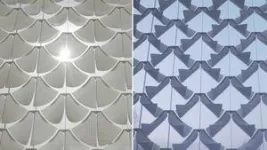
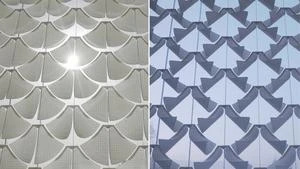
Material systems produced by this additive manufacturing technique called 4D-printing can autonomously change their shape in response to external stimuli. For the "Solar Gate," the researchers developed a computational fabrication method to control the extrusion of cellulosic materials using a standard 3D-printer, making it possible to harness the self-shaping and reversible behavior of the 4D-printed material system. In high humidity, the cellulosic materials absorb moisture and expand, causing the printed elements to curl and open. Conversely, in low humidity, the cellulosic materials release moisture and contract, causing the printed elements to flatten and close.
“Inspired by the hygroscopic movements of the scales of pine cones and the bracts of silver thistle, Solar Gate has succeeded in translating not only the high functionality and robustness of biological models into a bioinspired shading system but also the aesthetics of plant movements. This can be seen as the ‘royal road of bionics’, as everything that fascinates us about the biological concept generators has also been realized in the bio-inspired architectural product,” says Professor Thomas Speck, head of the Plant Biomechanics Group Freiburg and spokesperson for the Cluster of Excellence Living, Adaptive and Energy-autonomous Materials Systems (livMatS) at the University of Freiburg.
Architectural integration of self-shaping elements The research team tested the functionality and durability of the bioinspired adaptive shading system under real weather conditions for over a year. The "Solar Gate" was then installed on the livMatS Biomimetic Shell, a building demonstrator of the Cluster of Excellence IntCDC and the Cluster of Excellence livMatS, which serves as a research building of the University of Freiburg. The shading system has been installed on its south-facing skylight, which assists in the indoor climate regulation of the building. During winter, the 4D-printed shading elements open to allow sunlight in for natural heating. In summer, they close to minimize solar radiation. Powered solely by daily and seasonal weather cycles, this adaptive process operates without any electrical energy supply.
The "Solar Gate" thus represents an energy-autonomous and resource-efficient alternative to conventional shading systems. As buildings account for a significant proportion of global carbon emissions due to the typically high energy needed to maintain indoor comfort, reducing the energy required for heating, cooling and ventilation is of high importance. The "Solar Gate" highlights the potential of accessible, cost-effective technologies such as additive manufacturing and shows how cellulose, as an abundant, renewable material, can contribute to sustainable architectural solutions.
Project partners
The “Solar Gate” has been collaboratively developed by the Institute of Computational Design and Construction (ICD), Institute for Plastics Technology (IKT), and the Cluster of Excellence Integrative Computational Design and Construction for Architecture (IntCDC) at the University of Stuttgart, together with the Plant Biomechanics Group, Department for Microsystems Engineering (IMTEK), and the Cluster of Excellence Living, Adaptive and Energy-autonomous Materials Systems (livMatS) at the University of Freiburg.
Publication
Cheng, T., Tahouni, Y., Sahin, E.S., Ulrich, K., Lajewski, S., Bonten, C., Wood, D., Rühe, J., Speck, T., Menges, A.: 2024, Weather-responsive adaptive shading through biobased and bioinspired hygromorphic 4D-printing. Nature Communications, vol. 15, no. 1. (DOI: 10.1038/s41467-024-54808-8)
END
"Most attempts at weather responsiveness in architectural facades rely heavily on elaborate technical devices. Our research explores how we can harness the responsiveness of the material itself through advanced computational design and additive manufacturing," says Professor Achim Menges, head of the Institute for Computational Design and Construction (ICD) and spokesperson for the Cluster of Excellence Integrative Computational Design and Construction for Architecture (IntCDC) at the University of Stuttgart. "We are achieving a shading system that opens and closes autonomously in response to changes in the weather, without the need for operational energy or any mechatronic elements. The bio-material structure itself is the machine."
Using bioinspired design, natural materials, and widely accessible technologies, researchers at the universities of Stuttgart and Freiburg have developed the "Solar Gate" facade system – the first weather-responsive, adaptive shading system that operates without electrical energy. The scientists used the movement mechanisms of pine cones as a model for the "Solar Gate", which opens and closes in response to changes in humidity and temperature without consuming any metabolic energy. The team succeeded in replicating the anisotropic (direction-dependent) structure of cellulose in plant tissues using standard 3D-printers. The research results have been published in the journal Nature Communications.
Biobased hygromorphic materials and bioinspired 4D-printing Cellulose is a natural, abundant, and renewable material that swells and shrinks with variations in humidity. This property, known as hygromorphism, is frequently observed in nature, for example in the opening and closing of the scales of pine cones or the inflorescences of the silver thistle. The research team leveraged this hygromorphic property by custom-engineering biobased cellulose fibers and 4D-printing them into a bilayered structure inspired by the scales of the pine cone.
Material systems produced by this additive manufacturing technique called 4D-printing can autonomously change their shape in response to external stimuli. For the "Solar Gate," the researchers developed a computational fabrication method to control the extrusion of cellulosic materials using a standard 3D-printer, making it possible to harness the self-shaping and reversible behavior of the 4D-printed material system. In high humidity, the cellulosic materials absorb moisture and expand, causing the printed elements to curl and open. Conversely, in low humidity, the cellulosic materials release moisture and contract, causing the printed elements to flatten and close.
“Inspired by the hygroscopic movements of the scales of pine cones and the bracts of silver thistle, Solar Gate has succeeded in translating not only the high functionality and robustness of biological models into a bioinspired shading system but also the aesthetics of plant movements. This can be seen as the ‘royal road of bionics’, as everything that fascinates us about the biological concept generators has also been realized in the bio-inspired architectural product,” says Professor Thomas Speck, head of the Plant Biomechanics Group Freiburg and spokesperson for the Cluster of Excellence Living, Adaptive and Energy-autonomous Materials Systems (livMatS) at the University of Freiburg.
Architectural integration of self-shaping elements The research team tested the functionality and durability of the bioinspired adaptive shading system under real weather conditions for over a year. The "Solar Gate" was then installed on the livMatS Biomimetic Shell, a building demonstrator of the Cluster of Excellence IntCDC and the Cluster of Excellence livMatS, which serves as a research building of the University of Freiburg. The shading system has been installed on its south-facing skylight, which assists in the indoor climate regulation of the building. During winter, the 4D-printed shading elements open to allow sunlight in for natural heating. In summer, they close to minimize solar radiation. Powered solely by daily and seasonal weather cycles, this adaptive process operates without any electrical energy supply.
The "Solar Gate" thus represents an energy-autonomous and resource-efficient alternative to conventional shading systems. As buildings account for a significant proportion of global carbon emissions due to the typically high energy needed to maintain indoor comfort, reducing the energy required for heating, cooling and ventilation is of high importance. The "Solar Gate" highlights the potential of accessible, cost-effective technologies such as additive manufacturing and shows how cellulose, as an abundant, renewable material, can contribute to sustainable architectural solutions.
Project partners
The “Solar Gate” has been collaboratively developed by the Institute of Computational Design and Construction (ICD), Institute for Plastics Technology (IKT), and the Cluster of Excellence Integrative Computational Design and Construction for Architecture (IntCDC) at the University of Stuttgart, together with the Plant Biomechanics Group, Department for Microsystems Engineering (IMTEK), and the Cluster of Excellence Living, Adaptive and Energy-autonomous Materials Systems (livMatS) at the University of Freiburg.
Publication
Cheng, T., Tahouni, Y., Sahin, E.S., Ulrich, K., Lajewski, S., Bonten, C., Wood, D., Rühe, J., Speck, T., Menges, A.: 2024, Weather-responsive adaptive shading through biobased and bioinspired hygromorphic 4D-printing. Nature Communications, vol. 15, no. 1. (DOI: 10.1038/s41467-024-54808-8)
END
Attachments