New method searches through 10 sextillion drug molecules
Published 2025-02-26 · Original archive entry · Explore research explainers
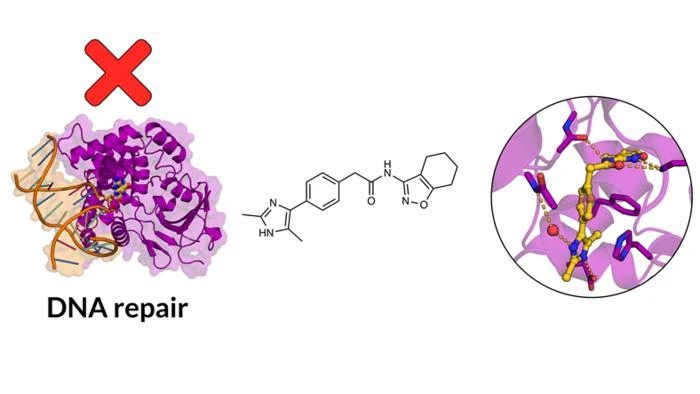
A recent study shows that computer algorithms can be used to find molecules that can be developed into anti-inflammatory drugs. In the article, the researchers also describe how the same strategy can be used to search through 10 sextillion alternatives to identify the best drug candidate.
One of the biggest challenges in drug development is finding the right candidates among the vast number of possible molecules. A new study published in Nature Communications shows that it is possible to identify drug molecules by modelling them using computer algorithms.
“We use the computer models to search through databases containing billions of molecules. This method will be able to speed up the costly drug development process,” says Jens Carlsson, one of the authors of the study.
Potential for anti-inflammatory drugs
The study, which was a collaboration with Karolinska Institutet and Stockholm University, focused on the enzyme OGG1, a protein that repairs damage to the cell’s DNA. The researchers were interested in identifying a molecule that could bind to this target protein and thus affect the activity of the enzyme. Using models of the protein, they designed more than a hundred different molecules, which were then produced. When the molecules were tested in experiments, the researchers could see that they inhibited activity of the enzyme and had an anti-inflammatory effect.
“It’s amazing that we can now design molecules and show that they actually work exactly as we hoped. The same strategy will work for many other proteins and diseases,” says Jens Carlsson.
Starting with simple molecules
Previously, drug development has focused on screening large libraries of chemicals containing drug-like molecules. However, this method is very costly and often fails to find good starting points for drug development. In the current study, the researchers used what is known as fragment-based drug design instead. The method involves first identifying a very small molecule that can bind to the target protein. When a molecule of this kind has been found, the researchers can then develop it step by step to create a drug.
“It’s like doing a jigsaw puzzle. We start with one piece of the puzzle and then gradually build up a drug molecule by adding new pieces. In the end, we have a drug molecule that fits the target protein perfectly,” says Jens Carlsson.
In the study, the researchers used a company that produces molecules on demand. They then created computer programs that can search through all the billions of molecules that are currently available for purchase. Using supercomputers, they can explore which molecules can bind to the surface of the target protein.
“We first searched among the billions of molecules that could be produced and tested quickly. And it went well; we found molecules that worked. Towards the end of the study, we began to think – how far can we go, if we don’t have the requirement that we have to be able to buy them?”
PhD student Andreas Luttens then wrote a new computer program that could generate all possible molecules. The number of potential alternatives then amounted to 10 sextillion (1022 or a 1 followed by 22 zeros). The researchers were then able to show that the same method they used to search among the molecules available for purchase would also work to search among the 10 sextillion alternatives.
“With our strategy, we can search through sextillions of drug molecules very efficiently. In the near future, we will be able to test all potential drug molecules in our computer models – a breakthrough that has great potential.”
New demands on medicinal chemists
Even though we now have the computational power to explore a huge number of molecules in search of new drugs, it’s not always certain that the new substances can actually be produced.
“We’ll need to develop new methods in the future in order to successfully develop the molecules that computations can design so quickly,” says Jens Carlsson.
Contact details
Jens Carlsson, Professor of Computational Chemistry at the Department of Cell and Molecular Biology, Uppsala University and SciLifeLab
Mobile phone number: +46(0)72-227 79 76
E-post: jens.carlsson@icm.uu.se
Article
Luttens, A., Vo, D.D., Scaletti, E.R. et al. Virtual fragment screening for DNA repair inhibitors in vast chemical space. Nat Commun 16, 1741 (2025). DOI: 10.1038/s41467-025-56893-9
END
One of the biggest challenges in drug development is finding the right candidates among the vast number of possible molecules. A new study published in Nature Communications shows that it is possible to identify drug molecules by modelling them using computer algorithms.
“We use the computer models to search through databases containing billions of molecules. This method will be able to speed up the costly drug development process,” says Jens Carlsson, one of the authors of the study.
Potential for anti-inflammatory drugs
The study, which was a collaboration with Karolinska Institutet and Stockholm University, focused on the enzyme OGG1, a protein that repairs damage to the cell’s DNA. The researchers were interested in identifying a molecule that could bind to this target protein and thus affect the activity of the enzyme. Using models of the protein, they designed more than a hundred different molecules, which were then produced. When the molecules were tested in experiments, the researchers could see that they inhibited activity of the enzyme and had an anti-inflammatory effect.
“It’s amazing that we can now design molecules and show that they actually work exactly as we hoped. The same strategy will work for many other proteins and diseases,” says Jens Carlsson.
Starting with simple molecules
Previously, drug development has focused on screening large libraries of chemicals containing drug-like molecules. However, this method is very costly and often fails to find good starting points for drug development. In the current study, the researchers used what is known as fragment-based drug design instead. The method involves first identifying a very small molecule that can bind to the target protein. When a molecule of this kind has been found, the researchers can then develop it step by step to create a drug.
“It’s like doing a jigsaw puzzle. We start with one piece of the puzzle and then gradually build up a drug molecule by adding new pieces. In the end, we have a drug molecule that fits the target protein perfectly,” says Jens Carlsson.
In the study, the researchers used a company that produces molecules on demand. They then created computer programs that can search through all the billions of molecules that are currently available for purchase. Using supercomputers, they can explore which molecules can bind to the surface of the target protein.
“We first searched among the billions of molecules that could be produced and tested quickly. And it went well; we found molecules that worked. Towards the end of the study, we began to think – how far can we go, if we don’t have the requirement that we have to be able to buy them?”
PhD student Andreas Luttens then wrote a new computer program that could generate all possible molecules. The number of potential alternatives then amounted to 10 sextillion (1022 or a 1 followed by 22 zeros). The researchers were then able to show that the same method they used to search among the molecules available for purchase would also work to search among the 10 sextillion alternatives.
“With our strategy, we can search through sextillions of drug molecules very efficiently. In the near future, we will be able to test all potential drug molecules in our computer models – a breakthrough that has great potential.”
New demands on medicinal chemists
Even though we now have the computational power to explore a huge number of molecules in search of new drugs, it’s not always certain that the new substances can actually be produced.
“We’ll need to develop new methods in the future in order to successfully develop the molecules that computations can design so quickly,” says Jens Carlsson.
Contact details
Jens Carlsson, Professor of Computational Chemistry at the Department of Cell and Molecular Biology, Uppsala University and SciLifeLab
Mobile phone number: +46(0)72-227 79 76
E-post: jens.carlsson@icm.uu.se
Article
Luttens, A., Vo, D.D., Scaletti, E.R. et al. Virtual fragment screening for DNA repair inhibitors in vast chemical space. Nat Commun 16, 1741 (2025). DOI: 10.1038/s41467-025-56893-9
END
Attachments