Throat microbiome holds clues to older Australians’ health
Published 2025-03-06 · Original archive entry · Explore research explainers
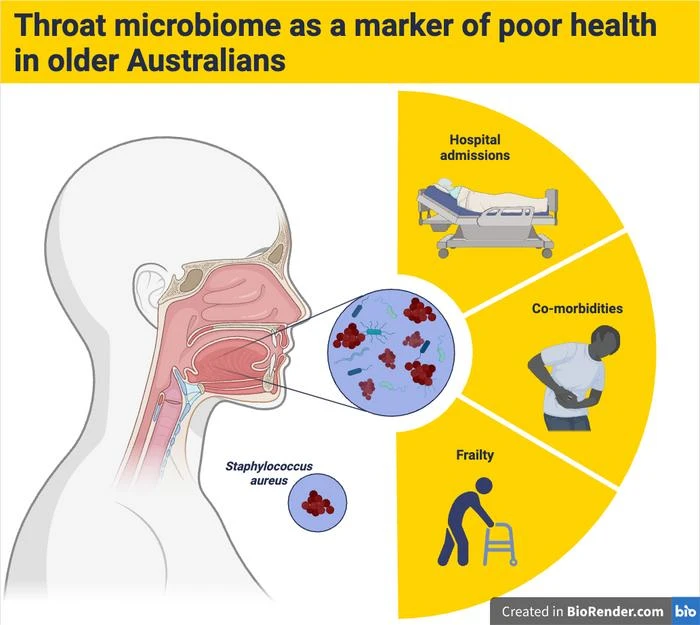
New research by Flinders University has uncovered a potential marker that could provide valuable insights into the overall health of older adults living in long-term aged care facilities.
Led by PhD candidate Sophie Miller in the College of Medicine and Public Health, the study found that a simple swab from the back of the throat, known as the oropharynx, may offer clues about health challenges faced by aged care residents.
“Our findings suggest that certain bacteria detected in the back of the throat could indicate greater health vulnerability in older adults,” says Miller.
Identifying vulnerable individuals in later life has proven successful through measures of physical robustness, such as grip strength and other physical assessments.
However, this study suggests the inclusion of a biological marker, which may provide additional insight into the risk of poor health outcomes in aged care.
“As we age, the community of bacteria and other micro-organisms in our throat changes. Factors like taking multiple medications and having more frequent healthcare visits, which are common in later life, can affect this balance,” she says.
“These changes that occur with age may result in physiological shifts that increase vulnerability to diseases and frailty.
The research involved the collection of oropharyngeal swabs from 190 residents of aged care facilities across metropolitan South Australia, and followed their health outcomes over 12 months.
One bacterium, Staphylococcus aureus (S. aureus), an organism ordinarily associated with infections - but not in this study context - was notably linked to poorer health outcomes.
Residents carrying this bacterium were found to be nearly ten times more likely to die within a year compared to non-carriers.
“This discovery suggests the usability of the microbiome as an additional marker of identifying residents who may require extra care or monitoring,” Miller explains.
The presence of S. aureus was found to reflect broader health challenges, rather than being linked to any specific infection.
Residents who tested positive for S. aureus tended to have a higher number of health conditions, further supporting the theory that S. aureus carriage might be indicative of overall poor health.
“Importantly, the presence of S. aureus was found to be a stronger predictor of mortality risk than an individual’s number of comorbidities—health conditions that are commonly used to assess the general health of elderly individuals.
“Even after adjusting for factors such as comorbid conditions, medications, and other health data, the link between S. aureus and mortality risk remained significantly high,” says Miller.
Senior author Professor Geraint Rogers, Director of the Microbiome and Host Health program at SAHMRI and Matthew Flinders Fellow at Flinders University, emphasises the potential significance of the findings.
“It’s fascinating that we see this relationship with S. aureus, even in the absence of any clear evidence of infection,” says Professor Rogers.
“This underscores the idea that the presence of certain bacteria, like S. aureus, could be an indicator of general health decline, rather than being directly associated with infection.
“This study marks an important step toward using simple microbial markers to inform healthcare strategies and improve outcomes for aged care residents.
“While the findings are compelling, more research is needed to confirm these results and explore the long-term implications.
“By studying larger groups of residents, we hope to uncover more ways to improve care and support for older adults,” adds Professor Rogers.
Further research will be crucial to better understand how these microbial markers could be used alongside traditional assessments to improve overall health outcomes for older Australians.
The article, ‘Oropharyngeal Staphylococcus aureus is linked to higher mortality in long-term aged care residents’, by Sophie J. Miller, Frank Zhang, Steven L. Taylor, Richard J. Woodman, Andrew P. Shoubridge, Lito Papanicolas and Geraint B. Rogers, has been published in the Age and Ageing journal.
DOI: 10.1093/ageing/afaf042
Acknowledgements: This research was supported by an Australian Medical Research Future Fund (MRFF) grant from the Australian Department of Health (GNT1152268). The Australian Department of Health reviewed the study proposal, but did not play a role in study design, data collection, analysis, interpretation, or manuscript writing. GBR is supported by a National Health and Medical Research Council (NHMRC) Senior Research Fellowship (GNT119378) and a Matthew Flinders Professorial Fellowship. SLT is supported by an NHMRC Emerging Leadership grant (GNT2008625).
END
Led by PhD candidate Sophie Miller in the College of Medicine and Public Health, the study found that a simple swab from the back of the throat, known as the oropharynx, may offer clues about health challenges faced by aged care residents.
“Our findings suggest that certain bacteria detected in the back of the throat could indicate greater health vulnerability in older adults,” says Miller.
Identifying vulnerable individuals in later life has proven successful through measures of physical robustness, such as grip strength and other physical assessments.
However, this study suggests the inclusion of a biological marker, which may provide additional insight into the risk of poor health outcomes in aged care.
“As we age, the community of bacteria and other micro-organisms in our throat changes. Factors like taking multiple medications and having more frequent healthcare visits, which are common in later life, can affect this balance,” she says.
“These changes that occur with age may result in physiological shifts that increase vulnerability to diseases and frailty.
The research involved the collection of oropharyngeal swabs from 190 residents of aged care facilities across metropolitan South Australia, and followed their health outcomes over 12 months.
One bacterium, Staphylococcus aureus (S. aureus), an organism ordinarily associated with infections - but not in this study context - was notably linked to poorer health outcomes.
Residents carrying this bacterium were found to be nearly ten times more likely to die within a year compared to non-carriers.
“This discovery suggests the usability of the microbiome as an additional marker of identifying residents who may require extra care or monitoring,” Miller explains.
The presence of S. aureus was found to reflect broader health challenges, rather than being linked to any specific infection.
Residents who tested positive for S. aureus tended to have a higher number of health conditions, further supporting the theory that S. aureus carriage might be indicative of overall poor health.
“Importantly, the presence of S. aureus was found to be a stronger predictor of mortality risk than an individual’s number of comorbidities—health conditions that are commonly used to assess the general health of elderly individuals.
“Even after adjusting for factors such as comorbid conditions, medications, and other health data, the link between S. aureus and mortality risk remained significantly high,” says Miller.
Senior author Professor Geraint Rogers, Director of the Microbiome and Host Health program at SAHMRI and Matthew Flinders Fellow at Flinders University, emphasises the potential significance of the findings.
“It’s fascinating that we see this relationship with S. aureus, even in the absence of any clear evidence of infection,” says Professor Rogers.
“This underscores the idea that the presence of certain bacteria, like S. aureus, could be an indicator of general health decline, rather than being directly associated with infection.
“This study marks an important step toward using simple microbial markers to inform healthcare strategies and improve outcomes for aged care residents.
“While the findings are compelling, more research is needed to confirm these results and explore the long-term implications.
“By studying larger groups of residents, we hope to uncover more ways to improve care and support for older adults,” adds Professor Rogers.
Further research will be crucial to better understand how these microbial markers could be used alongside traditional assessments to improve overall health outcomes for older Australians.
The article, ‘Oropharyngeal Staphylococcus aureus is linked to higher mortality in long-term aged care residents’, by Sophie J. Miller, Frank Zhang, Steven L. Taylor, Richard J. Woodman, Andrew P. Shoubridge, Lito Papanicolas and Geraint B. Rogers, has been published in the Age and Ageing journal.
DOI: 10.1093/ageing/afaf042
Acknowledgements: This research was supported by an Australian Medical Research Future Fund (MRFF) grant from the Australian Department of Health (GNT1152268). The Australian Department of Health reviewed the study proposal, but did not play a role in study design, data collection, analysis, interpretation, or manuscript writing. GBR is supported by a National Health and Medical Research Council (NHMRC) Senior Research Fellowship (GNT119378) and a Matthew Flinders Professorial Fellowship. SLT is supported by an NHMRC Emerging Leadership grant (GNT2008625).
END
Attachments