Exciting moments on the edge
Published 2025-03-12 · Original archive entry · Explore research explainers
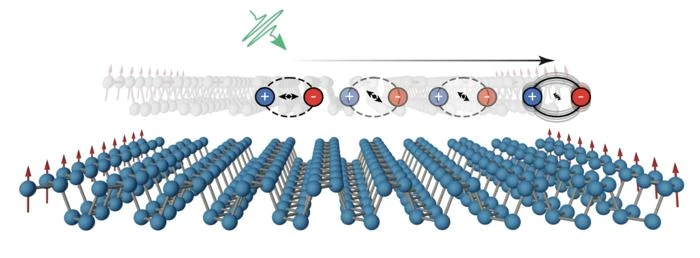
Scientists have long suspected that phosphorene nanoribbons (PNRs) – thin pieces of black phosphorus, only a few nanometres wide – might exhibit unique magnetic and semiconducting properties, but proving this has been difficult. In a recent study published in Nature, researchers focused on exploring the potential for magnetic and semiconducting characteristics of these nanoribbons. Using techniques such as ultrafast magneto-optical spectroscopy and electron paramagnetic resonance they were able to demonstrate the magnetic behaviour of PNRs at room temperature, and show how these magnetic properties can interact with light.
The study, carried out at the Cavendish Laboratory in collaboration with other institutes including the University of Warwick, University College London, Freie Universität Berlin and the European High Magnetic Field lab in Nijmegen, revealed several key findings about phosphorene nanoribbons. Remarkably, these nanoribbons exhibit macroscopic magnetic properties at room temperature. Under relatively weak magnetic fields (<1T) they surprisingly stand at attention in solution almost like iron filings arrange themselves around a magnet. Furthermore, when in thin films they can display macroscopic magnetic behaviour akin only to that of classic magnetic metals such as iron and nickel.
“Most excitingly, we discovered that in addition to these magnetic properties, PNRs host excited states on the magnetic edge of the nanoribbon, where it interacts with atomic vibrations (phonons) that are normally not allowed by the material’s bulk symmetries,” said Arjun Ashoka, Junior Research Fellow at Trinity College and the first author of the paper “This unusual interaction allows PNRs to uniquely couple magnetic, optical and vibrational properties on its one-dimensional edge.” .
"For years we've explored and utilised the devilish yet benevolent 2D surfaces of 3D materials, from catalysis to device physics. With these new nanoribbons we've hopefully unlocked access to new physics on the 1-dimensional analogue of a 2D surface: an edge."
This work is particularly significant as it marks the first experimental validations of the predicted, but difficult to observe magnetic properties of phosphorene nanoribbons.
“The confirmation that phosphorene nanoribbons are intrinsically both semiconducting and magnetic—without requiring low temperatures or doping—is particularly important and novel. While this property was predicted, directly observing it is an incredible validation of those predictions," adds Chris Howard from University College London whose team first synthesised these nanoribbons.
What stands out the most about this research is its potential to influence multiple avenues of science and technology. This research could enable new routes to spintronic devices, which use electron spin instead of charge to enable novel computing technologies such as scalable fabrication for quantum devices, flexible electronics and next generation transistors.
“The best thing about this work, apart from being a really exciting finding, has been the great team we have worked with over 10 institutes and 5 years, highlighting the amazing science that can be done when we work together,” said corresponding author Raj Pandya, who was a Junior Research Fellow at the Cavendish Laboratory at the time of this research and is now at the University of Warwick.
The researchers are excited about the future directions of this work. Their next steps involve finding ways to study the coupling of magnetism with light and vibrations on the edge of these ribbons and exploring their potential to develop entirely new device concepts.
Reference:
Ashoka, A., Clancy A., Panjwani A. et al., ‘Magnetically and optically active edges in phosphorene nanoribbons,’ Nature (2025), DOI: 10.1038/s41586-024-08563-x
END
The study, carried out at the Cavendish Laboratory in collaboration with other institutes including the University of Warwick, University College London, Freie Universität Berlin and the European High Magnetic Field lab in Nijmegen, revealed several key findings about phosphorene nanoribbons. Remarkably, these nanoribbons exhibit macroscopic magnetic properties at room temperature. Under relatively weak magnetic fields (<1T) they surprisingly stand at attention in solution almost like iron filings arrange themselves around a magnet. Furthermore, when in thin films they can display macroscopic magnetic behaviour akin only to that of classic magnetic metals such as iron and nickel.
“Most excitingly, we discovered that in addition to these magnetic properties, PNRs host excited states on the magnetic edge of the nanoribbon, where it interacts with atomic vibrations (phonons) that are normally not allowed by the material’s bulk symmetries,” said Arjun Ashoka, Junior Research Fellow at Trinity College and the first author of the paper “This unusual interaction allows PNRs to uniquely couple magnetic, optical and vibrational properties on its one-dimensional edge.” .
"For years we've explored and utilised the devilish yet benevolent 2D surfaces of 3D materials, from catalysis to device physics. With these new nanoribbons we've hopefully unlocked access to new physics on the 1-dimensional analogue of a 2D surface: an edge."
This work is particularly significant as it marks the first experimental validations of the predicted, but difficult to observe magnetic properties of phosphorene nanoribbons.
“The confirmation that phosphorene nanoribbons are intrinsically both semiconducting and magnetic—without requiring low temperatures or doping—is particularly important and novel. While this property was predicted, directly observing it is an incredible validation of those predictions," adds Chris Howard from University College London whose team first synthesised these nanoribbons.
What stands out the most about this research is its potential to influence multiple avenues of science and technology. This research could enable new routes to spintronic devices, which use electron spin instead of charge to enable novel computing technologies such as scalable fabrication for quantum devices, flexible electronics and next generation transistors.
“The best thing about this work, apart from being a really exciting finding, has been the great team we have worked with over 10 institutes and 5 years, highlighting the amazing science that can be done when we work together,” said corresponding author Raj Pandya, who was a Junior Research Fellow at the Cavendish Laboratory at the time of this research and is now at the University of Warwick.
The researchers are excited about the future directions of this work. Their next steps involve finding ways to study the coupling of magnetism with light and vibrations on the edge of these ribbons and exploring their potential to develop entirely new device concepts.
Reference:
Ashoka, A., Clancy A., Panjwani A. et al., ‘Magnetically and optically active edges in phosphorene nanoribbons,’ Nature (2025), DOI: 10.1038/s41586-024-08563-x
END