Neighborhood dispute among cells: Whichever successfully exerts force wins
Published 2025-03-17 · Original archive entry · Explore research explainers
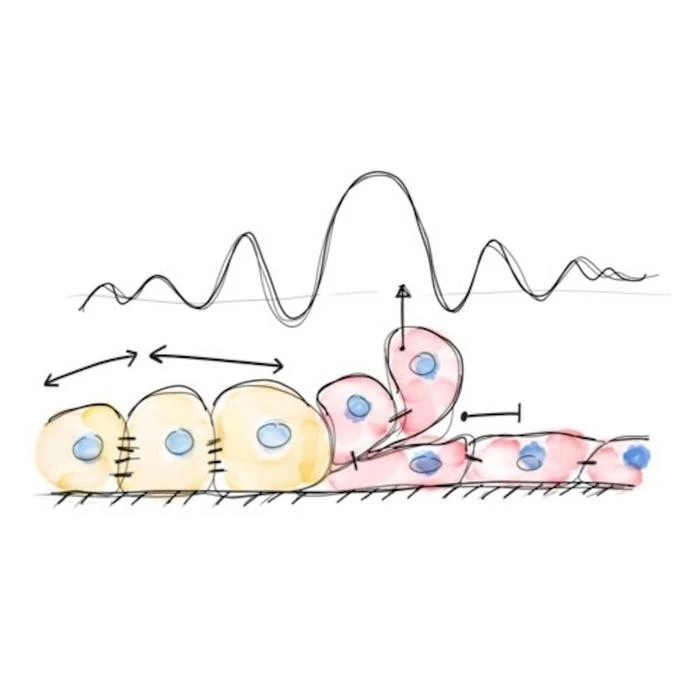
Trial of strength at the cellular level: cells are in constant competition with each other and so eliminate diseased or unwanted cells. Cell competition is therefore a central principle for maintaining the health of tissues and organs. Researchers have investigated the success factors of superior cells and discovered a previously unknown winning strategy in mechanical cell competition. They identified a variety in the ability of cells to exert mechanical forces onto other cells as the decisive regulator. With their results recently published in Nature Materials, the research team from Germany, France and Denmark challenges the classical interpretation of cell competition.
Winner and loser cells – competition as a survival principle
The formation of all organisms relies on the meticulous arrangement of diverse cell types, each with distinct roles and identities. Even minor deviations from the evolutionary blueprint can cause developmental abnormalities, accelerate aging, and contribute to disease. To preserve tissue and organ integrity, cell populations employ quality-control mechanisms. One such mechanism is a set of surveillance processes known as “cell competition.” Cells are able to adapt their properties in relation to their neighbors and compare their so-called fitness level to their neighboring cells. The stronger “winner” cells survive, while the weaker “loser” cells are removed from the cell structure and die. This mechanism helps to maintain a healthy and efficient cell community. Cell competition is therefore a crucial factor to maintain tissue health and is necessary for fighting pathogens. If such control mechanisms fail, tumors can develop.
New winning strategy uncovered in mechanical cell competition
The molecular factors and biochemical signals involved in cell death and the elimination of losers have already been extensively researched. Various scientific studies have further shown that cells can also be eliminated by mechanical forces. However, their exact role in cell competition remains unclear.
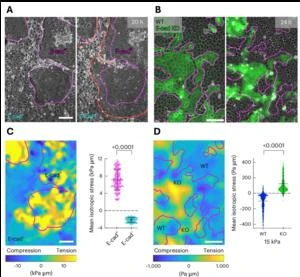
An international team of researchers, including experts from the Max-Planck-Zentrum für Physik und Medizin (MPZPM), the Institut Jacques Monod (CNRS, UP Cité, France), and the Niels Bohr Institute (Denmark), has identified a previously unknown mechanism in mechanical cell competition. In their work, the scientists reveal that “winner” cells excel at exerting mechanical forces to their surroundings including neighboring cells, giving them a survival advantage over “loser” cells. The researchers demonstrated that this effect is particularly pronounced at the interface between different cell populations, where healthy cells border mutated cells. Ladoux’s team observed that these active interfaces are hotspots for cell elimination and are marked by intensified mechanical force fluctuations.
The study confirms that these amplified fluctuations play a crucial role in the removal of cells that struggle to transfer mechanical stress. The results challenge the previously held belief that “winner” cells eliminate “loser” cells purely by compressing and squeezing them out of the tissue. Instead, the findings suggest that the competitive advantage of winner cells lies in their active resistance to their own elimination.
Where does the active resistance originate?
The junction protein E-cadherin plays a significant role in the intercellular force transmission in epithelia. It contributes to cells attaching themselves to each other (cell adhesions) while simultaneously connecting them mechanically to their physical environment. The precise mechanism of this mechanical coupling – which enables cells to perceive, signal, and respond to physical changes in their environment – is the subject of research by Prof. Benoît Ladoux, head of the division of “Tissue Mechanobiology” at the MPZPM. Ladoux´s team is investigating the relationships between adhesion and mechanical and biochemical signaling for the adaptation of living cells to changes in their physical environment at diverse levels, from individual molecules to tissues.
In the study, the international team combined mechanical measurements of forces within tissue with targeted biological interventions, such as switching off individual molecules, including E-cadherin. The group collaborated with theoretical physicists from the University of Copenhagen, who created computer simulations based on the mechanical differences between the cells. This allowed them to predict how individual components, in this case mechanical fluctuations, can alter observations. The prediction was then experimentally verified.
“We were surprised to find that compressed cells were not consistently not eliminated,” says Ladoux. “This observation fundamentally differs from previously known forms of mechanical cell competition, like the directed migration of winner cells toward losers. We suspected that changes in intercellular force transmission were caused by variations in E-cadherin adhesion strength, shaping the dynamics of cell competition. This insight has driven us to further investigate this direction.” First author of the paper, Andreas Schoenit, Institut Jacques Monod (CNRS, UP Cité, France), adds: “With our studies, we were able to identify force transmission capability as the main regulator of the outcome of cell competition. Since cell competition is a fundamental mechanism for maintaining tissue health, this discovery could have implications for many vital biological processes, including morphogenesis, acute inflammation and even cancer.”
END
Winner and loser cells – competition as a survival principle
The formation of all organisms relies on the meticulous arrangement of diverse cell types, each with distinct roles and identities. Even minor deviations from the evolutionary blueprint can cause developmental abnormalities, accelerate aging, and contribute to disease. To preserve tissue and organ integrity, cell populations employ quality-control mechanisms. One such mechanism is a set of surveillance processes known as “cell competition.” Cells are able to adapt their properties in relation to their neighbors and compare their so-called fitness level to their neighboring cells. The stronger “winner” cells survive, while the weaker “loser” cells are removed from the cell structure and die. This mechanism helps to maintain a healthy and efficient cell community. Cell competition is therefore a crucial factor to maintain tissue health and is necessary for fighting pathogens. If such control mechanisms fail, tumors can develop.
New winning strategy uncovered in mechanical cell competition
The molecular factors and biochemical signals involved in cell death and the elimination of losers have already been extensively researched. Various scientific studies have further shown that cells can also be eliminated by mechanical forces. However, their exact role in cell competition remains unclear.
An international team of researchers, including experts from the Max-Planck-Zentrum für Physik und Medizin (MPZPM), the Institut Jacques Monod (CNRS, UP Cité, France), and the Niels Bohr Institute (Denmark), has identified a previously unknown mechanism in mechanical cell competition. In their work, the scientists reveal that “winner” cells excel at exerting mechanical forces to their surroundings including neighboring cells, giving them a survival advantage over “loser” cells. The researchers demonstrated that this effect is particularly pronounced at the interface between different cell populations, where healthy cells border mutated cells. Ladoux’s team observed that these active interfaces are hotspots for cell elimination and are marked by intensified mechanical force fluctuations.
The study confirms that these amplified fluctuations play a crucial role in the removal of cells that struggle to transfer mechanical stress. The results challenge the previously held belief that “winner” cells eliminate “loser” cells purely by compressing and squeezing them out of the tissue. Instead, the findings suggest that the competitive advantage of winner cells lies in their active resistance to their own elimination.
Where does the active resistance originate?
The junction protein E-cadherin plays a significant role in the intercellular force transmission in epithelia. It contributes to cells attaching themselves to each other (cell adhesions) while simultaneously connecting them mechanically to their physical environment. The precise mechanism of this mechanical coupling – which enables cells to perceive, signal, and respond to physical changes in their environment – is the subject of research by Prof. Benoît Ladoux, head of the division of “Tissue Mechanobiology” at the MPZPM. Ladoux´s team is investigating the relationships between adhesion and mechanical and biochemical signaling for the adaptation of living cells to changes in their physical environment at diverse levels, from individual molecules to tissues.
In the study, the international team combined mechanical measurements of forces within tissue with targeted biological interventions, such as switching off individual molecules, including E-cadherin. The group collaborated with theoretical physicists from the University of Copenhagen, who created computer simulations based on the mechanical differences between the cells. This allowed them to predict how individual components, in this case mechanical fluctuations, can alter observations. The prediction was then experimentally verified.
“We were surprised to find that compressed cells were not consistently not eliminated,” says Ladoux. “This observation fundamentally differs from previously known forms of mechanical cell competition, like the directed migration of winner cells toward losers. We suspected that changes in intercellular force transmission were caused by variations in E-cadherin adhesion strength, shaping the dynamics of cell competition. This insight has driven us to further investigate this direction.” First author of the paper, Andreas Schoenit, Institut Jacques Monod (CNRS, UP Cité, France), adds: “With our studies, we were able to identify force transmission capability as the main regulator of the outcome of cell competition. Since cell competition is a fundamental mechanism for maintaining tissue health, this discovery could have implications for many vital biological processes, including morphogenesis, acute inflammation and even cancer.”
END
Attachments