How the brain responds to prices: Scientists discover neural marker for price perception
Published 2025-03-21 · Original archive entry · Explore research explainers
Russian scientists have discovered how the brain makes purchasing decisions. Using electroencephalography (EEG) and magnetoencephalography (MEG), researchers found that the brain responds almost instantly when a product's price deviates from expectations. This response engages brain regions involved in evaluating rewards and learning from past decisions. Thus, perceiving a product's value is not merely a conscious choice but also a function of automatic cognitive mechanisms. The results have been published in Frontiers in Human Neuroscience.
Every day, people are faced with prices of food, technology, and services. Sometimes, a product seems overpriced, while other times, it appears suspiciously cheap. Do consumers consciously judge prices, or does the brain do it automatically? Researchers from HSE University and Neurotrend, a Russian neuromarketing company, set out to investigate how the brain responds to unexpected prices.
Participants in the experiment were shown images of mobile phones (iPhone, Nokia, Xiaomi), followed by their hypothetical prices. The prices could be above, below, or matching the actual market value of the products. Afterward, the target word 'expensive' or 'cheap' appeared on the screen, and participants had to determine whether the word matched the given price. Throughout the experiment, the researchers recorded participants' brain activity using EEG and MEG, methods that track changes in brain neuron activity. A total of 65 individuals participated in the study.
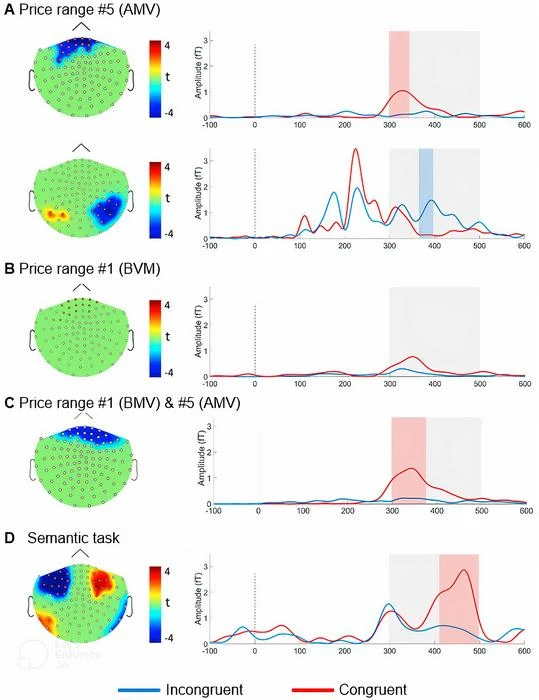
The findings reveal that perceiving prices significantly different from the actual market value triggered a strong N400 signal, an electrical impulse in the brain typically generated when confronted with unexpected information. Notably, prices perceived as excessively high triggered a stronger response than those seen as too low. The scientists explain this by suggesting that implausibly high discounts may be perceived with scepticism. Additionally, it appears that the brain's response can vary depending on the product's brand. For the Xiaomi mobile phone, the price range that triggered a strong N400 response was found to be broader. This may suggest that people did not have a clear enough understanding of the real market value of this product.
Andrew Kislov
'Back when I was in my bachelor's programme at HSE University, I wondered whether it was possible to determine from brain activity what price a person considers acceptable. Our experiments have confirmed that it is indeed possible,’ comments Andrew Kislov, doctoral student at the HSE Faculty of Social Sciences and co-author of the study. 'Globally, we are working to develop an objective method for assessing customer preferences. To what extent, in doing so, do we have the right to invade a person's inner world? This is a good question, but in this project, we simply aimed to determine the maximum price that would be comfortable for people, and this method does not pose any real threat to customers.'
To identify which regions of the brain respond to prices, the researchers analysed MEG data. They found that when perceiving 'non-optimal' prices, the frontal cortex and anterior cingulate gyrus—regions responsible for decision-making and assessing rewards—were activated.
Vasily Klucharev
'The results demonstrate that when the price does not meet expectations, the brain responds almost instantly. Moreover, the response is linked to brain regions involved in assessing rewards and learning from past decisions. This means that the perception of a product's value is part of automatic cognitive mechanisms that are activated long before an individual consciously makes a decision,' explains the chief researcher Vasily Klucharev, Head of the International Laboratory of Social Neurobiology.
The study also provides marketers with new tools: instead of relying solely on surveys, they can gain insight into consumers' perception of prices at the neurocognitive level.
Anna Shestakova
'Marketers are increasingly saying that conventional consumer surveys don't provide a complete picture, as people cannot always explain why a certain price seems too high or too low to them. People often say what they think is expected of them. Therefore, we conducted this study in collaboration with a leading neuromarketing company, Neurotrend, and discovered that it is possible to examine an individual's brain and determine whether a specific product price meets their expectations. This approach can help predict how people will perceive the price of a new product even before it is released to the market,' explains the chief researcher Anna Shestakova, Director of the HSE Institute for Cognitive Neuroscience.
END
Every day, people are faced with prices of food, technology, and services. Sometimes, a product seems overpriced, while other times, it appears suspiciously cheap. Do consumers consciously judge prices, or does the brain do it automatically? Researchers from HSE University and Neurotrend, a Russian neuromarketing company, set out to investigate how the brain responds to unexpected prices.
Participants in the experiment were shown images of mobile phones (iPhone, Nokia, Xiaomi), followed by their hypothetical prices. The prices could be above, below, or matching the actual market value of the products. Afterward, the target word 'expensive' or 'cheap' appeared on the screen, and participants had to determine whether the word matched the given price. Throughout the experiment, the researchers recorded participants' brain activity using EEG and MEG, methods that track changes in brain neuron activity. A total of 65 individuals participated in the study.
The findings reveal that perceiving prices significantly different from the actual market value triggered a strong N400 signal, an electrical impulse in the brain typically generated when confronted with unexpected information. Notably, prices perceived as excessively high triggered a stronger response than those seen as too low. The scientists explain this by suggesting that implausibly high discounts may be perceived with scepticism. Additionally, it appears that the brain's response can vary depending on the product's brand. For the Xiaomi mobile phone, the price range that triggered a strong N400 response was found to be broader. This may suggest that people did not have a clear enough understanding of the real market value of this product.
Andrew Kislov
'Back when I was in my bachelor's programme at HSE University, I wondered whether it was possible to determine from brain activity what price a person considers acceptable. Our experiments have confirmed that it is indeed possible,’ comments Andrew Kislov, doctoral student at the HSE Faculty of Social Sciences and co-author of the study. 'Globally, we are working to develop an objective method for assessing customer preferences. To what extent, in doing so, do we have the right to invade a person's inner world? This is a good question, but in this project, we simply aimed to determine the maximum price that would be comfortable for people, and this method does not pose any real threat to customers.'
To identify which regions of the brain respond to prices, the researchers analysed MEG data. They found that when perceiving 'non-optimal' prices, the frontal cortex and anterior cingulate gyrus—regions responsible for decision-making and assessing rewards—were activated.
Vasily Klucharev
'The results demonstrate that when the price does not meet expectations, the brain responds almost instantly. Moreover, the response is linked to brain regions involved in assessing rewards and learning from past decisions. This means that the perception of a product's value is part of automatic cognitive mechanisms that are activated long before an individual consciously makes a decision,' explains the chief researcher Vasily Klucharev, Head of the International Laboratory of Social Neurobiology.
The study also provides marketers with new tools: instead of relying solely on surveys, they can gain insight into consumers' perception of prices at the neurocognitive level.
Anna Shestakova
'Marketers are increasingly saying that conventional consumer surveys don't provide a complete picture, as people cannot always explain why a certain price seems too high or too low to them. People often say what they think is expected of them. Therefore, we conducted this study in collaboration with a leading neuromarketing company, Neurotrend, and discovered that it is possible to examine an individual's brain and determine whether a specific product price meets their expectations. This approach can help predict how people will perceive the price of a new product even before it is released to the market,' explains the chief researcher Anna Shestakova, Director of the HSE Institute for Cognitive Neuroscience.
END