Blood on the menu
New research could make it easier to grow health-promoting blood oranges
Published 2012-03-13 · Original archive entry · Explore research explainers
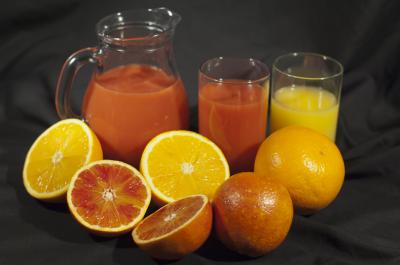
For the red pigmentation to develop, blood oranges normally require a period of cold as they ripen. The only place to reliably grow them on a commercial scale is in the Sicilian area of Italy around Mount Etna. Here, the combination of sun and cold/sunny days and warm nights provides ideal growing conditions.
Scientists have identified the gene responsible for blood orange pigmentation, naming it Ruby, and have discovered how it is controlled.
"Blood oranges contain naturally-occurring pigments associated with improved cardiovascular health, controlling diabetes and reducing obesity," said Professor Cathie Martin from the John Innes Centre on Norwich Research Park.
"Our improved understanding of this trait could offer relatively straightforward solutions to growing blood oranges reliably in warmer climates through genetic engineering."
The pigments are anthocyanins, flavonoids that give red, purple and blue fruit their colour. Previous studies have shown that drinking blood orange juice reduces oxidative stress in diabetic patients, protects DNA against oxidative damage and that it may reduce cardiovascular risk factors more generally, as demonstrated for other high-anthocyanin foods.
A 2010 study found that blood orange juice limits the development of fat cells and weight gain in mice and provides resistance to obesity compared to blond orange juice or water.
Blood oranges are grown outside Sicily, for example in Japan, South Africa and Iran. But in some years entire harvests are lost because the right conditions cannot be created during ripening. Or in Florida and Brazil, the anthocyanin content is weak and unreliable.
The scientists isolated the Ruby gene from the flesh of blood and blond oranges. They found that it is controlled by mobile genetic elements that are activated by the stress of cold.
They accessed all globally known blood orange types to analyse whether any produce anthocyanins without cold. Most blood orange cultivars originated directly or indirectly from Sicily, but one old variety, Jingxian, is of Chinese origin. In the Jingxian variety, the production of anthocyanins is dependent on a different mobile element, but again this is activated by cold.
"Our results offer little hope of conventionally breeding or identifying new varieties of blood orange that are free from cold dependency," said Martin.
"We are now experimenting with hooking the Ruby gene up with a specific fruit promoter so it can be induced in another way."
Blood oranges are a derivative of sweet orange, the most commonly grown fruit tree in the world. The current study, to be published in The Plant Cell, also confirmed that sweet oranges are a hybrid between the Southeast Asian pummelo and mandarin.
The research was funded by an EU project focused on flavonoids, FLORA, an EU project called ATHENA focussed on anthocyanins and polyphenols, a studentship from the John Innes Foundation, strategic funding from the Biotechnology and Biological Sciences Research Council (BBSRC) and the Italian Agronanotech project.
It led the scientists on an historical as well as scientific journey, unearthing the earliest paintings featuring blood oranges, 19th century botanical drawings and their earliest mentions in historic texts.
INFORMATION:
A video to accompany this is available to view at: http://youtu.be/0ZtTulQQTM4
Scientists have identified the gene responsible for blood orange pigmentation, naming it Ruby, and have discovered how it is controlled.
"Blood oranges contain naturally-occurring pigments associated with improved cardiovascular health, controlling diabetes and reducing obesity," said Professor Cathie Martin from the John Innes Centre on Norwich Research Park.
"Our improved understanding of this trait could offer relatively straightforward solutions to growing blood oranges reliably in warmer climates through genetic engineering."
The pigments are anthocyanins, flavonoids that give red, purple and blue fruit their colour. Previous studies have shown that drinking blood orange juice reduces oxidative stress in diabetic patients, protects DNA against oxidative damage and that it may reduce cardiovascular risk factors more generally, as demonstrated for other high-anthocyanin foods.
A 2010 study found that blood orange juice limits the development of fat cells and weight gain in mice and provides resistance to obesity compared to blond orange juice or water.
Blood oranges are grown outside Sicily, for example in Japan, South Africa and Iran. But in some years entire harvests are lost because the right conditions cannot be created during ripening. Or in Florida and Brazil, the anthocyanin content is weak and unreliable.
The scientists isolated the Ruby gene from the flesh of blood and blond oranges. They found that it is controlled by mobile genetic elements that are activated by the stress of cold.
They accessed all globally known blood orange types to analyse whether any produce anthocyanins without cold. Most blood orange cultivars originated directly or indirectly from Sicily, but one old variety, Jingxian, is of Chinese origin. In the Jingxian variety, the production of anthocyanins is dependent on a different mobile element, but again this is activated by cold.
"Our results offer little hope of conventionally breeding or identifying new varieties of blood orange that are free from cold dependency," said Martin.
"We are now experimenting with hooking the Ruby gene up with a specific fruit promoter so it can be induced in another way."
Blood oranges are a derivative of sweet orange, the most commonly grown fruit tree in the world. The current study, to be published in The Plant Cell, also confirmed that sweet oranges are a hybrid between the Southeast Asian pummelo and mandarin.
The research was funded by an EU project focused on flavonoids, FLORA, an EU project called ATHENA focussed on anthocyanins and polyphenols, a studentship from the John Innes Foundation, strategic funding from the Biotechnology and Biological Sciences Research Council (BBSRC) and the Italian Agronanotech project.
It led the scientists on an historical as well as scientific journey, unearthing the earliest paintings featuring blood oranges, 19th century botanical drawings and their earliest mentions in historic texts.
INFORMATION:
A video to accompany this is available to view at: http://youtu.be/0ZtTulQQTM4