Highways of the brain: High-cost and high-capacity
Published 2012-06-19 · Original archive entry · Explore research explainers
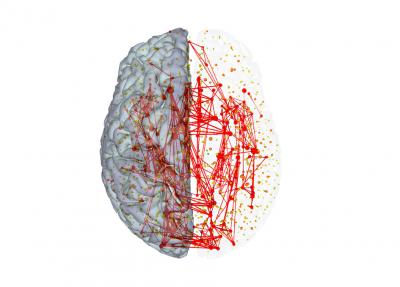
BLOOMINGTON, Ind. -- A new study proposes a communication routing strategy for the brain that mimics the American highway system, with the bulk of the traffic leaving the local and feeder neural pathways to spend as much time as possible on the longer, higher-capacity passages through an influential network of hubs, the so-called rich club.
The study, published this week online in the Early Edition of the Proceedings of the National Academy of Sciences, involves researchers from Indiana University and the University Medical Center Utrecht in the Netherlands and advances their earlier findings that showed how select hubs in the brain not only are powerful in their own right but have numerous and strong connections between each other.
The current study characterizes the influential network within the rich club as the "backbone" for global brain communication. A costly network in terms of the energy and space consumed, said Olaf Sporns, professor in the Department of Psychological and Brain Sciences at IU Bloomington, but one with a big pay-off: providing quick and effective communication between billions and billions of brain cells.
"Until now, no one knew how central the brain's rich club really was," Sporns said. "It turns out the rich club is always right in the middle when it comes to how brain regions talk to each other. It absorbs, transforms and disseminates information. This underscores its importance for brain communication."
In earlier work, using diffusion imaging, the researchers found a group of 12 strongly interconnected bihemispheric hub regions, comprising the precuneus, superior frontal and superior parietal cortex, as well as the subcortical hippocampus, putamen and thalamus. Together, these regions form the brain's "rich club." Most of these areas are engaged in a wide range of complex behavioral and cognitive tasks, rather than more specialized processing such as vision and motor control.
For the current study, Martijn van den Heuvel, a professor at the Rudolf Magnus Institute of Neuroscience at University Medical Center Utrecht, used diffusion tensor imaging data for two sets of 40 healthy subjects to map the large-scale connectivity structure of the brain. The cortical sheet was divided into 1,170 regions, and then pathways between the regions were reconstructed and measured. As in the previous study, the rich club nodes were widely distributed and had up to 40 percent more connectivity compared to other areas.
The connections measured -- almost 700,000 in total -- were classified in one of three ways: as rich club connections if they connected nodes within the rich club; as feeder connections if they connected a non-rich club node to a rich club node; and as local connections if they connected non-rich club nodes. Rich club connections made up the majority of all long-distance neural pathways. The study also found that connections classified as rich club connections were used more heavily for communication than other feeder and local connections. A path analysis showed that when a minimally short path is traced from one area of the brain to another, it travels through the rich club network 69 percent of the time, even though the network accounts for only 10 percent of the brain.
A common pattern in communication paths spanning long distances, Sporns said, was that such paths involved sequences of steps leading across local, feeder, rich club, feeder and back to local connections. In other words, he said, many communication paths first traveled toward the rich club before reaching their destinations.
"It is as if the rich club acts as an attractor for signal traffic in the brain," Sporns said. "It soaks up information which is then integrated and sent back out to the rest of the brain."
Van den Heuvel agreed.
"It's like a big 'neuronal magnet' for communication and information integration in our brains," he said. "Seeking out the rich club may offer a strategy for neurons and brain regions to find short communication paths across the brain, and might provide insight into how our brain manages to be so highly efficient."
From an evolutionary standpoint, it was important for the brain to minimize energy consumption and wiring volume, but if these were the only factors, there would be no rich club because of the extra resources it requires, Sporns said. The rich club is expensive, at least in terms of wiring volume, and perhaps also in terms of metabolic cost. The trade-off for higher cost, Sporns said, is higher performance -- the integration of diverse signals and the ability to select short paths across the network.
"Brain neurons don't have maps; how do they find paths to get in touch? Perhaps the rich club helps with this, offering the brain's neurons and regions a way to communicate efficiently based on a routing strategy that involves the rich club."
People use related strategies to navigate social networks.
"Strangely, neurons may solve their communication problems just like the people to which they belong," Sporns said.
INFORMATION:
Co-authors of "High-cost, high-capacity backbone for global brain communication" are Rene S. Kahn, University Medical Center, Utrecht; and Joaquin Goni, Indiana University.
Van den Heuvel was supported by a Fellowship of the Rudolf Magnus Institute of Neuroscience and by the Dutch Brain foundation. Sporns and Goñi were supported by the JS McDonnell Foundation.
A copy of the study is available through Eurekalert. For additional assistance, contact Tracy James, IU Communications, at 812-855-0084 or traljame@iu.edu.
Sporns can be reached at 812-855-2772 or osporns@indiana.edu. Van den Heuvel can be reached at 31 88-75-58244 or m.p.vandenheuvel@umcutrecht.nl.
The study, published this week online in the Early Edition of the Proceedings of the National Academy of Sciences, involves researchers from Indiana University and the University Medical Center Utrecht in the Netherlands and advances their earlier findings that showed how select hubs in the brain not only are powerful in their own right but have numerous and strong connections between each other.
The current study characterizes the influential network within the rich club as the "backbone" for global brain communication. A costly network in terms of the energy and space consumed, said Olaf Sporns, professor in the Department of Psychological and Brain Sciences at IU Bloomington, but one with a big pay-off: providing quick and effective communication between billions and billions of brain cells.
"Until now, no one knew how central the brain's rich club really was," Sporns said. "It turns out the rich club is always right in the middle when it comes to how brain regions talk to each other. It absorbs, transforms and disseminates information. This underscores its importance for brain communication."
In earlier work, using diffusion imaging, the researchers found a group of 12 strongly interconnected bihemispheric hub regions, comprising the precuneus, superior frontal and superior parietal cortex, as well as the subcortical hippocampus, putamen and thalamus. Together, these regions form the brain's "rich club." Most of these areas are engaged in a wide range of complex behavioral and cognitive tasks, rather than more specialized processing such as vision and motor control.
For the current study, Martijn van den Heuvel, a professor at the Rudolf Magnus Institute of Neuroscience at University Medical Center Utrecht, used diffusion tensor imaging data for two sets of 40 healthy subjects to map the large-scale connectivity structure of the brain. The cortical sheet was divided into 1,170 regions, and then pathways between the regions were reconstructed and measured. As in the previous study, the rich club nodes were widely distributed and had up to 40 percent more connectivity compared to other areas.
The connections measured -- almost 700,000 in total -- were classified in one of three ways: as rich club connections if they connected nodes within the rich club; as feeder connections if they connected a non-rich club node to a rich club node; and as local connections if they connected non-rich club nodes. Rich club connections made up the majority of all long-distance neural pathways. The study also found that connections classified as rich club connections were used more heavily for communication than other feeder and local connections. A path analysis showed that when a minimally short path is traced from one area of the brain to another, it travels through the rich club network 69 percent of the time, even though the network accounts for only 10 percent of the brain.
A common pattern in communication paths spanning long distances, Sporns said, was that such paths involved sequences of steps leading across local, feeder, rich club, feeder and back to local connections. In other words, he said, many communication paths first traveled toward the rich club before reaching their destinations.
"It is as if the rich club acts as an attractor for signal traffic in the brain," Sporns said. "It soaks up information which is then integrated and sent back out to the rest of the brain."
Van den Heuvel agreed.
"It's like a big 'neuronal magnet' for communication and information integration in our brains," he said. "Seeking out the rich club may offer a strategy for neurons and brain regions to find short communication paths across the brain, and might provide insight into how our brain manages to be so highly efficient."
From an evolutionary standpoint, it was important for the brain to minimize energy consumption and wiring volume, but if these were the only factors, there would be no rich club because of the extra resources it requires, Sporns said. The rich club is expensive, at least in terms of wiring volume, and perhaps also in terms of metabolic cost. The trade-off for higher cost, Sporns said, is higher performance -- the integration of diverse signals and the ability to select short paths across the network.
"Brain neurons don't have maps; how do they find paths to get in touch? Perhaps the rich club helps with this, offering the brain's neurons and regions a way to communicate efficiently based on a routing strategy that involves the rich club."
People use related strategies to navigate social networks.
"Strangely, neurons may solve their communication problems just like the people to which they belong," Sporns said.
INFORMATION:
Co-authors of "High-cost, high-capacity backbone for global brain communication" are Rene S. Kahn, University Medical Center, Utrecht; and Joaquin Goni, Indiana University.
Van den Heuvel was supported by a Fellowship of the Rudolf Magnus Institute of Neuroscience and by the Dutch Brain foundation. Sporns and Goñi were supported by the JS McDonnell Foundation.
A copy of the study is available through Eurekalert. For additional assistance, contact Tracy James, IU Communications, at 812-855-0084 or traljame@iu.edu.
Sporns can be reached at 812-855-2772 or osporns@indiana.edu. Van den Heuvel can be reached at 31 88-75-58244 or m.p.vandenheuvel@umcutrecht.nl.