Mars's dramatic climate variations are driven by the Sun
Published 2012-09-06 · Original archive entry · Explore research explainers
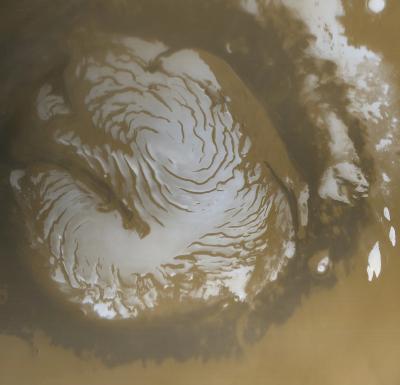
On Mars's poles there are ice caps of ice and dust with layers that reflect to past climate variations on Mars. Researchers from the Niels Bohr Institute have related the layers in the ice cap on Mars's north pole to variations in solar insolation on Mars, thus established the first dated climate history for Mars, where ice and dust accumulation has been driven by variations in insolation. The results are published in the scientific journal, Icarus.
The ice caps on Mars's poles are kilometres thick and composed of ice and dust. There are layers in the ice caps, which can be seen in cliffs and valley slopes and we have known about these layers for decades, since the first satellite images came back from Mars. The layers are believed to reflect past climate on Mars, in the same way that the Earth's climate history can be read by analysing ice cores from the ice caps on Greenland and Antarctica.
Solar insolation on Mars has varied dramatically over time, mainly due to large variations in the tilt of Mars's rotational axis (obliquity) and this led to dramatic climate variations on Mars. For years people have tried to link the solar insolation and layer formation by looking for signs of periodic sequences in the visible layers, which can be seen in the upper 500 meters. Periodic signals might be traceable back to known variations in the solar insolation on Mars, but so far it has been unclear whether one could find a correlation between variations in insolation and the layers.
Correlation between ice, dust and sun
"Here we have gone in a completely different direction. We have developed a model for how the layers are built up based on fundamental physical processes and it demonstrates a correlation between ice and dust accumulation and solar insolation, explains Christine Hvidberg, a researcher in ice physics at the Centre for Ice and Climate at the Niels Bohr Institute at the University of Copenhagen.
She explains that in the model the layer formation is driven by insolation and the dust rich layers can be formed by two processes: 1: Increased evaporation of ice during the summer at high obliquity (when the rotational axis tilts down) and 2: Variations in dust accumulation as a result of variations in the axial tilt. The model is simple, but physically possible and it can be used to examine the relationship between climate variability and layer formation.
The researchers established a framework for the model that could explain the layer formation so that it was consistent with the observations. By comparing the layer distribution in the model with precise measurements of the layer structure from high resolution satellite images of the ice cap on Mars's north pole, they have discovered that the model is able to reproduce the complex sequences in the layers.
Climate history over 1 million years
"The model dates the upper 500 meters of the northern ice cap on Mars, equivalent to approximately 1 million years and an average accumulation rate of ice and dust of 0.55 mm per year. It links the individual layers to the maxima in solar insolation and thereby establishes a dated climate history of the north pole of Mars over 1 million years," says Christine Hvidberg.
Even though the model is only based on a comparison with the visible layers in the upper 500 meters, preliminary studies indicate that the entire thickness and internal structure of the ice cap can be explained by the model and can thus explain how ice and dust accumulation on Mars's north pole has been driven by variations in solar insolation for millions of years.
INFORMATION:
Article in Icarus
http://dx.doi.org/10.1016/j.icarus.2012.08.009
For more information contact:
Christine Schott Hvidberg, Associate Professor, Centre for Ice and Climate
Niels Bohr Institute, University of Copenhagen
Phone: +45-35 32 05 63, Email: ch@gfy.ku.dk
The ice caps on Mars's poles are kilometres thick and composed of ice and dust. There are layers in the ice caps, which can be seen in cliffs and valley slopes and we have known about these layers for decades, since the first satellite images came back from Mars. The layers are believed to reflect past climate on Mars, in the same way that the Earth's climate history can be read by analysing ice cores from the ice caps on Greenland and Antarctica.
Solar insolation on Mars has varied dramatically over time, mainly due to large variations in the tilt of Mars's rotational axis (obliquity) and this led to dramatic climate variations on Mars. For years people have tried to link the solar insolation and layer formation by looking for signs of periodic sequences in the visible layers, which can be seen in the upper 500 meters. Periodic signals might be traceable back to known variations in the solar insolation on Mars, but so far it has been unclear whether one could find a correlation between variations in insolation and the layers.
Correlation between ice, dust and sun
"Here we have gone in a completely different direction. We have developed a model for how the layers are built up based on fundamental physical processes and it demonstrates a correlation between ice and dust accumulation and solar insolation, explains Christine Hvidberg, a researcher in ice physics at the Centre for Ice and Climate at the Niels Bohr Institute at the University of Copenhagen.
She explains that in the model the layer formation is driven by insolation and the dust rich layers can be formed by two processes: 1: Increased evaporation of ice during the summer at high obliquity (when the rotational axis tilts down) and 2: Variations in dust accumulation as a result of variations in the axial tilt. The model is simple, but physically possible and it can be used to examine the relationship between climate variability and layer formation.
The researchers established a framework for the model that could explain the layer formation so that it was consistent with the observations. By comparing the layer distribution in the model with precise measurements of the layer structure from high resolution satellite images of the ice cap on Mars's north pole, they have discovered that the model is able to reproduce the complex sequences in the layers.
Climate history over 1 million years
"The model dates the upper 500 meters of the northern ice cap on Mars, equivalent to approximately 1 million years and an average accumulation rate of ice and dust of 0.55 mm per year. It links the individual layers to the maxima in solar insolation and thereby establishes a dated climate history of the north pole of Mars over 1 million years," says Christine Hvidberg.
Even though the model is only based on a comparison with the visible layers in the upper 500 meters, preliminary studies indicate that the entire thickness and internal structure of the ice cap can be explained by the model and can thus explain how ice and dust accumulation on Mars's north pole has been driven by variations in solar insolation for millions of years.
INFORMATION:
Article in Icarus
http://dx.doi.org/10.1016/j.icarus.2012.08.009
For more information contact:
Christine Schott Hvidberg, Associate Professor, Centre for Ice and Climate
Niels Bohr Institute, University of Copenhagen
Phone: +45-35 32 05 63, Email: ch@gfy.ku.dk