UD researcher on project team for NASA's first visit to the sun
Published 2010-10-07 · Original archive entry · Explore research explainers
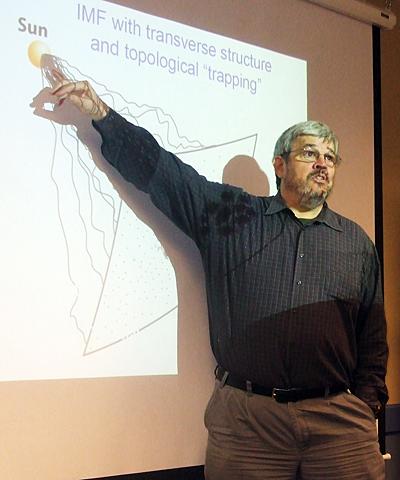
A University of Delaware researcher is helping to design instruments for a robotic space probe that will go where no other has gone before: the sun.
William Matthaeus, professor of physics and astronomy at UD, is involved in NASA's Solar Probe Plus project, which is slated to launch by 2018.
The unmanned spacecraft, the size of a small car, will plunge directly into the sun's atmosphere to help uncover answers to perplexing mysteries about the fiery ball of plasma at the center of our solar system.
"The experiments selected for Solar Probe Plus are specifically designed to solve two key questions of solar physics -- why is the sun's outer atmosphere so much hotter than the sun's visible surface, and what propels the solar wind that affects Earth and our solar system? We've been struggling with these questions for decades and this mission should finally provide those answers," said Dick Fisher, director of NASA's Heliophysics Division, in a NASA news release.
Astrophysicists have been discussing the idea of sending an unmanned mission to the sun for years, Matthaeus says, but the technology to protect a space probe from the star's mega-heat was unavailable until recently.
To avoid the fate of the mythical Icarus, who flew too close to the sun and melted his wax-and-feather wings, the spacecraft's heat shield must be able to withstand extremely high temperatures and blasts of intense radiation in the solar atmosphere as it makes the nearly 90-million-mile trip from Earth to within 4 million miles of the sun.
"At the Solar Probe's closest approach, the light from the sun will be more than 500 times as intense as at Earth, and the surrounding gas, although very tenuous, will likely be at hundreds of thousands of degrees," Matthaeus notes. "Fortunately, NASA engineers have developed an effective special carbon-fiber heat shield and thermal control system."
The Solar Probe Plus mission encompasses five investigations totaling approximately $180 million for preliminary analysis, design, development and testing of the spacecraft and the instruments that will fly aboard it.
Matthaeus is the lead theorist on the Integrated Science Investigation of the Sun (ISIS) project, which is led by David McComas at the Southwest Research Institute in San Antonio, Texas. The team is developing two instruments for monitoring the electrons, protons and ions that are accelerated to high energies in the sun's atmosphere. This continuous stream of outward-flowing particles from the sun is known as solar wind. It causes the northern and southern lights on Earth, and can cause magnetic storms capable of knocking out electrical power grids.
"The more we rely on satellite technology, such as GPS, the more vulnerable to magnetic storms we become. So we need to understand how they work in order to protect societal assets such as satellites in space, as well as humans who explore or work in space," says Matthaeus.
"The Solar Probe Plus orbit will spiral inward. The spacecraft will eventually get as close to 9-10 solar radii, which is about 20 times closer to the sun than Earth is," he notes.
As the instruments aboard the spacecraft measure magnetic and electric properties, astrophysicists will be able to eliminate some theories for how solar wind is generated and better understand the heliosphere, the vast magnetic bubble that contains our solar system.
"It is a real mission of discovery, visiting the sun's immediate environment for the first time," notes Matthaeus. "All along its journey into the solar atmosphere, Solar Probe will measure many of the ongoing processes that are responsible for maintaining and controlling the heliosphere."
INFORMATION:
Matthaeus is working to have UD students participate in exchange programs with collaborators from Italy, Great Britain, Thailand and Argentina who are involved in the theoretical research related to the mission.
Additionally, Matthaeus is a co-investigator on the Plasma Electron And Current Experiment (PEACE) electron instrument for the Cluster mission, an unmanned space mission sponsored by the European Space Agency to study Earth's magnetosphere using four identical spacecraft orbiting the Earth in formation; and on NASA's Magnetospheric Multiscale Mission, under development to explore magnetic reconnection, the often explosive mechanism by which magnetic energy is dissipated in the outer layers of Earth's magnetosphere, where Earth's magnetic field meets the solar wind.
William Matthaeus, professor of physics and astronomy at UD, is involved in NASA's Solar Probe Plus project, which is slated to launch by 2018.
The unmanned spacecraft, the size of a small car, will plunge directly into the sun's atmosphere to help uncover answers to perplexing mysteries about the fiery ball of plasma at the center of our solar system.
"The experiments selected for Solar Probe Plus are specifically designed to solve two key questions of solar physics -- why is the sun's outer atmosphere so much hotter than the sun's visible surface, and what propels the solar wind that affects Earth and our solar system? We've been struggling with these questions for decades and this mission should finally provide those answers," said Dick Fisher, director of NASA's Heliophysics Division, in a NASA news release.
Astrophysicists have been discussing the idea of sending an unmanned mission to the sun for years, Matthaeus says, but the technology to protect a space probe from the star's mega-heat was unavailable until recently.
To avoid the fate of the mythical Icarus, who flew too close to the sun and melted his wax-and-feather wings, the spacecraft's heat shield must be able to withstand extremely high temperatures and blasts of intense radiation in the solar atmosphere as it makes the nearly 90-million-mile trip from Earth to within 4 million miles of the sun.
"At the Solar Probe's closest approach, the light from the sun will be more than 500 times as intense as at Earth, and the surrounding gas, although very tenuous, will likely be at hundreds of thousands of degrees," Matthaeus notes. "Fortunately, NASA engineers have developed an effective special carbon-fiber heat shield and thermal control system."
The Solar Probe Plus mission encompasses five investigations totaling approximately $180 million for preliminary analysis, design, development and testing of the spacecraft and the instruments that will fly aboard it.
Matthaeus is the lead theorist on the Integrated Science Investigation of the Sun (ISIS) project, which is led by David McComas at the Southwest Research Institute in San Antonio, Texas. The team is developing two instruments for monitoring the electrons, protons and ions that are accelerated to high energies in the sun's atmosphere. This continuous stream of outward-flowing particles from the sun is known as solar wind. It causes the northern and southern lights on Earth, and can cause magnetic storms capable of knocking out electrical power grids.
"The more we rely on satellite technology, such as GPS, the more vulnerable to magnetic storms we become. So we need to understand how they work in order to protect societal assets such as satellites in space, as well as humans who explore or work in space," says Matthaeus.
"The Solar Probe Plus orbit will spiral inward. The spacecraft will eventually get as close to 9-10 solar radii, which is about 20 times closer to the sun than Earth is," he notes.
As the instruments aboard the spacecraft measure magnetic and electric properties, astrophysicists will be able to eliminate some theories for how solar wind is generated and better understand the heliosphere, the vast magnetic bubble that contains our solar system.
"It is a real mission of discovery, visiting the sun's immediate environment for the first time," notes Matthaeus. "All along its journey into the solar atmosphere, Solar Probe will measure many of the ongoing processes that are responsible for maintaining and controlling the heliosphere."
INFORMATION:
Matthaeus is working to have UD students participate in exchange programs with collaborators from Italy, Great Britain, Thailand and Argentina who are involved in the theoretical research related to the mission.
Additionally, Matthaeus is a co-investigator on the Plasma Electron And Current Experiment (PEACE) electron instrument for the Cluster mission, an unmanned space mission sponsored by the European Space Agency to study Earth's magnetosphere using four identical spacecraft orbiting the Earth in formation; and on NASA's Magnetospheric Multiscale Mission, under development to explore magnetic reconnection, the often explosive mechanism by which magnetic energy is dissipated in the outer layers of Earth's magnetosphere, where Earth's magnetic field meets the solar wind.