PRESS-NEWS.org - Press Release Distribution
PRESS RELEASES DISTRIBUTION

NASA's Hurricane Mission explores Tropical Storm Nadine

NASA's Hurricane Mission explores Tropical Storm Nadine
2012-09-18
(Press-News.org) NASA's Hurricane Severe Storms Sentinel (HS3) Mission is in full-swing and one of the unmanned Global Hawk aircraft investigate Tropical Storm Nadine on Sept. 14 and 15, while NASA satellites continued to obtain imagery of the storm as seen from space.

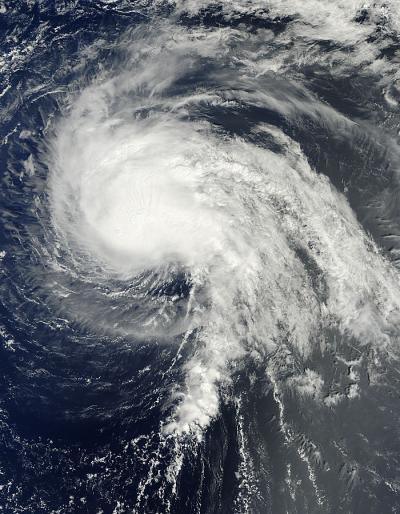
The Moderate Resolution Imaging Spectroradiometer aboard NASA's Terra satellite captured a true-color image of Hurricane Nadine in the Atlantic Ocean on Sept. 16 at 1345 UTC (9:45 a.m. EDT) while NASA's Global Hawk was flying around the storm. Nadine strengthened to a hurricane on Friday, Sept. 14 at 11 p.m. EDT, and weakened back to a tropical storm on Sunday, Sept. 16 at 11 p.m. EDT. Nadine's highest wind speed as a hurricane was 80 mph (130 kmh).

NASA's Global Hawk landed back at the Wallops Flight Facility, Wallops Island, Va., in the morning hours on Sept. 15 after spending a full day gathering data from Hurricane Nadine. "During the flight, Nadine strengthened from a tropical storm to a hurricane despite being hit by very strong westerly winds at upper levels and very dry air on its periphery," said Scott Braun, HS3 Mission Principal Investigator from NASA's Goddard Space Flight Center, Greenbelt, Md. Data from this flight will help scientists determine how a storm like Nadine can intensify even in the presence of seemingly adverse conditions. Nadine is currently a tropical storm.

"The Global Hawk, one of two associated with the HS3 mission, sought to determine how the structure of Nadine might change under the influence of strong vertical wind shear as it moved northward in the Atlantic, " Braun said. During its 22.5 hour flight around Nadine, the Global Hawk covered more than one million square kilometers (386,100 square miles) going back and forth over the storm in what's called a "lawnmower pattern." The Global Hawk captured data using instruments aboard and also dropping sensors called sondes into the storm. The dropsonde system ejected the small sensors tied to parachutes that drift down through the storm measuring winds, temperature and humidity.

At 11 a.m. EDT) on Sept. 17, Tropical Storm Nadine had maximum sustained winds near 70 mph (100 kmh). It was located about 585 miles southwest of the Azores, near 32.9 North and 35.3 East. Nadine is moving to the northeast near 15 mph (24 kmh). The National Hurricane Center forecasts some weakening in the next day.


INFORMATION:


[Attachments] See images for this press release:
NASA's Hurricane Mission explores Tropical Storm Nadine

ELSE PRESS RELEASES FROM THIS DATE:

Newly demonstrated capabilities of low-powered nanotweezers may benefit cellular-level studies

Newly demonstrated capabilities of low-powered nanotweezers may benefit cellular-level studies
2012-09-18
Using ultra-low input power densities, researchers at the University of Illinois at Urbana-Champaign have demonstrated for the first time how low-power "optical nanotweezers" can be used to trap, manipulate, and probe nanoparticles, including fragile biological samples. "We already know that plasmonic nanoantennas enhance local fields by up to several orders of magnitude, and thus, previously showed that we can use these structures with a regular CW laser source to make very good optical tweezers," explains, Kimani Toussaint, Jr., assistant professor of mechanical science ...

NASA sees powerful Typhoon Sanba make landfall

NASA sees powerful Typhoon Sanba make landfall
2012-09-18
Typhoon Sanba made landfall in southern South Korea on Monday, Sept. 17 and was moving northeast bringing heavy rainfall, and gusty winds along its path. Sanba downed trees, and caused power outages, canceled flights and canceled ferries. NASA's Aqua satellite captured a visible image of Sanba on Sept. 17 after it made landfall and observed the large extent of its cloud cover from South Korea to eastern Siberia. NASA's Aqua satellite passed over Tropical Storm Sanba on Sept. 17 at 0430 UTC (12:30 a.m. EDT/1:30 p.m. local time Seoul, South Korea) and the Moderate Resolution ...

Researchers reveal underlying mechanism of powerful chemotherapy for prostate cancer treatment

2012-09-18
NEW YORK (Sept. 17, 2012) -- The power of taxane-based chemotherapy drugs are misunderstood and potentially underestimated, according to researchers at Weill Cornell Medical College in the September 15 issue of the journal Cancer Research. Most physicians and investigators believe that taxane chemotherapy (paclitaxel, docetaxel and cabazitaxel) just does one thing -- stop a cancer cell from dividing -- but the team of Weill Cornell scientists have revealed it acts much more powerfully and broadly, especially against prostate cancer. "Taxanes are one of the best class ...

NASA sees Eastern Pacific storms power up and down

NASA sees Eastern Pacific storms power up and down
2012-09-18
While Tropical Storm Kristy faded into a remnant low pressure area, Lane strengthened into a hurricane. NASA's Terra satellite caught a look at both storms when it passed overhead on Sept. 16 and showed a much tighter circulation within Hurricane Lane than in weakening Tropical Storm Kristy. When NASA's Terra satellite passed over the Eastern Pacific on Sept. 16 at 18:45 UTC (2:45 p.m. EDT) the Moderate Resolution Imaging Spectroradiometer instrument aboard the satellite captured Tropical Storm Kristy (at the time a tropical storm) and Hurricane Lane, located to Kristy's ...

'Brain training' may lessen cognitive impairments associated with coronary bypass surgery

2012-09-18
Each year in Quebec, nearly 6000 people undergo coronary bypass surgery. Recovery is long and quality of life is greatly affected, in particular because most patients experience cognitive deficits that affect attention and memory for weeks or even months after the surgery. However, cognitive training helps to significantly reduce these postoperative complications according to a study that will be presented by Dr. Louis Bherer, PhD (Psychology), a laboratory director and researcher at the Institut universitaire de gériatrie de Montréal (IUGM), an institution affiliated with ...

Crews uncover massive Roman mosaic in southern Turkey

Crews uncover massive Roman mosaic in southern Turkey
2012-09-18
A University of Nebraska-Lincoln archeological team has uncovered a massive Roman mosaic in southern Turkey -- a meticulously crafted, 1,600-square-foot work of decorative handiwork built during the region's imperial zenith. It's believed to be the largest mosaic of its type in the region and demonstrates the surprising reach and cultural influence of the Roman Empire in the area during the third and fourth centuries A.D., said Michael Hoff, Hixson-Lied professor of art history at UNL and the director of the excavation. "Its size signals, in no small part, that the ...

Viruses not to blame for chronic fatigue syndrome after all

2012-09-18
Contrary to previous findings, new research finds no link between chronic fatigue syndrome and the viruses XMRV (xenotropic murine leukemia virus-related virus) and pMLV (polytropic murine leukemia virus). A study to be published on September 18 in mBio®, the online open-access journal of the American Society for Microbiology, reveals that research that reported patients with chronic fatigue syndrome carried these two viruses was wrong and that there is still no evidence for an infectious cause behind chronic fatigue syndrome. "The bottom line is we found no evidence ...

Chronic fatigue syndrome is not linked to suspect viruses

2012-09-18
The causes of chronic fatigue syndrome (CFS) have long eluded scientists. In 2009, a paper in the journal Science linked the syndrome—sometimes called myalgic encephalomyelitis (ME)—to infection with a mouse retrovirus called XMRV (xenotropic murine leukemia virus (MLV)-related virus). Given that affected patients often have symptoms consistent with a chronic infection, this viral connection seemed plausible, and the findings were celebrated as a major achievement for a complex disease that afflicts nearly 1 million in the U.S. Another study in early 2010 published in Proceedings ...

Kelsey McBride PR Signs Authors Jayne Jones And Alicia Long

2012-09-18
Kelsey McBride, president of Kelsey McBride PR, officially announced today that Jayne Jones and Alicia Long, co-authors of Capitol Hell, signed on for her agency's PR services. Jayne and Alicia's brilliant debut novel, Capitol Hell, is about the dysfunctional behind the scenes happenings on Capitol Hill. This off-beat, funny novel captures and shares what it is like to be a young staffer working on The Hill. "Everybody needs a little humor during election season," Jones said. Jayne and Alicia began their political careers by working as staffers on former ...

Event To Teach Women How To Ask For Pay Raises Or Negotiate Salaries

2012-09-18
Research shows women are less likely than men to ask for what they want. Event teaches women the skills they need to ask for their next pay raise or negotiate salary. Minneapolis, MN September 10, 2012 - Women to gather to learn how to ask for their pay raises. 100 professional women will attend a day long workshop that will teach them how to ask for a pay raise or negotiate their next salary offer. Saturday, October 13th at the new Brave New Workshop's Experimental Thinking Centre, downtown Minneapolis, 824 Hennepin Avenue. 9:30 a.m. - 4:00 p.m. Women make less ...

LAST 30 PRESS RELEASES:

Globe-trotting ancient ‘sea-salamander’ fossils rediscovered from Australia’s dawn of the Age of Dinosaurs

Roadmap for Europe’s biodiversity monitoring system

Novel camel antimicrobial peptides show promise against drug-resistant bacteria

Scientists discover why we know when to stop scratching an itch

A hidden reason inner ear cells die – and what it means for preventing hearing loss

Researchers discover how tuberculosis bacteria use a “stealth” mechanism to evade the immune system

New microscopy technique lets scientists see cells in unprecedented detail and color

Sometimes less is more: Scientists rethink how to pack medicine into tiny delivery capsules

Scientists build low-cost microscope to study living cells in zero gravity

The Biophysical Journal names Denis V. Titov the 2025 Paper of the Year-Early Career Investigator awardee

Scientists show how your body senses cold—and why menthol feels cool

Scientists deliver new molecule for getting DNA into cells

Study reveals insights about brain regions linked to OCD, informing potential treatments

Does ocean saltiness influence El Niño?

2026 Young Investigators: ONR celebrates new talent tackling warfighter challenges

Genetics help explain who gets the ‘telltale tingle’ from music, art and literature

Many Americans misunderstand medical aid in dying laws

Researchers publish landmark infectious disease study in ‘Science’

New NSF award supports innovative role-playing game approach to strengthening research security in academia

Kumar named to ACMA Emerging Leaders Program for 2026

AI language models could transform aquatic environmental risk assessment

New isotope tools reveal hidden pathways reshaping the global nitrogen cycle

Study reveals how antibiotic structure controls removal from water using biochar

Why chronic pain lasts longer in women: Immune cells offer clues

Toxic exposure creates epigenetic disease risk over 20 generations

More time spent on social media linked to steroid use intentions among boys and men

New study suggests a “kick it while it’s down” approach to cancer treatment could improve cure rates

Milken Institute, Ann Theodore Foundation launch new grant to support clinical trial for potential sarcoidosis treatment

New strategies boost effectiveness of CAR-NK therapy against cancer

Study: Adolescent cannabis use linked to doubling risk of psychotic and bipolar disorders

[Press-News.org] NASA's Hurricane Mission explores Tropical Storm Nadine