PRESS-NEWS.org - Press Release Distribution
PRESS RELEASES DISTRIBUTION

An ocean away: 2 new encrusting anemones found in unexpected locations

An ocean away: 2 new encrusting anemones found in unexpected locations
2012-11-29
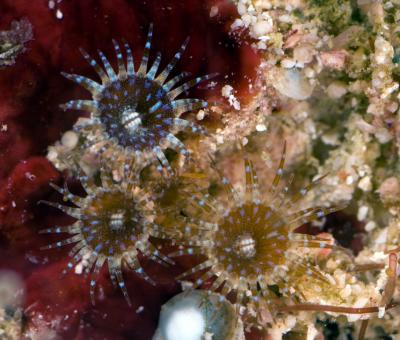
(Press-News.org) As a result of field work by associate professor James Davis Reimer and two graduate students from the University of the Ryukyus in Okinawa, Japan has found two new species of encrusting anemones, or colonial zoanthids, in unexpected locations. The species belong to the genus Neozoanthus, which was previously known only from a single species in the Indian Ocean. Surprisingly, the new species were found in the Pacific Ocean, in southern Japan and on the Great Barrier Reef, Australia. The study was published in the open access journal ZooKeys.

The only previous species of Neozoanthus was described in 1972 from Madagascar, and subsequently it was not seen for almost 40 years, until recent research had ascertained that new Pacific specimens likely belonged to Neozoanthus (Reimer et al. 2011, in the journal Marine Biology). The new study formally describes these new specimens as two species.

The members of this genus are small, with individual polyps no more than 6 mm in diameter, and have red, gray, blue or purple oral discs; all inhabit coral reef ecosystems in areas with strong currents and some siltation. Both new species and the species from Madagascar contain symbiotic, photosynthetic, single-celled algae that can provide them with energy from the sun.

"We were very surprised in 2008 to discover Neozoanthus in the Pacific, in Japan," said Reimer, "and initially thought that perhaps these were very rare." However, further research in southern Japan by graduate students Yuka Irei and Takuma Fujii, co-authors on the new paper, revealed that the Japanese species was locally common. A further surprise came during the Census of Marine Life's Census of Coral Reef Ecosystems (CReefs) surveys on the Great Barrier Reef in 2009 and 2010, when similar encrusting anemones were found thousands of kilometers away from both Madagascar and Japan.

"These findings can be explained by the fact that there are very few zoanthid researchers in the world. These species are not particularly hard to find, but there was no one looking for them," Reimer added. "This research demonstrates how little we know about marine biodiversity, even in regions relatively well researched."


INFORMATION:

Original source

Reimer JD, Irei Y, Fujii T (2012) Two new species of Neozoanthus (Cnidaria, Hexacorallia, Zoantharia) from the Pacific. ZooKeys 246: 69. doi: 10.3897/zookeys.246.3886

About ZooKeys

ZooKeys is a peer-reviewed, open-access journal launched to support free exchange of ideas and information in biodiversity science, issued by Pensoft Publishers. All papers published in ZooKeys can be freely copied, downloaded, printed and distributed at no charge for the reader. ZooKeys implemented several cutting-edge innovation in publishing and dissemination of science information and is considered a technological leader in its field.

Posted by Pensoft Publishers.


[Attachments] See images for this press release:
An ocean away: 2 new encrusting anemones found in unexpected locations

ELSE PRESS RELEASES FROM THIS DATE:

Black hole upsets galaxy models

Black hole upsets galaxy models
2012-11-29
This press release is available in German. A group headed by Remco van den Bosch from the Max Planck Institute for Astronomy has discovered a black hole that shakes the foundations of current models of galaxy evolution. This monster has 17 billion solar masses and is thus significantly heavier than the models predict. And even more significantly: the object could be the most massive black hole known to date. Astronomers believe there is a super-massive black hole at the heart of every galaxy. Its mass ranges from several hundred thousand solar masses to a few billion. ...

Inviting customer complaints can kill business: UBC research

2012-11-29
Giving customers a chance to complain can be a bad idea if customers believe they're to blame for a product's failure, a new study from the Sauder School of Business at UBC shows. "It's commonly assumed that giving customers a chance to voice grievances allows companies to maintain relationships," says Marketing Professor Darren Dahl, who co-authored the recent Journal of Marketing study with PhD student Lea Dunn. "But our research shows that when a person feels implicated in a product's failure – think building Ikea furniture – they're more likely to shift blame to ...

Maths helps mobiles & tablets match eyes' ability to switch from sunshine to shadow

Maths helps mobiles & tablets match eyes ability to switch from sunshine to shadow
2012-11-29
Researchers have pushed the boundaries of High Dynamic Range (HDR) video to match our own eyes' ability to cope with the real world's ever rapidly changing light intensity - such as sun simply going behind clouds. Now researchers at WMG at the University of Warwick, have found a way to compress and stream HDR video directly to monitors and mobile devices, such as an iPad, bringing enormous benefits to industries including gaming and security. Researchers at WMG at the University of Warwick, working in partnership with spinout company goHDR Ltd, have succeeded in achieving ...

First-ever hyperspectral images of Earth's auroras

First-ever hyperspectral images of Earths auroras
2012-11-29
WASHINGTON, Nov. 29—Hoping to expand our understanding of auroras and other fleeting atmospheric events, a team of space-weather researchers designed and built NORUSCA II, a new camera with unprecedented capabilities that can simultaneously image multiple spectral bands, in essence different wavelengths or colors, of light. The camera was tested at the Kjell Henriksen Observatory (KHO) in Svalbard, Norway, where it produced the first-ever hyperspectral images of auroras—commonly referred to as "the Northern (or Southern) Lights"—and may already have revealed a previously ...

Bacteria hijack host cell process, create their own food supply to become infectious

2012-11-29
COLUMBUS, Ohio – Bacteria that cause the tick-borne disease anaplasmosis in humans create their own food supply by hijacking a process in host cells that normally should help kill the pathogenic bugs, scientists have found. This bacterium, Anaplasma phagocytophilum (Ap), secretes a protein that can start this process. The protein binds with another protein produced by white blood cells, and that connection creates compartments that siphon host-cell nutrients to feed the bacteria, enabling their growth inside the white blood cells. The finding defies conventional wisdom ...

Insects beware: The sea anemone is coming

2012-11-29
Bethesda, MD—As insects evolve to become resistant to insecticides, the need to develop new ways to control pests grows. A team of scientists from Leuven, Belgium have discovered that the sea anemone's venom harbors several toxins that promise to become a new generation of insecticides that are environmentally friendly and avoid resistance by the insects. Since these toxins disable ion channels that mediate pain and inflammation, they could also spur drug development aimed at pain, cardiac disorders, epilepsy and seizure disorders, and immunological diseases such as multiple ...

Brain inflammation likely key initiator to prion and Parkinson's disease

2012-11-29
Prion diseases represent a family of neurodegenerative disorders associated with the loss of brain cells and caused by proteins called prions (derived from 'protein' and 'infection'). The diseases are found in both humans and animals, such as Creutzfeld-Jakob disease and mad cow disease respectively. Although mostly harmless, prions can transform into infectious agents, which accumulate in the brain and destroy the nervous tissue. But how exactly does the accumulation of prions cause destruction of the brain? "Understanding the process by which prions destroy neurons ...

New genetic test detects early breast cancer and identifies future risk

2012-11-29
Bethesda, MD—Physicians may now be better at detecting breast cancer than ever before, but much more work remains to ensure accurate diagnosis is possible and especially to assess future risk. That's why researchers from Germany have been working to develop a new test of gene action to predict cancer risk both at first diagnosis and into the future. In a new research report appearing in the December 2012 issue of The FASEB Journal, researchers show that the various genetic switches, which are turned on and off in the regular development of every cell in the body, can be ...

New approach allows past data to be used to improve future climate projections

2012-11-29
Climate scientists are still grappling with one of the main questions of modern times: how high will global temperatures rise if the atmospheric concentration of carbon dioxide doubles. Many researchers are turning to the past because it holds clues to how nature reacted to climate change before the anthropogenic impact. The divergent results of this research, however, have made it difficult to make precise predictions about the impact of increased carbon dioxide on future warming. An international team of scientists have evaluated previously published estimates and assigned ...

'Dark core' may not be so dark after all

Dark core may not be so dark after all
2012-11-29
ATHENS, Ohio (Nov. 29, 2012)—Astronomers were puzzled earlier this year when NASA's Hubble Space Telescope spotted an overabundance of dark matter in the heart of the merging galaxy cluster Abell 520. This observation was surprising because dark matter and galaxies should be anchored together, even during a collision between galaxy clusters. Astronomers have abundant evidence that an as-yet-unidentified form of matter is responsible for 90 percent of the gravity within galaxies and clusters of galaxies. Because it is detected via its gravity and not its light, they call ...

LAST 30 PRESS RELEASES:

Norbert Holtkamp appointed director of Fermi National Accelerator Laboratory

New agentic AI platform accelerates advanced optics design

Biologists discover neurons use physical signals — not electricity — to stabilize communication

Researchers discover that a hormone can access the brain by hitchhiking

University of Oklahoma researcher awarded funding to pursue AI-powered material design

Exploring how the visual system recovers following injury

Support for parents with infants at pediatric check-ups leads to better reading and math skills in elementary school

Kids’ behavioral health is a growing share of family health costs

Day & night: Cancer disrupts the brain’s natural rhythm

COVID-19 vaccination significantly reduces risk to pregnant women and baby

The role of vaccination in maternal and perinatal outcomes associated with COVID-19 in pregnancy

Mayo Clinic smartwatch system helps parents shorten and defuse children's severe tantrums early

Behavioral health spending spikes to 40% of all children’s health expenditures, nearly doubling in a decade

Digital cognitive behavioral treatment for generalized anxiety disorder

Expenditures for pediatric behavioral health care over time and estimated family financial burden

Air conditioning in nursing homes and mortality during extreme heat

The Alps to lose a record number of glaciers in the next decade

What makes a good proton conductor?

New science reporting guide published for journalists in Bulgaria

New international study reveals major survival gaps among children with cancer

New science reporting guide published for journalists in Turkey

Scientists develop a smarter mRNA therapy that knows which cells to target

Neuroanatomy-informed brain–machine hybrid intelligence for robust acoustic target detection

Eight SwRI hydrogen projects funded by ENERGYWERX

The Lundquist Institute and its start-up company Vitalex Biosciences Announces Strategic Advancement of Second-Generation fungal Vaccine VXV-01 through Phase 1 Trials under $40 Million Competitive Con

Fine particles in pollution are associated with early signs of autoimmune disease

Review article | Towards a Global Ground-Based Earth Observatory (GGBEO): Leveraging existing systems and networks

Penn and UMich create world’s smallest programmable, autonomous robots

Cleveland researchers launch first major study to address ‘hidden performance killer’ in athletes

To connect across politics, try saying what you oppose

[Press-News.org] An ocean away: 2 new encrusting anemones found in unexpected locations